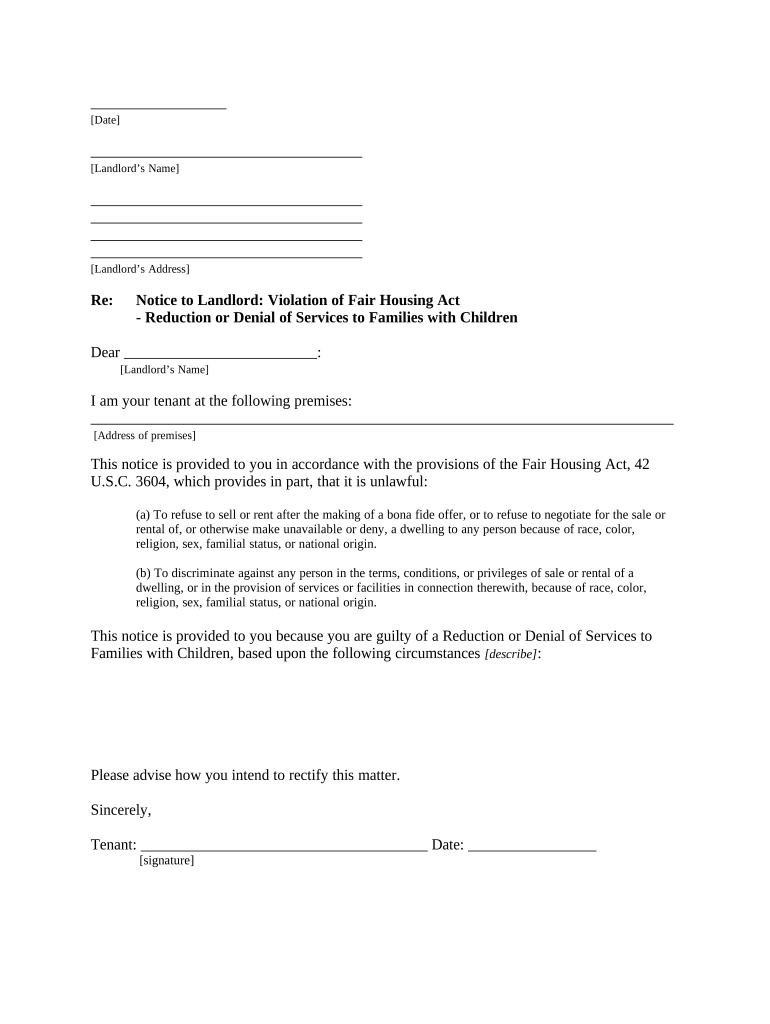
Letter from Tenant to Landlord about Fair Housing Reduction or Denial of services to Family with Children - Delaware 2026

Get Form
Letter from Tenant to Landlord about Fair Housing Reduction or Denial of services to Family with Children - Delaware Preview on Page 1

Here's how it works

01. Edit your form online
Type text, add images, blackout confidential details, add comments, highlights and more.
02. Sign it in a few clicks
Draw your signature, type it, upload its image, or use your mobile device as a signature pad.
03. Share your form with others
Send it via email, link, or fax. You can also download it, export it or print it out.

How to use or fill out Letter from Tenant to Landlord about Fair Housing Reduction or Denial of services to Family with Children - Delaware

Form edit decoration
9.5
Ease of Setup
DocHub User Ratings on G2
9.0
Ease of Use
DocHub User Ratings on G2
  1. Click ‘Get Form’ to open it in the editor.
  2. Begin by entering the date at the top of the document. This is important for record-keeping.
  3. Fill in the landlord’s name and address in the designated fields. Ensure accuracy to avoid any miscommunication.
  4. In the greeting, address your landlord directly by name, maintaining a professional tone.
  5. Provide your address as the tenant in the specified section. This establishes your identity and residence.
  6. Clearly state the violation of the Fair Housing Act, referencing specific sections that apply. This adds legal weight to your notice.
  7. Describe the circumstances leading to this notice in detail. Be factual and concise to support your claims effectively.
  8. Request a response from your landlord on how they plan to rectify this issue, ensuring you leave space for their reply.
  9. Sign and date at the bottom of the letter, confirming its authenticity.
  10. Complete the proof of delivery section by selecting how you delivered this notice and signing it again if necessary.

Start using our platform today for free to streamline your document editing and ensure effective communication with your landlord!

be ready to get more

Complete this form in 5 minutes or less

Get form

Got questions?

We have answers to the most popular questions from our customers. If you can't find an answer to your question, please contact us.
Contact us
Typically, testing involves using people with similar profiles, but who differ in one protected characteristic, such as race. Common tests include responding to a rental or sale advertisement and viewing an advertised property. Testing is a legitimate and necessary method of uncovering illegal housing discrimination.
Under the Delaware Fair Housing Act, no one may take any of the following actions in the sale and rental of housing or in mortgage lending based on race, color, religion, sex, national origin, disability, familial status, marital status, sexual orientation, age, gender identity, creed or source of income.
The seven federally protected classes under the Fair Housing Act are race, religion, national origin, color, familial status (the presence of children under the age of 18 in a household), sex, and disability.
Discrimination based on disability accounted for the majority (52.61 percent) of complaints filed with FHOs, HUD, and FHAP agencies.
FAIR HOUSING COMPLAINTS Disability continues to be the top basis of alleged discrimination under the Fair Housing Act, with 5,069 complaints filed with HUD and its state agency Fair Housing Assistance Program (FHAP) partners in FY 2022.

Security and compliance

At DocHub, your data security is our priority. We follow HIPAA, SOC2, GDPR, and other standards, so you can work on your documents with confidence.

Learn more
ccpa2
pci-dss
gdpr-compliance
hipaa
soc-compliance

People also ask

The most common complaints include: Costs: the costs were unclear or different from the original estimate. Delay: no clear reason for the work taking longer than expected. Poor information: a process wasnt well explained, or there wasnt enough information for a consumer to make an informed choice.
Under the Federal Fair Housing Act and the California Fair Employment Housing Act, familial status discrimination is defined as unfair treatment by a housing provider because an individual has children.

Related links