Demand to Produce Copy of Will from Heir to Executor or Person in Possession of Will - District of Columbia 2026

Get Form
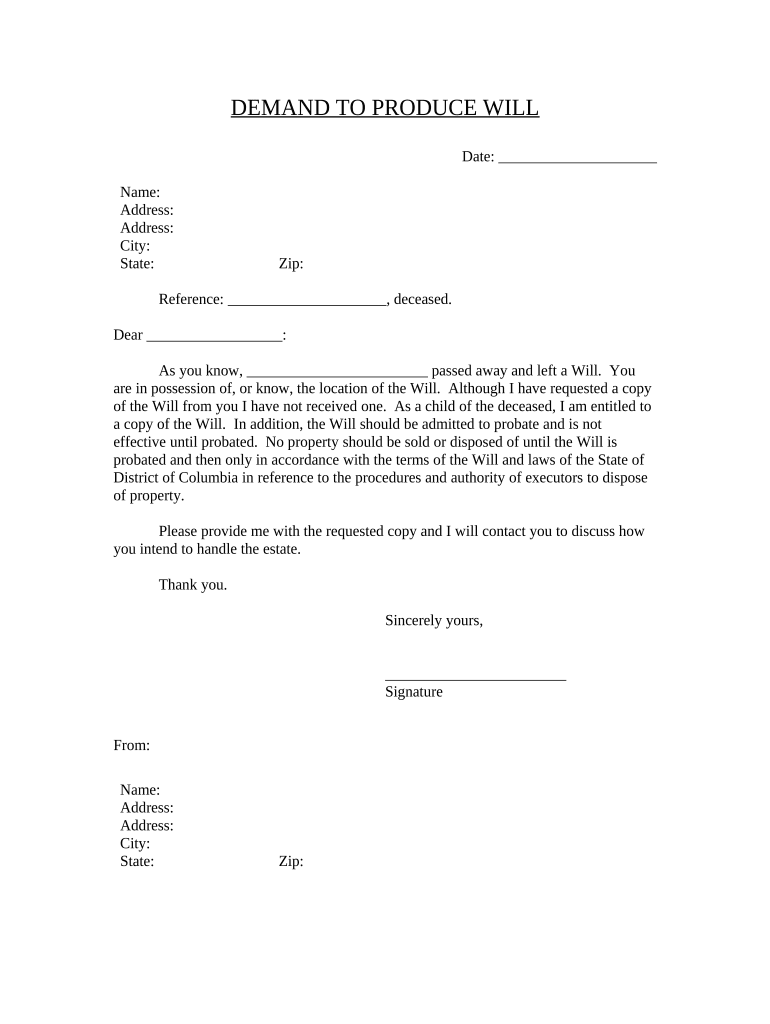
Demand to Produce Copy of Will from Heir to Executor or Person in Possession of Will - District of Columbia Preview on Page 1

Here's how it works

01. Edit your form online
Type text, add images, blackout confidential details, add comments, highlights and more.
02. Sign it in a few clicks
Draw your signature, type it, upload its image, or use your mobile device as a signature pad.
03. Share your form with others
Send it via email, link, or fax. You can also download it, export it or print it out.

How to use or fill out Demand to Produce Copy of Will from Heir to Executor or Person in Possession of Will - District of Columbia with our platform

Form edit decoration
9.5
Ease of Setup
DocHub User Ratings on G2
9.0
Ease of Use
DocHub User Ratings on G2
  1. Click ‘Get Form’ to open the Demand to Produce Copy of Will in the editor.
  2. Begin by entering the date at the top of the form. This is essential for record-keeping purposes.
  3. Fill in your name and address details accurately. Ensure that all fields are completed, including city, state, and zip code.
  4. In the 'Reference' section, write the name of the deceased individual whose will you are requesting.
  5. Address the letter to the executor or person in possession of the will by filling in their name in the greeting line.
  6. In the body of the letter, clearly state your relationship to the deceased and your entitlement to a copy of the will.
  7. Conclude with your signature and provide your contact information again at the bottom for clarity.

Start using our platform today for free to streamline your document editing and signing process!

be ready to get more

Complete this form in 5 minutes or less

Get form

Got questions?

We have answers to the most popular questions from our customers. If you can't find an answer to your question, please contact us.
Contact us
The executor of an estate has an important role, especially in larger and more complex estates. Ask your executor in advance if they are willing and able to fulfill this role. You may choose to share a copy of your will with your executor and let them know where the original will is located.
An executor oversees the administration of the deceased persons estate. This includes identifying and collecting all assets, such as bank accounts, real estate, and personal property, and determining their value. Executors manage the estates assets until they are ready to be distributed to the beneficiaries.
To this end, executors are prohibited from altering the deceaseds will. When it comes time to distribute assets to named beneficiaries, they may not change, override or ignore the will. Executors of estates are also discouraged from distributing assets to beneficiaries before the estate has been appropriately taxed.
The executor has authority from the county probate court to act in this role, but that doesnt necessarily mean that the executor has the final say on all decisions regarding the estate. In fact, theyre instead tasked with simply following the guidelines set forth by the will and other estate planning documents.
An heir is someone whos legally entitled to your property if you dont have a will, while a beneficiary is someone you name in a legal document (your will or trust) to receive your assets.

Security and compliance

At DocHub, your data security is our priority. We follow HIPAA, SOC2, GDPR, and other standards, so you can work on your documents with confidence.

Learn more
ccpa2
pci-dss
gdpr-compliance
hipaa
soc-compliance

People also ask

In California, executors can make a move on estate property for themselves, but only in some instances and only with all the legal boxes ticked. This type of decision gets a very close look by the court because, lets face it, its easy for conflicts of interest to pop up.
In California, the beneficiaries typically obtain access to a copy of the Will through probate. The probate process commences at the time of death, so the Will is filed with the probate court. Afterward, the proxy appointed to oversee execution can provide all the beneficiaries and family members with a copy.

Related links