
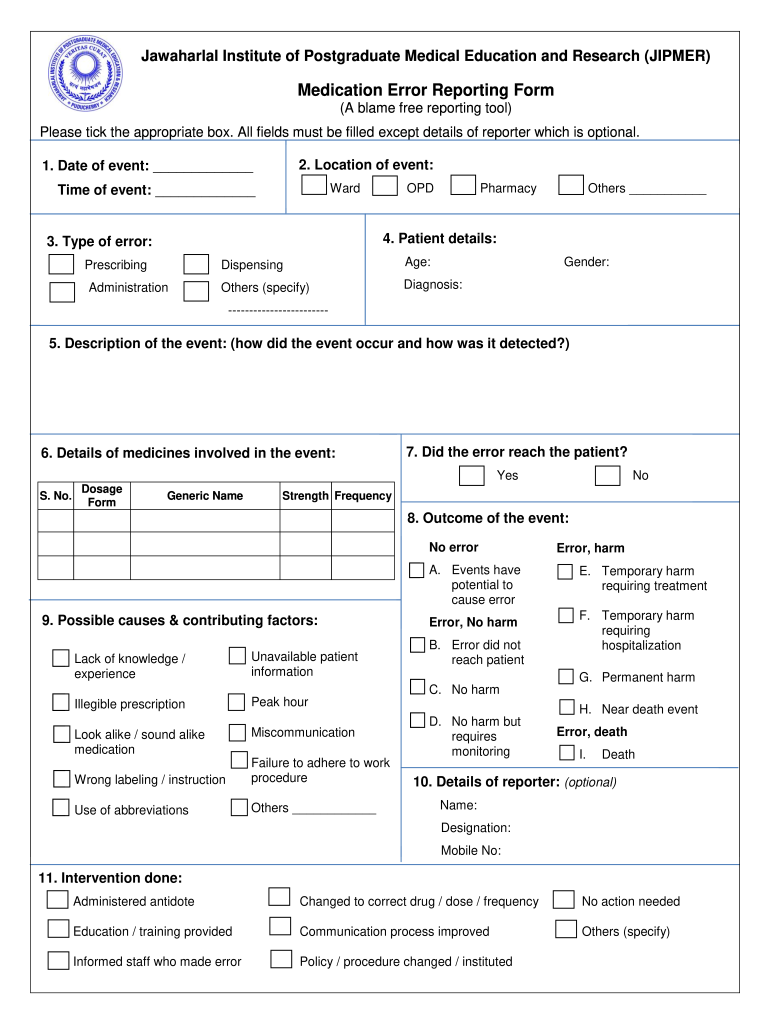







Overview of Medication Error Reporting Form
A medication error reporting form serves as a critical tool designed to capture and document incidents related to medication errors, enhancing patient safety and promoting effective healthcare practices. These forms are essential for healthcare professionals, as they encourage a non-punitive approach to error reporting while also providing vital data for improving medication management protocols.
Definition and Importance of Medication Errors
Medication errors encompass a wide range of incidents that may occur during the prescribing, dispensing, or administration of medications. These errors can involve:
- Wrong Dose: Administering an incorrect quantity of medication.
- Wrong Drug: Delivering the incorrect medication to a patient.
- Incorrect Administration Route: Using the wrong method to administer a drug (e.g., oral instead of intravenous).
- Timing Errors: Failing to administer a medication at the appropriate time or frequency.
Understanding these errors is crucial, as they can lead to adverse patient outcomes, increased healthcare costs, and can affect overall patient trust in healthcare systems.
Elements of a Medication Error Reporting Form Template
A well-structured medication error reporting form includes several key elements that facilitate the accurate recording of information. Essential components consist of:
- Basic Information: Patient demographics including name, age, and medical history.
- Error Details: Type of medication error, circumstances leading to the event, and outcomes (e.g., patient harm).
- Intervention Taken: Steps taken to rectify the error or mitigate its effect.
- Reporting Individual: Information on the person reporting the error while ensuring confidentiality.
These elements enable healthcare providers to analyze trends in medication errors and develop strategies for reducing such incidents in the future.
Steps to Complete a Medication Error Report
Completing a medication error report involves several systematic steps to ensure accuracy and thoroughness:
- Prompt Reporting: As soon as an error is identified, the healthcare provider should document it immediately to preserve details.
- Fill in Patient Information: Enter the patient’s details, including identifiers such as name, date of birth, and medical record number.
- Describe the Error: Elaborate on the type of medication error, specifying what went wrong and how it occurred.
- Document Outcomes: Record any effects the medication error had on the patient, whether they were adverse or mitigated.
- List Interventions: Detail any actions taken to address the error and ensure patient safety, including notifying supervisors or additional care providers.
Following these steps ensures that the report is comprehensive and actionable.
Confidentiality and Non-Punitive Reporting
It is essential to emphasize the confidentiality of the medication error reporting process. Healthcare institutions often create a blame-free environment to encourage reporting without fear of disciplinary actions. Key points include:
- Anonymity: Reporters' identities should remain confidential to promote candidness and openness in reporting.
- Focus on Improvement: Emphasizing that the objective of reporting medication errors is to improve systems and processes rather than to assign blame helps create a safety-focused culture.
Best Practices for Using a Medication Error Reporting Form
Healthcare facilities should implement best practices to effectively utilize medication error reporting forms. Considerations include:
- Training Staff: Educate healthcare personnel about the importance and correct usage of medication error reporting forms.
- Regular Review: Institutions should routinely analyze submitted reports to identify trends and areas requiring intervention.
- Feedback Loop: Provide feedback to staff based on reports submitted to foster an atmosphere of continuous improvement.
Utilizing these best practices can enhance the overall safety protocols within healthcare settings.
Common Scenarios of Medication Errors
Real-world scenarios highlight the need for diligent reporting practices. Examples include:
- Dispensing Errors: A pharmacist mislabels a prescription, leading to a patient receiving a different medication.
- Dosage Errors: A nurse administers a double dose of a critical medication due to miscommunication during shift changes.
- Patient Misidentification: A patient is given another's medication due to similar names or room assignments.
Understanding these scenarios emphasizes the importance of accurate error documentation and learning from past mistakes to enhance future patient care.




