Mutual Wills containing Last Will and Testaments for Unmarried Persons living together with No Children - Kentucky 2026

Get Form
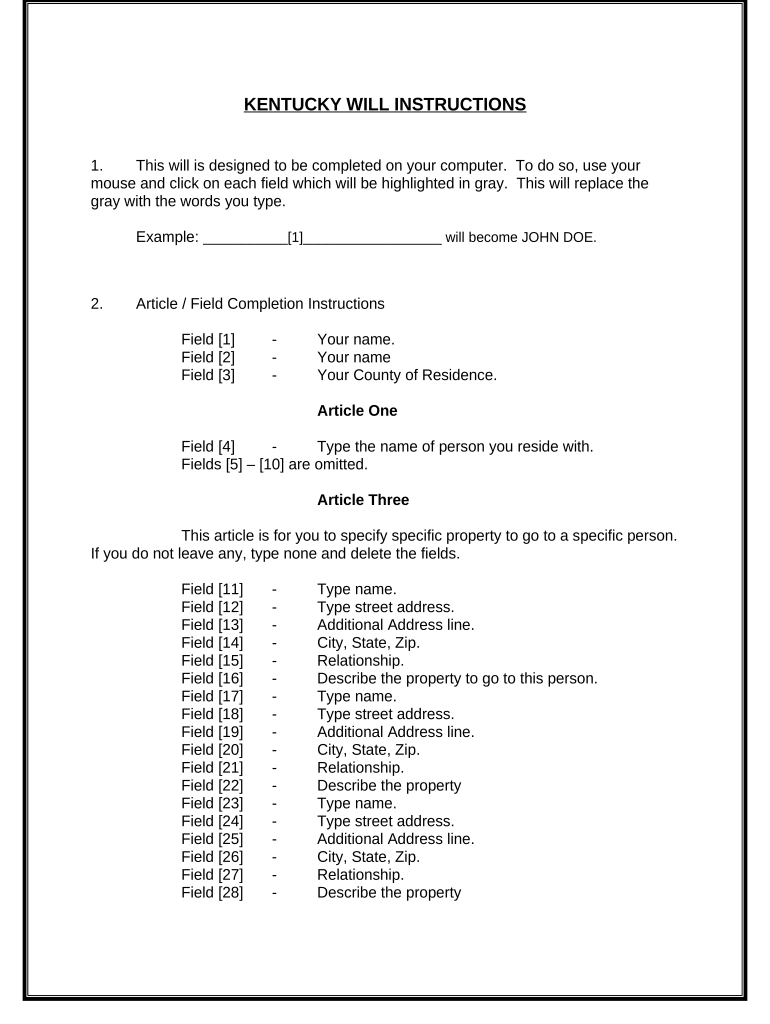
Mutual Wills containing Last Will and Testaments for Unmarried Persons living together with No Children - Kentucky Preview on Page 1

Here's how it works

01. Edit your form online
Type text, add images, blackout confidential details, add comments, highlights and more.
02. Sign it in a few clicks
Draw your signature, type it, upload its image, or use your mobile device as a signature pad.
03. Share your form with others
Send it via email, link, or fax. You can also download it, export it or print it out.

How to use or fill out Mutual Wills containing Last Will and Testaments for Unmarried Persons living together with No Children - Kentucky

Form edit decoration
9.5
Ease of Setup
DocHub User Ratings on G2
9.0
Ease of Use
DocHub User Ratings on G2
  1. Click ‘Get Form’ to open it in the editor.
  2. Begin by entering your name in Field [1] and your county of residence in Field [3].
  3. In Article One, specify the name of the person you reside with in Field [4].
  4. For Article Three, list any specific property you wish to bequeath. If none, type 'none' and delete the fields.
  5. In Article Four, designate who will receive your homestead by filling out Field [29] or checking the box for heirs at law.
  6. Complete Article Five by naming a person to receive all remaining property in Field [31], or check heirs at law.
  7. Appoint a Personal Representative in Article Six by filling out Fields [34] and [35].
  8. Review all entries for accuracy before printing. Ensure you sign in front of two witnesses.

Start using our platform today to easily complete your Mutual Wills online for free!

be ready to get more

Complete this form in 5 minutes or less

Get form

Got questions?

We have answers to the most popular questions from our customers. If you can't find an answer to your question, please contact us.
Contact us
At Trust Will, you can create an online will that meets Kentucky legal requirements. After creating your will, you will have the option to print out your documents so that they can be physically signed. You can also choose to have your documents shipped to you.
One alternative to mutual Wills is the granting of a legal or equitable life interest only to the spouse, with an interest in remainder to the ultimate beneficiaries.
Pitfalls of mutual wills First, they heavily restrict a surviving spouses choices. As they cannot validly revoke the mutual will, they are stuck with it for the rest of their life. They cannot add or remove any beneficiaries, which means they cannot accommodate relationships that change over time.
A Last Will and Testament, often simply called a will, is one estate planning document that single people should consider creating. However, single people should also consider a trust, depending on their assets and how they want those assets to be distributed.
Top five mistakes when writing a Will Failing to have the Will witnessed correctly. All Wills need to be signed in the presence of two independent witnesses, who in turn must sign the document. Creating a DIY Will. Forgetting key assets. Not updating the Will after your circumstances change. Not writing one at all.

Security and compliance

At DocHub, your data security is our priority. We follow HIPAA, SOC2, GDPR, and other standards, so you can work on your documents with confidence.

Learn more
ccpa2
pci-dss
gdpr-compliance
hipaa
soc-compliance

People also ask

The disadvantages of a mutual Will Additionally, mutual Wills limit the ability of the survivor to make lifetime gifts for inheritance tax purposes or take advantage of more favourable legal or tax advice.
To clarify, a joint will is different from a mutual will. A joint will is one document signed by two people. A mutual will represents two individual wills that are signed separately, but are largely the same in content.
What are the disadvantages of mirror wills? A potential issue to consider when creating a mirror will is that the spouse or partner could later change their will. In fact, they can change the will at any time even when both are still living without agreement or consent.

Related links