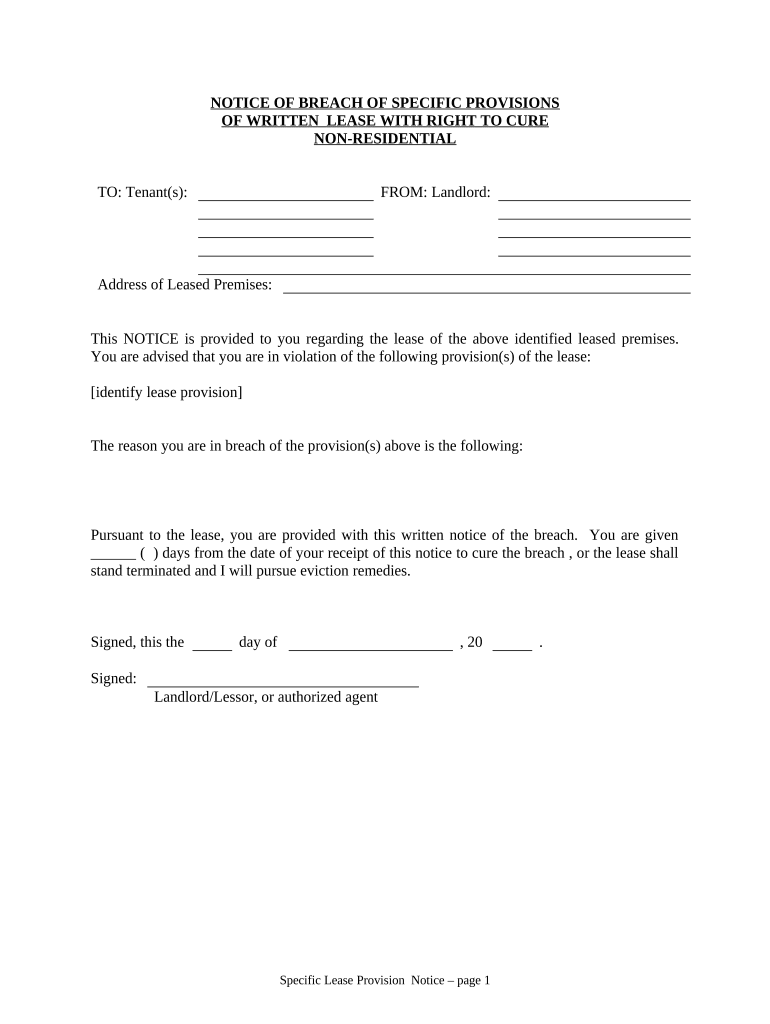
Notice of Breach of Written Lease for Violating Specific Provisions of Lease with Right to Cure for Nonresidential Property from Landlord to Tenant - Kansas 2026

Get Form
Notice of Breach of Written Lease for Violating Specific Provisions of Lease with Right to Cure for Nonresidential Property from Landlord to Tenant - Kansas Preview on Page 1

Here's how it works

01. Edit your form online
Type text, add images, blackout confidential details, add comments, highlights and more.
02. Sign it in a few clicks
Draw your signature, type it, upload its image, or use your mobile device as a signature pad.
03. Share your form with others
Send it via email, link, or fax. You can also download it, export it or print it out.

How to use or fill out Notice of Breach of Written Lease for Violating Specific Provisions of Lease with Right to Cure for Nonresidential Property from Landlord to Tenant - Kansas

Form edit decoration
9.5
Ease of Setup
DocHub User Ratings on G2
9.0
Ease of Use
DocHub User Ratings on G2
  1. Click ‘Get Form’ to open it in the editor.
  2. Begin by entering the Tenant(s) name in the designated field at the top of the form.
  3. Next, fill in your name as the Landlord in the appropriate section.
  4. Provide the address of the leased premises where indicated.
  5. Identify and specify the lease provision(s) that have been violated in the provided space.
  6. Clearly state the reason for the breach in the corresponding section below.
  7. Indicate how many days are allowed for curing the breach by filling in the blank provided.
  8. Sign and date the notice at the bottom, ensuring all required fields are completed.
  9. Complete the Proof of Delivery section by selecting how you delivered this notice and signing it accordingly.

Start using our platform today to streamline your document editing and ensure a smooth process!

be ready to get more

Complete this form in 5 minutes or less

Get form

Got questions?

We have answers to the most popular questions from our customers. If you can't find an answer to your question, please contact us.
Contact us
To evict you, the landlord must provide a notice to you that you have 14 days to correct the problem, otherwise you will have to vacate 30 days after you get the notice. In other words, the lease will terminate 30 days after the notice date, unless you can correct the problem in 14 days.
A landlord cannot end a lease early without going through proper eviction procedures. A serious breach happens when a party to the lease violates the terms of the contract. Both parties have a responsibility to try to remedy the situation before taking the major step of terminating the lease.
Evictions always go on your record, but lease breaks dont If you stop paying rent entirely then you will have breached your lease, which is just cause for eviction - youll get a demand letter and then your name will be filed in housing court.
A breach of lease is when the landlord or tenant breaks one of the provisions set out in the lease document. However, even when one person breaches the lease, the other party still has a number of rights. Although rights dont guarantee anyones actions, they are recognized in court.
A tenant can breach their tenancy agreement deliberately by, for example, failing to pay their rent, refusing access to the property for a periodic visit or refusing to leave the property at the end of the term.

Security and compliance

At DocHub, your data security is our priority. We follow HIPAA, SOC2, GDPR, and other standards, so you can work on your documents with confidence.

Learn more
ccpa2
pci-dss
gdpr-compliance
hipaa
soc-compliance

People also ask

The landlord must give the tenant a Kansas eviction notice called a 30-Day Notice to Comply, which provides the tenant with 14 days to fix the issue. Lease violations include: Illegal activity. Damage to the rental unit.
Cure or quit is a notice given to tenants to stop violating a clause of their lease agreement. Either state statute or the lease agreement will determine how long the tenant has to respond to or stop the prohibited activity. If the tenant refuses to stop, the landlord will file to evict the tenant.

Related links