




01. Edit your 460 form online
Type text, add images, blackout confidential details, add comments, highlights and more.

Type text, add images, blackout confidential details, add comments, highlights and more.

Draw your signature, type it, upload its image, or use your mobile device as a signature pad.

Send form 460 via email, link, or fax. You can also download it, export it or print it out.
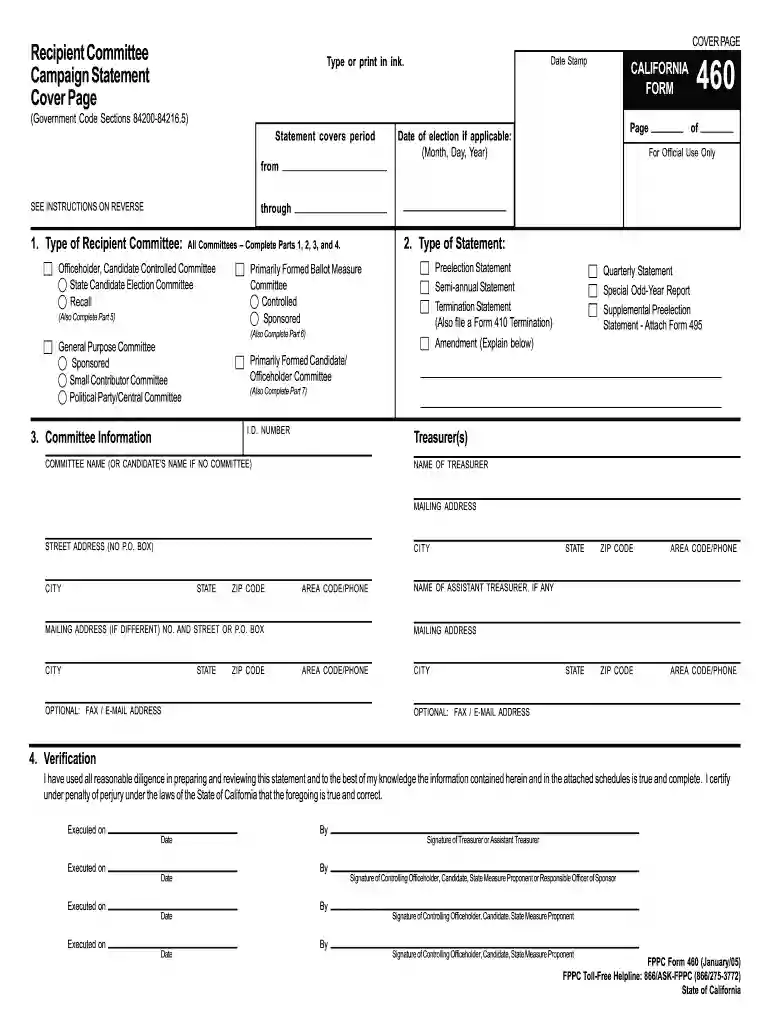
The FPPC Form 460, officially referred to as the Recipient Committee Campaign Statement, is an essential document used by various committees to report campaign contributions and expenditures in California. This form primarily aids in maintaining transparency and public trust by ensuring detailed disclosure of financial activities related to campaign financing. It is utilized by candidate-controlled committees, general purpose committees, and primarily formed ballot measure committees. These entities are required to disclose the total contributions received, expenditures made, and other financial information relevant to their campaign activities.
The FPPC Form 460 comprises several sections vital for comprehensive reporting of campaign finances. Important sections include:
Understanding and accurately completing these sections ensures compliance with legal requirements and promotes informed electorate decisions.
Utilizing the FPPC Form 460 involves several steps to ensure its accurate completion and submission:
Adhering to this structured approach facilitates accurate and compliant reporting.
Completing the FPPC Form 460 necessitates a step-by-step approach to ensure accuracy and compliance:
This structured process aids in creating a transparent report that aligns with legal standards.
Understanding terms specific to the FPPC Form 460 enhances comprehension and accurate completion. Key terms include:
These terms are foundational for accurately interpreting and managing campaign finances.
California imposes state-specific regulations and guidelines regarding the filing of the FPPC Form 460. Important considerations include:
Committees must adhere to these state-specific requirements to ensure legal compliance and maintain public trust.
Compliance with filing deadlines is crucial for maintaining the committee's good standing. Key deadlines include:
Respecting these deadlines helps avoid legal penalties and ensures transparent reporting.
Failure to comply with FPPC Form 460 requirements can result in significant penalties. Non-compliance consequences include:
Committees are strongly advised to prioritize accurate and timely filing to avoid these potential negative outcomes.
We've got more versions of the 460 form form. Select the right 460 form version from the list and start editing it straight away!
Of course, it is possible with DocHub. This reliable and compliant online editor features a phone-based signing option. After you log in to your DocHub account and add your fppc form 460 to our editor, fill out all required areas and use the Sign tool on the top barf. Click on Create your signature and select Phone from the available choices. Here, you scan a QR code with your smartphone and draw your signature on your phone screen, as you usually do when approving physical papers. If you access DocHub right from your mobile device, you can electronically sign your document by drawing your electronic signature, adding its image, or simply with a typed name.
If you are using Chrome, there are two simple ways to edit your fppc form 460 online. First, visit the DocHub site, add your document, and edit it utilizing our toolbar. You may also install our Chrome extension and edit any document by dragging and dropping it in your web browser window.
At DocHub, your data security is our priority. We follow HIPAA, SOC2, GDPR, and other standards, so you can work on your documents with confidence.


(See the FPPC Campaign Disclosure. Manuals for candidates and ballot measure committees.) Date Received: A monetary contribution has been received when theRead more
A candidate or officeholder who has a controlled committee, or who has raised or spent or will raise or spend $2,000 or more during a calendar year inRead more


