




2014 form 940-2026

Get Form
2014 form 940 Preview on Page 1

Here's how it works

01. Edit your form online
Type text, add images, blackout confidential details, add comments, highlights and more.
02. Sign it in a few clicks
Draw your signature, type it, upload its image, or use your mobile device as a signature pad.
03. Share your form with others
Send it via email, link, or fax. You can also download it, export it or print it out.

Definition and Meaning of the 2014 Form 940

The 2014 Form 940, officially known as the Employer's Annual Federal Unemployment (FUTA) Tax Return, is a critical document for employers in the United States. This form is utilized to report and calculate federal unemployment taxes owed by employers who pay unemployment compensation. The FUTA tax enables states to offer unemployment benefits to individuals who have lost their jobs through no fault of their own.

Employers must file Form 940 to report their annual payroll tax liability for each employee who earns a salary. It is essential to understand that the form is specifically designed for employers, not employees, and only applies to those who have a payroll in states that impose unemployment taxes. The guidelines established in the form also assist in determining which employers are liable for the tax, thereby helping in compliance with federal regulations.

Understanding the 2014 Form 940 is crucial for employers to ensure they meet their federal obligations accurately and on time. By reporting the correct tax liabilities, employers can avoid unnecessary penalties or interest charges that arise from misreporting or late submissions.

How to Obtain the 2014 Form 940

Acquiring the 2014 Form 940 is a straightforward process. Employers can access it through several channels, ensuring easy availability for those needing to file. The primary options for obtaining the form include:

  • IRS Website: The form can be downloaded directly from the official IRS website. Employers can locate the necessary forms in the Forms and Publications section, typically under the "Current Forms" category.

  • Tax Software: Many tax preparation software programs, including TurboTax and QuickBooks, provide digital access to Form 940 as part of their services. This integration allows for easier tax filing and data management.

  • Local IRS Offices: Employers may also visit their nearest IRS office to request a physical copy of the form if they prefer handling paperwork in person.

  • Tax Professionals: Consulting with a certified tax professional is another avenue for employers needing the form. Tax professionals can provide guidance and assistance in completing the form correctly while ensuring all necessary submissions are made on time.

For those filing electronically, it is essential to utilize approved tax software that supports Form 940, as this can facilitate accurate reporting and help ensure compliance with federal regulations.

Steps to Complete the 2014 Form 940

Filling out the 2014 Form 940 involves a systematic approach to ensure accuracy in reporting. Employers should follow these key steps:

  1. Gather Payroll Information: Before starting the form, compile all relevant payroll data for the year, including total wages paid and any exemptions, which will be necessary for accurate reporting.

  2. Fill Out General Information: Provide essential details, including the employer's name, address, and Employer Identification Number (EIN). This information is crucial for identifying the employer within IRS records.

  3. Complete the Wage and Tax Computation:

    • Enter the total payments made to employees subject to FUTA.
    • Calculate the taxable wages and the applicable tax rates.
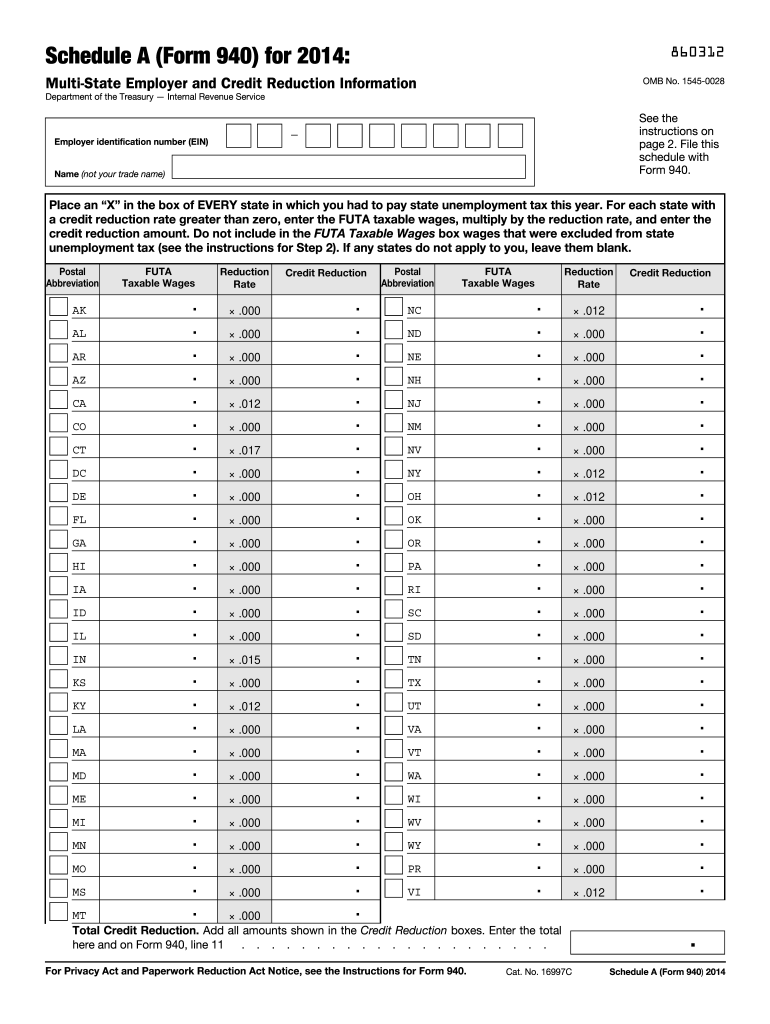
    • Report any adjustments related to state unemployment taxes, especially in states with credit reductions.
  4. Report Any Adjustments: If applicable, complete Part 2 of the form to reflect any adjustments to the FUTA tax liability—this includes any amounts paid to states for unemployment taxes that may qualify for future tax credits.

  5. Calculate the Total Amount Due: Finalize by calculating the total FUTA tax liability and the amount due, ensuring correctness to avoid future penalties.

  6. Sign and Date the Form: The form must be signed and dated by the employer or an authorized representative before submission to validate its authenticity.

  7. Keep Copies: For record-keeping purposes, maintain copies of the completed Form 940 and any supporting documentation for future reference and in case of IRS inquiries.

Following these steps diligently ensures that the form is filled out correctly and submitted on time, avoiding common pitfalls that could lead to issues with the IRS.

Important Terms Related to 2014 Form 940

Familiarizing oneself with key terms associated with the 2014 Form 940 is essential for understanding its function and compliance requirements. Some important terms include:

  • FUTA Tax: The Federal Unemployment Tax Act requires employers to pay unemployment tax on the first $7,000 earned by each employee. This tax funds the federal government's unemployment programs.

  • Employer Identification Number (EIN): A unique nine-digit number assigned by the IRS to businesses for tax purposes, which must be included on all tax forms, including Form 940.

  • Taxable Wages: The amount of employee earnings subject to federal unemployment tax, critical for determining the overall tax liability when completing the form.

  • Credit Reduction States: States that have not repaid federal loans for unemployment benefits may have a reduction in the FUTA tax credit, impacting the total amount due on the form.

  • Form 940 Schedule A: An additional form that may need to be filed by employers in certain circumstances, such as when submitting credit reduction calculations for multi-state employment scenarios.

Understanding these terms not only simplifies the filing process but also aids employers in ensuring compliance with federal regulations, minimizing potential issues down the line.

Filing Deadlines for the 2014 Form 940

Employers must adhere to specific deadlines to ensure timely filing of the 2014 Form 940. The general timeline is as follows:

  • Annual Filing: Form 940 must be filed with the IRS by January 31 of the year following the tax reporting year. For the 2014 tax year, this meant a filing deadline of January 31, 2015. If filing electronically, employers may benefit from a slight extension, allowing submissions until the end of February.

  • Quarterly Payments: Although the Form 940 is filed annually, employers are required to submit quarterly payments for their FUTA taxes if the total owed is $500 or more. Any owed taxes should be paid by the end of each quarter to avoid interest and penalties.

  • Extensions: Employers wishing to file for an extension can do so using Form 8800, which grants an additional extension period. However, any amounts owed must still be paid by the original due date to avoid penalties.

Adhering to these deadlines is crucial for maintaining compliance with IRS regulations and avoiding unnecessary fines.

Penalties for Non-Compliance with the 2014 Form 940

Failure to comply with the regulations surrounding the 2014 Form 940 can result in various penalties. Awareness of these potential consequences is vital for employers:

  • Late Filing Penalty: If Form 940 is not filed by the due date, the IRS may impose a penalty of five percent of the tax owed for each month the return is late, capped at 25 percent. This penalty is assessed based on the total liabilites reported for that year.

  • Failure to Pay Penalty: Employers who do not pay the full amount of tax owed by the deadline may face penalties of up to 0.5 percent of the unpaid taxes for each month the payment is late, also accumulating up to 25 percent of the total unpaid amount.

  • Interest Charges: In addition to penalties, the IRS may charge interest on any unpaid balances. This interest rate fluctuates quarterly and is compounded daily until the balance is paid in full.

  • Deficiencies and Audits: Missing or inaccurate information may lead to audits and further complications, including adjustments to tax liabilities, which can create additional fines or obligations.

Understanding these penalties reinforces the importance of accurate and timely filing of the 2014 Form 940, allowing employers to maintain compliance and avoid financial repercussions.

See more 2014 form 940 versions

We've got more versions of the 2014 form 940 form. Select the right 2014 form 940 version from the list and start editing it straight away!
Versions Form popularity Fillable & printable
2023 2.9 Satisfied (88 Votes)
2022 4.4 Satisfied (43 Votes)
2021 4.8 Satisfied (160 Votes)
2020 3.9 Satisfied (49 Votes)
2019 4.3 Satisfied (134 Votes)
2018 4 Satisfied (65 Votes)
2017 4.4 Satisfied (137 Votes)
2016 4.4 Satisfied (90 Votes)
2015 4 Satisfied (22 Votes)
2014 4 Satisfied (35 Votes)
2013 4 Satisfied (28 Votes)
2011 4.4 Satisfied (45 Votes)
2010 4.3 Satisfied (46 Votes)
be ready to get more

Complete this form in 5 minutes or less

Get form

Got questions?

We have answers to the most popular questions from our customers. If you can't find an answer to your question, please contact us.
Contact us
Use Form 940 to report your annual Federal Unemployment Tax Act (FUTA) tax. Together with state unemployment tax systems, the FUTA tax provides funds for paying unemployment compensation to workers who have lost their jobs. Most employers pay both a federal and a state unemployment tax. 2014 Instructions for Form 940 - IRS IRS (.gov) pub irs-prior i940--2014 IRS (.gov) pub irs-prior i940--2014 PDF
Form 940 is required for businesses who are subject to Federal Unemployment (FUTA). The 940 is an annual federal tax form used to report wages subject to and taxes paid for FUTA. This form is separate from the 941, 944, and 943 forms.
If you manually filed your tax form: Go to Taxes, then Payroll Tax. Select the Filings tab. Select Resources, then Archived forms and filings. Select the ▼ dropdown menu to filter the form type you want to view. Select the form name, then View. IRS requested prior years form 940 and 941. How do retrieve, complete QuickBooks - Intuit employees-and-payroll QuickBooks - Intuit employees-and-payroll
Each year, every business with employees must file Form 940 to compute the amount of unemployment tax that must be paid on the federal level. This payroll tax is based on the first $7,000 of each employees wages (including owners of S corporations who receive a salary for work performed for their businesses). Guide to IRS Form 940 for Small Businesses - Paychex Paychex articles payroll-taxes wh Paychex articles payroll-taxes wh
If you do not file Form 940, you could be hit with a Failure-to-File (FTF) penalty. The IRS applies this penalty to any taxpayer (individual or business) that has failed to file their taxes on time.
be ready to get more

Complete this form in 5 minutes or less

Get form

People also ask

Get federal tax forms for current and prior years Download them from IRS.gov. Order online and have them delivered by U.S. mail. Order by phone at 1-800-TAX-FORM (1-800-829-3676) Get federal tax return forms and file by mail | USAGov USA.gov federal-tax-forms USA.gov federal-tax-forms
Each year, every business with employees must file Form 940 to compute the amount of unemployment tax that must be paid on the federal level. This payroll tax is based on the first $7,000 of each employees wages (including owners of S corporations who receive a salary for work performed for their businesses).
Any LLC with employees will also need to file Form 940, which is the Employers Annual Federal Unemployment (FUTA) Tax Return and Form 941, which is the Employers Quarterly Federal Tax Return, or Form 944, the Employers Annual Federal Tax Return.

Related links