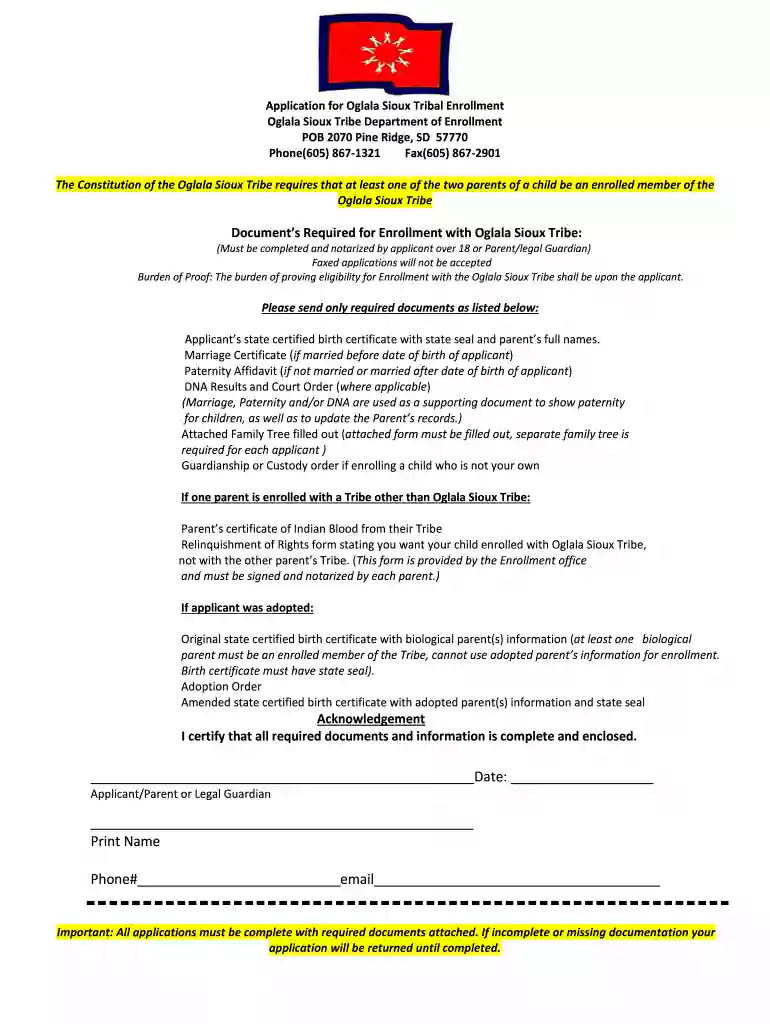
Who are the Oglala Sioux?
The Oglala, or Scatter Their Own, are one of the seven bands of the Tetonowan (Lakota or Dwellers of the Prairie) of the Great Sioux Nation. Historically, they were warriors and hunters and expert horsemen.
What are the requirements for tribal enrollment?
The criterion varies from tribe to tribe, so uniform membership requirements do not exist. Two common requirements for membership are lineal decendency from someone named on the tribes base roll or relationship to a tribal member who descended from someone named on the base roll.
Who is the leader of the Oglala Sioux Tribe?
The most famous and historically DocHub Oglala Sioux chief is Red Cloud (Maȟpya Lta), known for leading the Lakota to victory against the U.S. in Red Clouds War and signing the Fort Laramie Treaty, while the current tribal leader (President) is Frank Star Comes Out. Red Cloud was a powerful warrior and statesman in the 19th century, while President Star Comes Out leads the tribe today in modern governance. Historical Oglala Chiefs: Red Cloud (c. 18221909): A renowned Oglala leader, he successfully fought to close the Bozeman Trail and establish reservations, becoming a symbol of Lakota resistance and diplomacy. Jack Red Cloud (c. 18581928): Red Clouds son, he succeeded his father and continued to lead the Oglala through the challenges of reservation life, preserving Lakota traditions. Crazy Horse: Another legendary Oglala warrior, though not always formally a chief, he was a crucial war leader alongside Red Cloud. American Horse (Wasechun-tashunka): An influential Oglala chief known for his wisdom and leadership during the late 19th century. Current Leadership: Frank Star Comes Out: The current President of the Oglala Sioux Tribe, elected for a term beginning in late 2024, focusing on tribal governance and legal issues with the U.S. government. AI can make mistakes, so double-check responsesOglala Sioux Tribe Tribal PresidentDec 24, 2024Oglala Sioux Tribe (.gov)Oglala Sioux Tribe - South Dakota Department of Tribal RelationsNotable Tribal Members. Red Cloud, an Oglala chief, was a respected warrior and statesman. From 1866-1868, he successfully led theSouth Dakota Department of Tribal Relations (.gov)
Do the Sioux tribe still exist?
Yes, the Sioux (Oceti Sakowin) tribe absolutely still exists today, living in numerous reservations and communities across the Great Plains (South Dakota, North Dakota, Nebraska, Minnesota, Montana) and Canada, actively preserving their culture, language (Lakota, Dakota, Nakota), and fighting for tribal sovereignty and land rights. They are not a historical group but a vibrant, modern people with ongoing political and cultural influence. Key Facts About the Modern Sioux: Names: They are known as Sioux (an exonym), but refer to themselves as Oceti Sakowin (Seven Council Fires). Divisions: The Oceti Sakowin includes the Dakota, Lakota, and Nakota peoples. Reservations: Major reservations are in the Dakotas, Minnesota, Nebraska, and Montana (U.S.), plus reserves in Saskatchewan and Manitoba (Canada). Population: Hundreds of thousands identify as Sioux, with DocHub populations on and off reservations. Modern Activism: They lead movements for environmental protection (like the #NoDAPL protests) and fight for land rights, famously refusing monetary compensation for the Black Hills in favor of their return. Cultural Revival: Theres a strong focus on revitalizing their languages and traditions through educational programs and ceremonies. In short, the Sioux are a living, active nation with deep roots and a strong future. AI can make mistakes, so double-check responsesSioux - WikipediaThe Sioux or Oceti Sakowin (/suː/ SOO; Dakota/Lakota: Očhthi akwiŋ [oˈtʃʰeːtʰi ʃaˈkoːwĩ]) are groups of Native American tribes WikipediaStanding Rock Sioux Tribe: HomepageWe stand together for Tribal sovereignty. Stradling the South Dakota and North Dakota border, the Standing Rock Indian ReservationStanding Rock Sioux Tribe
Who had power in the Sioux tribe?
The Chiefs even famous leaders such as Red Cloud, Sitting Bull and Crazy Horse had no power, only respect based on their wisdom and bravery in war. Decisions were DocHubed by the Council of elders; important decisions had to be agreed by all the men in a band or tribe.