Marital Legal Separation and Property Settlement Agreement for persons with No Children, No Joint Property or Debts where Divorce Action Filed - Indiana 2026

Get Form
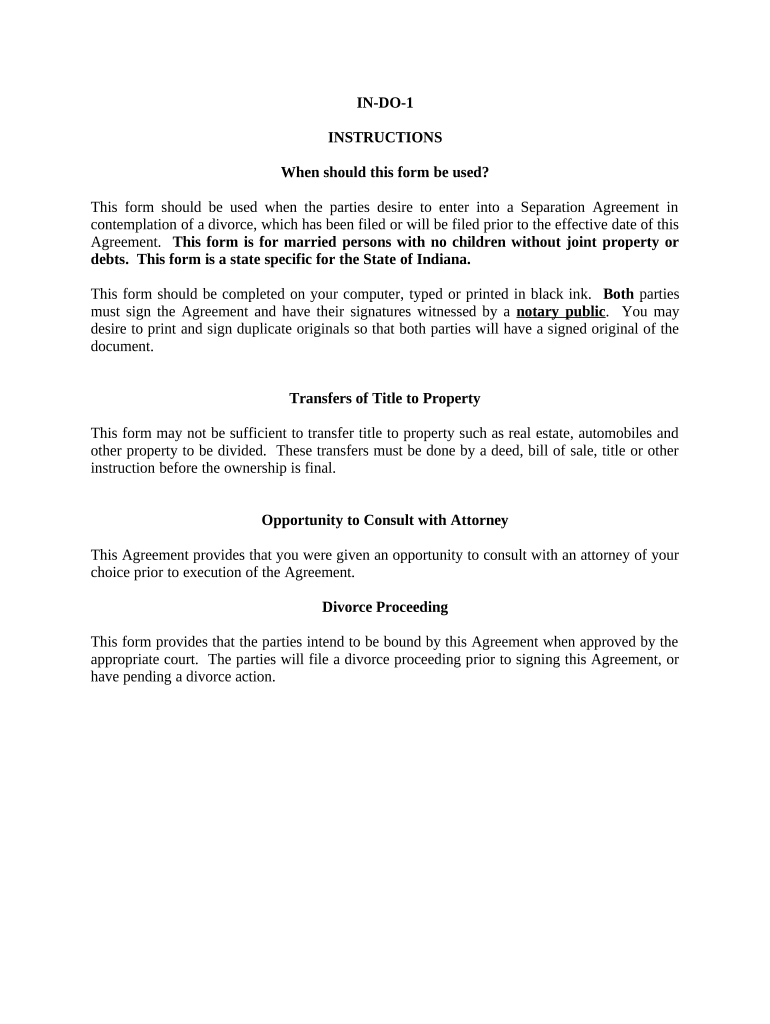
Marital Legal Separation and Property Settlement Agreement for persons with No Children, No Joint Property or Debts where Divorce Action Filed - Indiana Preview on Page 1

Here's how it works

01. Edit your form online
Type text, add images, blackout confidential details, add comments, highlights and more.
02. Sign it in a few clicks
Draw your signature, type it, upload its image, or use your mobile device as a signature pad.
03. Share your form with others
Send it via email, link, or fax. You can also download it, export it or print it out.

How to use or fill out Marital Legal Separation and Property Settlement Agreement for persons with No Children, No Joint Property or Debts where Divorce Action Filed - Indiana

Form edit decoration
9.5
Ease of Setup
DocHub User Ratings on G2
9.0
Ease of Use
DocHub User Ratings on G2
  1. Click ‘Get Form’ to open it in the editor.
  2. Begin by entering the full legal names of both parties at the top of the form. Ensure accuracy as this information is crucial for legal purposes.
  3. In Section 1, confirm that both parties agree to live separately and free from interference. Each party should initial to indicate understanding.
  4. Proceed to Section 2, where each party must disclose their financial status. Fill in any relevant details about assets and liabilities.
  5. In Section 3, specify ownership of personal property and any agreements regarding household furnishings. Clearly outline who retains what items.
  6. Complete Section 4 by confirming there are no children involved in the marriage. Both parties should initial this section.
  7. Review Sections 5 through 21 carefully, ensuring all agreements regarding debts, future earnings, and mutual waivers are accurately filled out.
  8. Once completed, both parties must sign the document in front of a notary public to validate the agreement legally.

Start using our platform today to easily fill out your Marital Legal Separation Agreement for free!

be ready to get more

Complete this form in 5 minutes or less

Get form

Got questions?

We have answers to the most popular questions from our customers. If you can't find an answer to your question, please contact us.
Contact us
The statute lists marital property as that owned by either spouse before the marriage as well as property acquired during the marriage by the parties joint efforts or by one party alone. This means that any property acquired by either party, before or during the marriage, is marital property in Indiana.
Alternative Dispute Resolution Fee IC 33-23-6-1 If the county has an approved plan from the Judicial Conference of Indiana, the clerk shall collect from the party filing a petition for legal separation, paternity, or dissolution of marriage a fee of $20.
When drafting a divorce settlement, clearly identify separate property and include waiver clauses for spousal support. Use explicit language stating each partys rights and relinquishments regarding properties and alimony. Ensure both parties voluntarily agree and sign the agreement.
Because California is a community property state, if the couple bought the house while they were married, they both have an ownership stake in it, and neither can compel the other to leave.
Both divorces and separations give couples decrees that allocate their finances and allocate their child custody rights, but there are stark differences. As we mentioned above, legal separations in Indiana last only one year.
be ready to get more

Complete this form in 5 minutes or less

Get form

People also ask

Divorce can be costly. Legal costs can add up as both partners may need attorneys to sort through paperwork, divide assets or determine custody of children. Legal separation could be cheaper than divorce, but laws can vary from state to state and greatly affect the cost of these two distinct legal processes.
Like a divorce proceeding, you must also provide the court with a legal reason, or grounds, for your request. In Indiana, youll need to demonstrate to the judge that there are conditions or circumstances within your marriage that make it currently intolerable to live with your spouse.

Related links