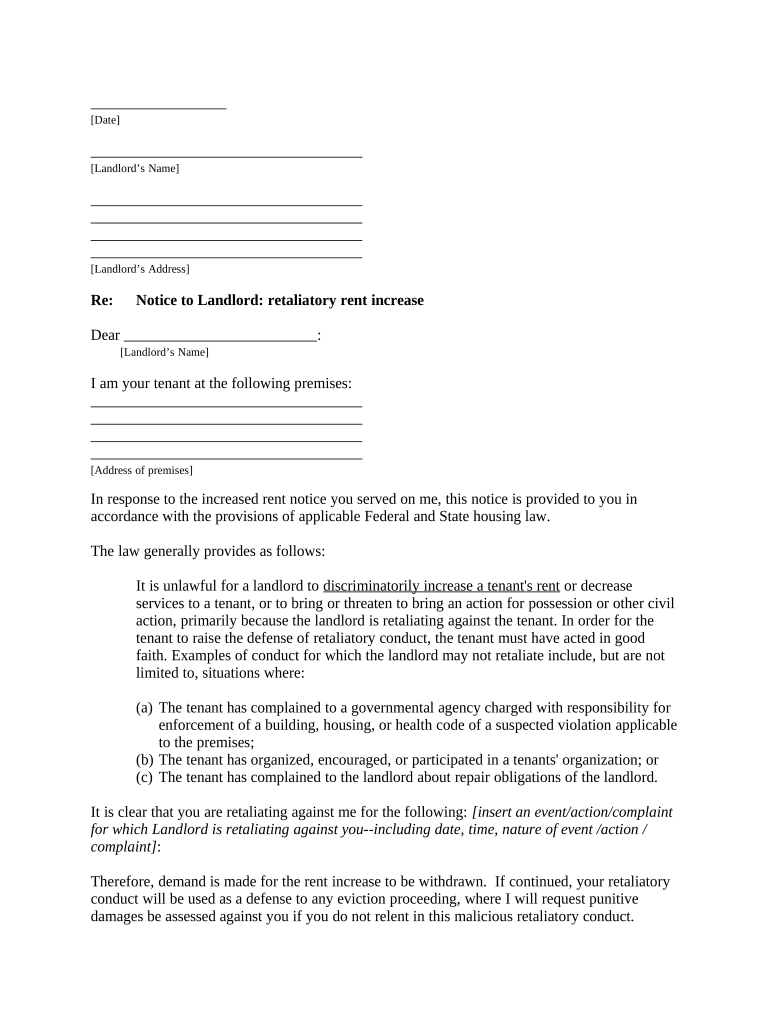
Letter from Tenant to Landlord containing Notice to landlord to withdraw retaliatory rent increase - Indiana 2026

Get Form
Letter from Tenant to Landlord containing Notice to landlord to withdraw retaliatory rent increase - Indiana Preview on Page 1

Here's how it works

01. Edit your form online
Type text, add images, blackout confidential details, add comments, highlights and more.
02. Sign it in a few clicks
Draw your signature, type it, upload its image, or use your mobile device as a signature pad.
03. Share your form with others
Send it via email, link, or fax. You can also download it, export it or print it out.

How to use or fill out Letter from Tenant to Landlord containing Notice to landlord to withdraw retaliatory rent increase - Indiana with our platform

Form edit decoration
9.5
Ease of Setup
DocHub User Ratings on G2
9.0
Ease of Use
DocHub User Ratings on G2
  1. Click ‘Get Form’ to open it in the editor.
  2. Begin by entering the date at the top of the document. This sets the context for your notice.
  3. Fill in the landlord’s name and address in the designated fields. Ensure accuracy for effective communication.
  4. In the salutation, address your landlord directly by name, reinforcing a personal touch.
  5. Specify your address as the tenant in the provided section. This clarifies your identity and residence.
  6. Detail the retaliatory actions taken by your landlord in response to your complaints. Be specific about dates and events.
  7. Clearly state your demand for withdrawal of the rent increase, emphasizing that you will continue paying your usual rent amount.
  8. Sign and date at the bottom of the letter, ensuring all necessary parties are aware of this formal communication.
  9. Complete the Proof of Delivery section by selecting how you delivered this notice, ensuring proper documentation.

Start using our platform today to easily fill out and manage your important documents for free!

be ready to get more

Complete this form in 5 minutes or less

Get form

Got questions?

We have answers to the most popular questions from our customers. If you can't find an answer to your question, please contact us.
Contact us
Under AB 1482, landlords are limited to increasing rent by no more than 5% plus the local CPI (inflation rate) or 10%, whichever is lower. The local inflation rate is determined by the California Consumer Price Index (CCPI), which is released annually by the California Department of Finance.
Landlord wants to raise your rent? Here are 3 sample emails you can use to negotiate Sending your request in writing creates a record of your conversation. Keep your tone calm and point out your track record as a good tenant. Prepare to counteroffer with a specific number thats not your maximum.
Explain your situation clearly and politely. Provide details on why an increase would be difficult for you, such as any changes in your income, expenses, or personal circumstances. Acknowledge that the landlord has expenses and may need to raise rents, but ask them to consider keeping your rent the same this year.
You do not have to agree to the rent increase or sign a new tenancy agreement. But your landlord could take steps to end your tenancy if you do not agree. For example, with a section 21 notice. If your contract has a rent review clause, it should say how often the rent could go up.
When informing a tenant about a rent increase, clearly state the new rent amount and effective date. Include an offer for a new lease reflecting the updated terms. Ensure the notice complies with local laws regarding timing and delivery method, such as written notice given 30 days before the increase.

Security and compliance

At DocHub, your data security is our priority. We follow HIPAA, SOC2, GDPR, and other standards, so you can work on your documents with confidence.

Learn more
ccpa2
pci-dss
gdpr-compliance
hipaa
soc-compliance

People also ask

Time the request appropriately. Emphasize that youve been a good, reliable tenant. Provide context about your personal financial situation. Suggest a rent freeze rather than an outright decrease. Offer to sign a longer lease in exchange for the rent remaining the same. Frame the request as a partnership.
Note that even if the landlord proves that he or she has a valid reason for the eviction, the tenant can prove retaliation by showing that the landlords effort to evict the tenant is not in good faith and is primarily based on a goal of punishing the tenant for exercising said rights.

Related links