Indiana judgment form 2026

Get Form
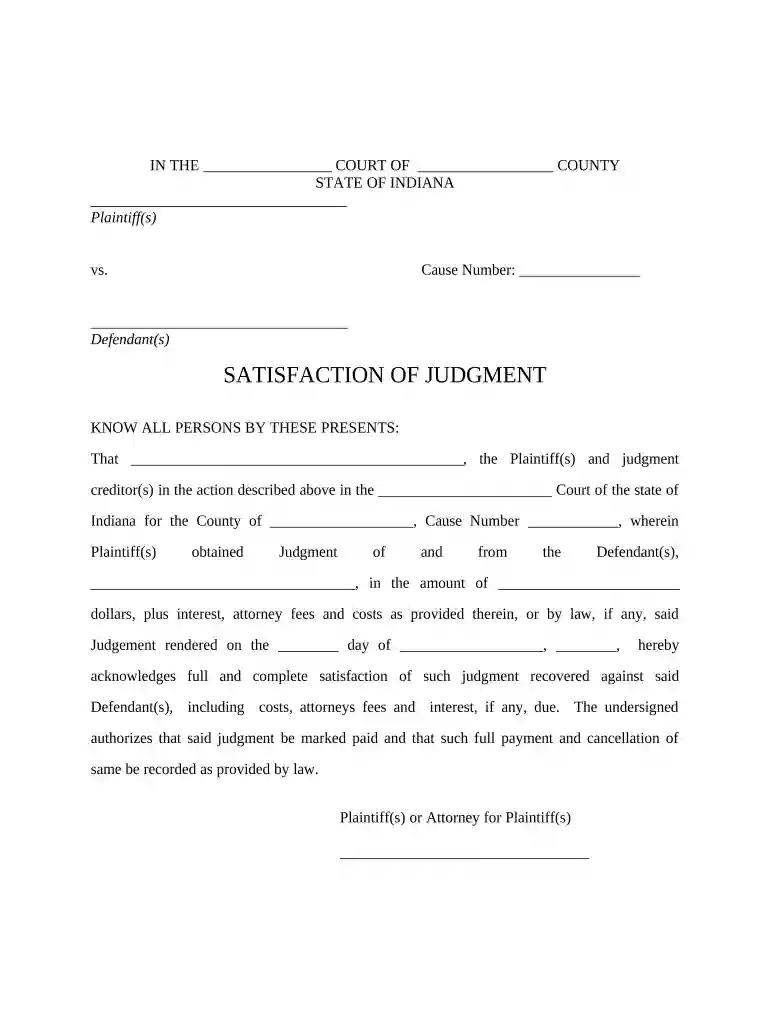
indiana judgment form Preview on Page 1

Here's how it works

01. Edit your form online
Type text, add images, blackout confidential details, add comments, highlights and more.

02. Sign it in a few clicks
Draw your signature, type it, upload its image, or use your mobile device as a signature pad.

03. Share your form with others
Send it via email, link, or fax. You can also download it, export it or print it out.

How to use or fill out Indiana Judgment Form with our platform

Form edit decoration
9.5
Ease of Setup
DocHub User Ratings on G2
9.0
Ease of Use
DocHub User Ratings on G2
  1. Click ‘Get Form’ to open the Indiana Judgment Form in the editor.
  2. Begin by filling in the court name and county at the top of the form. This identifies where your judgment is being filed.
  3. Enter the cause number assigned to your case, which is crucial for tracking purposes.
  4. In the plaintiff section, write down the names of all plaintiffs involved in the case.
  5. Next, fill in the defendant's name and ensure accuracy as this is essential for legal documentation.
  6. Specify the amount of judgment awarded, including any additional costs like interest and attorney fees.
  7. Complete the date when the judgment was rendered to provide a clear timeline of events.
  8. Sign and date at the bottom of the form, ensuring that all required acknowledgments are completed by a notary public if necessary.
  9. Finally, certify mailing by filling out that section with accurate addresses for all parties involved.

Start using our platform today to streamline your document editing and signing process for free!

be ready to get more

Complete this form in 5 minutes or less

Get form

Got questions?

We have answers to the most popular questions from our customers. If you can't find an answer to your question, please contact us.
Contact us
In Indiana, to obtain a default judgment, five documents must be filed: Complaint, Summons, Affidavit of Default, Motion for Default Judgment, and Proposed Default Judgment. These documents ensure proper notification to the defendant and allow the plaintiff to seek a judgment without needing a trial.
Garnishing Wages If a person fails to pay a judgment voluntarily, the easiest way to collect is to garnish up to 25% of his wages. (The wages of very low income workers, however, are exempt from garnishment.) But you cant garnish a welfare, Social Security, unemployment, pension, or disability check.
The court can also order you to pay the costs of collecting the debt, interest charges, or attorney fees. Important: Judgments give debt collectors much stronger tools to collect the debt from you, including wage or bank account garnishments, as well as putting on a lien on your home.
If you dont pay a debt you owe, a creditor or debt collector can sue you. If they win the case theyll get a court judgment, which gives them access to serious debt collection methods like wage garnishment.
Depending on the defendants financial situation, it can be very difficult to collect a judgment. Some people do not work or have assets and are not able to pay judgments. Other defendants may have the money but refuse to pay it out of spite or for other reasons.
be ready to get more

Complete this form in 5 minutes or less

Get form

People also ask

If the defendant responds to the lawsuit, then it can take months or even years, to finally get to a judgment depending on how hard the defendant fights. If the defendant does not answer the lawsuit and we secure a default judgment, we must wait an additional 30 days before taking further actions.
A judgment may be provided either in written or oral form depending on the circumstances. Oral judgments are often provided at the conclusion of a hearing and are frequently used by courts with heavier caseloads or where a judgment must be rendered quickly.

Related links