Indiana joint tenancy 2026

Get Form
indiana joint tenancy Preview on Page 1

Here's how it works

01. Edit your form online
Type text, add images, blackout confidential details, add comments, highlights and more.
02. Sign it in a few clicks
Draw your signature, type it, upload its image, or use your mobile device as a signature pad.
03. Share your form with others
Send it via email, link, or fax. You can also download it, export it or print it out.

How to use or fill out Indiana Joint Tenancy with Our Platform

Form edit decoration
9.5
Ease of Setup
DocHub User Ratings on G2
9.0
Ease of Use
DocHub User Ratings on G2
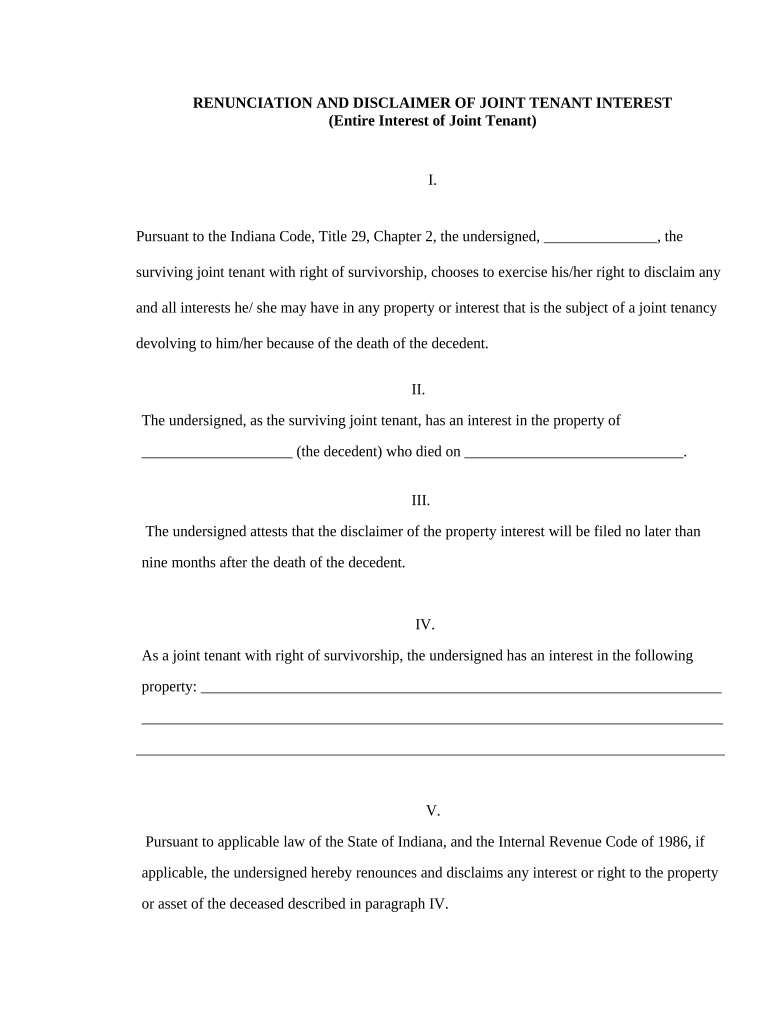
  1. Click ‘Get Form’ to open the Indiana Joint Tenancy document in the editor.
  2. In Section I, enter your name as the surviving joint tenant who is disclaiming interest. This identifies you as the individual exercising this right.
  3. In Section II, fill in the name of the decedent and their date of death. This information is crucial for establishing the context of your disclaimer.
  4. Section III requires you to acknowledge that your disclaimer will be filed within nine months after the decedent's death. Ensure you understand this timeline.
  5. In Section IV, list all properties in which you have an interest as a joint tenant. Be thorough and precise to avoid any legal complications.
  6. Section V involves renouncing any rights to the property mentioned in Section IV. Confirm that you wish to proceed with this disclaimer.
  7. Complete Sections VI and VII by affirming that this renunciation relates back to the date of death and sign where indicated. Don’t forget to include dates.
  8. Finally, ensure that a Notary Public witnesses your signature in the designated area for legal validation.

Start using our platform today for free to streamline your document editing and signing process!

be ready to get more

Complete this form in 5 minutes or less

Get form

Got questions?

We have answers to the most popular questions from our customers. If you can't find an answer to your question, please contact us.
Contact us
Joint tenancy with right of survivorship: This form of co-ownership means that when one owner dies, their share automatically passes to the surviving owner(s). In Indiana, joint tenancy can help avoid probate for the property, as the transfer of ownership is immediate.
Joint Tenancy is sometimes referred to as Poor Mans Estate Planning because it happens automatically, without the need for any probate proceeding. Assets that you hold in joint tenancy cannot be left to someone else through a Will or Trust.
Generally, joint tenancy protects the interest of a non-debtor joint tenant. This means a creditor cannot seize their share of the property if another owner has debt. However, creditors may negotiate to settle liens or, in some cases, force the sale of the jointly-owned property to recover debts from a joint tenant.
To establish a JT when conveying land in Indiana, the conveyance of land must express that the grantees will hold the land in JT with a right of survivorship (JTWROS). This means that when a person wishes to create a JT, the deed must indicate JTWROS, otherwise it will be a tenancy in common.
Loss of Control When you enter a joint tenancy, you lose sole control over the property. Any decision regarding the property must be made jointly with the other owner(s).

Security and compliance

At DocHub, your data security is our priority. We follow HIPAA, SOC2, GDPR, and other standards, so you can work on your documents with confidence.

Learn more
ccpa2
pci-dss
gdpr-compliance
hipaa
soc-compliance

People also ask

However, joint tenancy also has its disadvantages. Potential conflicts between co-owners can arise, especially if they have different ideas about how the property should be used or managed. Another disadvantage is the inability to designate separate shares of the property.
One of the biggest risks of joint ownership is that the other owners financial liabilities may affect you. If the joint owner has debts, files for bankruptcy, or is subject to a tax lien or judgment, creditors may pursue the jointly owned property.

Related links