




01. Edit your 941 2012 online
Type text, add images, blackout confidential details, add comments, highlights and more.

Type text, add images, blackout confidential details, add comments, highlights and more.

Draw your signature, type it, upload its image, or use your mobile device as a signature pad.

Send 2012 form 941 via email, link, or fax. You can also download it, export it or print it out.
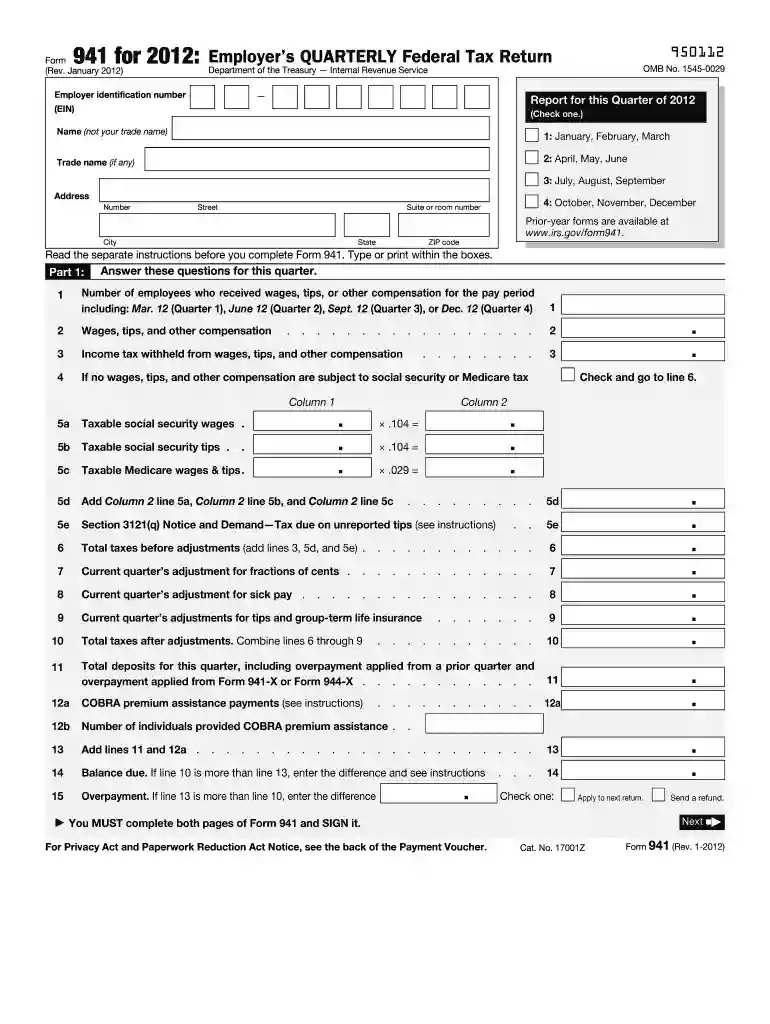
IRS Form 941 for 2012, also known as the Employer's Quarterly Federal Tax Return, is a crucial form used by businesses to report their payroll tax liabilities to the Internal Revenue Service (IRS). This form provides a systematic method for employers to detail wages paid to employees, social security and Medicare taxes, and employee tips. A comprehensive understanding of its sections is essential for compliance and avoiding any legal issues associated with payroll taxes.
Completing IRS Form 941 for 2012 involves detailed data entry and understanding of specific payroll tax regulations. Employers should ensure that their payroll systems are updated to accurately compute and report relevant financial details.
Acquiring IRS Form 941 for 2012 is a straightforward process. It is accessible online through the IRS website and can be downloaded for immediate use. Hard copies are available upon request from IRS offices for those preferring paper submissions.
Completing Form 941 accurately is critical to avoid penalties. Ensure all data, such as employee wages and taxes, align with payroll records for each quarter.
Form 941 is pivotal in maintaining lawful standing with federal tax obligations. Accurate, timely filing prevents penalties and assists in demonstrating compliance through detailed records of paid and withheld taxes.
Understanding the terminology associated with IRS Form 941 is essential for accurate completion and compliance.
Filing deadlines for Form 941 are crucial for avoiding late penalties. Recognizing the quarterly timeline helps employers plan submissions efficiently.
The IRS imposes penalties for late filing or failure to file Form 941. Understanding potential consequences helps mitigate risks and prioritize timely submissions.
Choosing between electronic and paper forms affects processing time and convenience. Select the method best suited to your business’s needs.
Not every business is required to file Form 941. Understanding eligibility ensures compliance without unnecessary filings.


IRS publications provide detailed instructions and specifications for Form 941, ensuring accuracy and compliance.
We've got more versions of the 941 2012 form. Select the right 941 2012 version from the list and start editing it straight away!
| Versions | Form popularity | Fillable & printable |
|---|---|---|
| 2024 | 4.8 Satisfied (58 Votes) | |
| 2023 | 4.2 Satisfied (60 Votes) | |
| 2022 | 4.8 Satisfied (92 Votes) | |
| 2022 | 4.4 Satisfied (44 Votes) | |
| 2021 | 4.3 Satisfied (182 Votes) | |
| 2021 | 4.3 Satisfied (151 Votes) | |
| 2020 | 4.4 Satisfied (186 Votes) | |
| 2020 | 4.3 Satisfied (183 Votes) | |
| 2020 | 4.1 Satisfied (43 Votes) | |
| 2019 | 4.1 Satisfied (40 Votes) | |
| 2018 | 4.4 Satisfied (178 Votes) | |
| 2017 | 4.1 Satisfied (60 Votes) | |
| 2016 | 4.4 Satisfied (389 Votes) | |
| 2015 | 4.3 Satisfied (39 Votes) | |
| 2014 | 4.3 Satisfied (28 Votes) |
At DocHub, your data security is our priority. We follow HIPAA, SOC2, GDPR, and other standards, so you can work on your documents with confidence.


If line 10 for the prior quarter was less than $2,500 but line 10 on this return is $100,000 or more, you must provide a record of your federal tax liability.Read more
Aug 7, 2012 Use Form 943 to report federal income tax withheld and employer and employee social security and Medicare taxes on wages paid to farmworkers. IfRead more
Dec 21, 2011 Employment taxes. D. File Form 941 (or Form 944) for the calendar quarter in which you make final wage payments. Note. Do not forget to checkRead more


