Commercial real estate contracts 2026

Get Form
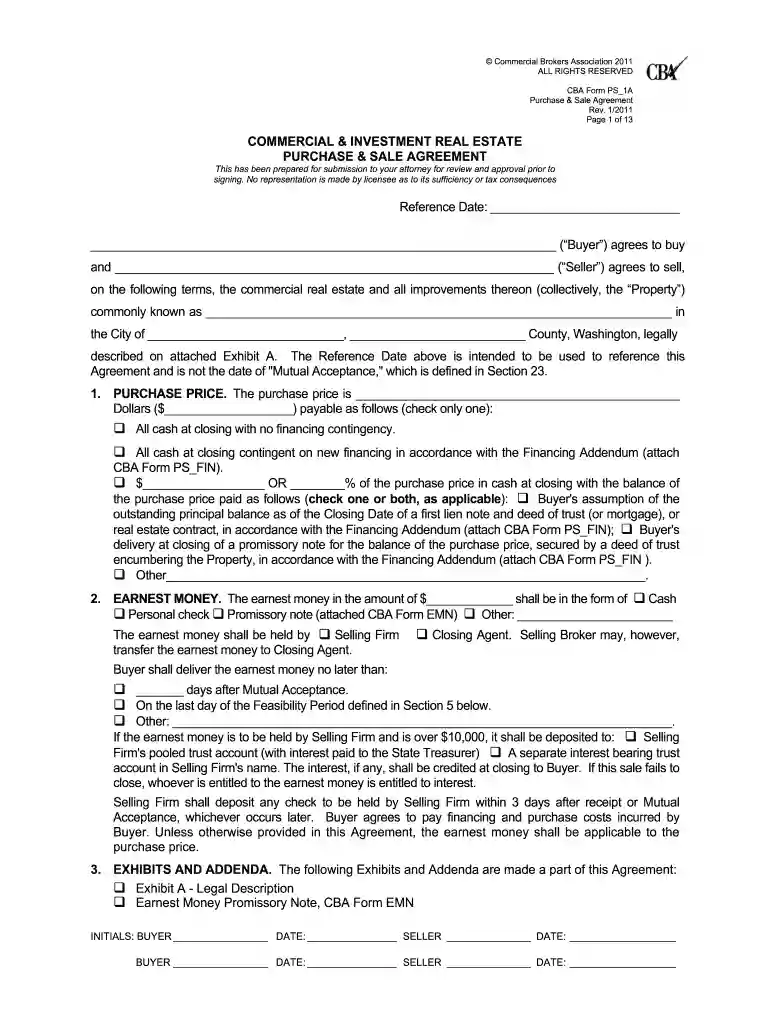
texas commercial real estate contract pdf Preview on Page 1

Here's how it works

01. Edit your texas commercial real estate contract pdf online
Type text, add images, blackout confidential details, add comments, highlights and more.

02. Sign it in a few clicks
Draw your signature, type it, upload its image, or use your mobile device as a signature pad.

03. Share your form with others
Send texas commercial real estate purchase agreement via email, link, or fax. You can also download it, export it or print it out.

How to use or fill out commercial real estate contracts with our platform

Form edit decoration
9.5
Ease of Setup
DocHub User Ratings on G2
9.0
Ease of Use
DocHub User Ratings on G2
  1. Click ‘Get Form’ to open the commercial real estate contract in the editor.
  2. Begin by filling in the 'Reference Date' and details for both the Buyer and Seller, ensuring accuracy as these are crucial for legal purposes.
  3. In the 'Purchase Price' section, specify the total amount and select your payment method. Options include all cash or financing contingencies; make sure to check only one box.
  4. Complete the 'Earnest Money' section by indicating the amount and form of earnest money. Choose who will hold it—either Selling Firm or Closing Agent—and provide a timeline for delivery.
  5. Review and attach any necessary Exhibits and Addenda that apply to your agreement, such as legal descriptions or financing addendums.
  6. Finalize by signing in the designated areas for both Buyer and Seller, ensuring all initials are present where required.

Start using our platform today to streamline your commercial real estate transactions effortlessly!

See more commercial real estate contracts versions

We've got more versions of the commercial real estate contracts form. Select the right commercial real estate contracts version from the list and start editing it straight away!
Versions Form popularity Fillable & printable
2011 4.9 Satisfied (44 Votes)
be ready to get more

Complete this form in 5 minutes or less

Get form

Got questions?

We have answers to the most popular questions from our customers. If you can't find an answer to your question, please contact us.
Contact us
The 3-3-3 rule in real estate refers to different guidelines, most commonly the 30/30/3 rule for buyers (max 30% housing costs, 30% down payment/closing, home price under 3x income), a checklist for buyer readiness (3 months savings, 3 months mortgage payments, 3 property evaluations), or a property evaluation method (past trends, future development, 3 comparables). Theres also a 3-3-3 rule for agents focusing on connection marketing (3 calls, 3 notes, 3 resources) and a 3-30-300 rule for corporate real estate (utilities, rent, payroll). For Buyers (Most Common) 30/30/3 Rule: A financial guideline to prevent overspending. 30% Housing Costs: Total monthly housing costs (mortgage, taxes, insurance) should not exceed 30% of your gross monthly income. 30% Down Payment: Save a 30% down payment plus closing costs. 3x Income: The homes purchase price should be no more than three times your gross annual income. Buyer Readiness Checklist: Ensures youre prepared to buy. 3 months: of emergency savings. 3 months: of mortgage payments saved. 3 property evaluations: before making an offer. For Property Evaluation The 3-Year Check: Analyze the propertys area by looking at. 3 Years Past: Past price trends in the neighborhood. 3 Years Future: Upcoming infrastructure projects (metro, malls). 3 Properties Nearby: Compare with at least three similar properties to avoid overpaying. For Real Estate Agents Connection-First Marketing: A habit-building rule. Call 3 people monthly. Send 3 handwritten notes monthly. Share 3 valuable resources monthly. For financial advice, consult a professional. Agents Shifting to Connection-First Marketing | Florida RealtorsSep 4, 2025| Florida RealtorsHow to Evaluate a Property with the 3-3-3 Rule - LinkedInSep 22, 2025 Manmeeth Jain. Deputy Vice President | Branch Business Head, HDFC Bank Ltd Sharing insights on Real Estate, InvestmentLinkedIn Manmeeth Jain
The four main types of real estate contracts are Purchase Agreements (for buying/selling), Lease Agreements (for renting), Assignment Contracts (transferring contract rights, often in wholesaling), and Power of Attorney (allowing someone to sign on your behalf). These cover different transaction types, from property transfer to temporary occupancy and legal representation. Heres a breakdown of each: Purchase Agreement: A contract between a buyer and seller detailing the terms (price, contingencies, closing date) for a property sale. Lease Agreement: An agreement between a landlord and tenant for renting property, outlining rent, duration, and rules. Assignment Contract: Transfers rights (like the right to buy) from one party to another, common in real estate investing. Power of Attorney (POA): Grants someone else the legal authority to act on your behalf in real estate transactions, useful if you cant be present. Other related real estate contracts include Listing Agreements (with agents) and Option Contracts, but the four above are foundational for transactions. AI can make mistakes, so double-check responsesWhat Are the Four Types of Real Estate Contracts? - MVSK Law FirmFeb 7, 2023 The four types of real estate contracts include purchase agreements, assignment contracts, lease agreements, and power Mazzoni Valvano Szewczyk Karam4 Types of Real Estate Contracts for Beginners | MashvisorJul 9, 2019Mashvisor
This rule of thumb uses the same idea as the 1% rule. However, The 2% rule suggests that a rental property is a good investment if the money from rent each month is equal to or higher than 2% of the purchase price. How useful is the 2 percent rule? These days, its almost completely obsolete and rarely used.
The 7 essential rules (or elements) for a valid contract are Offer, Acceptance, Consideration, Intention (to create legal relations), Capacity, Legality, and often Certainty of Terms, ensuring mutual understanding and a legal purpose for the agreement. These components ensure both parties agree freely, understand their obligations, and the contract serves a lawful purpose, making it enforceable in court. Here are the 7 key rules: Offer: One party makes a clear proposal to another. Acceptance: The other party unequivocally agrees to the terms of the offer. Consideration: Something of value (money, goods, services, promises) exchanged between parties, forming the bargained-for exchange. Intention: Both parties must intend for the agreement to be legally binding. Capacity: Parties must be legally competent (e.g., of sound mind, legal age). Legality: The contracts purpose must be lawful and not against public policy. Certainty of Terms: The terms must be clear and definite so obligations are understood by all. When all these elements are present, a contract becomes a legally enforceable agreement, protecting the rights and responsibilities of those involved. For legal advice, consult a professional. 7 Essential Elements of A Contract - LegalSifterThe contract provides assurance that the parties will perform the roles and responsibilities as intended, and provides some protecLegalSifterEssential Elements of a Contract: The Guide for 2025 - ConcordMay 30, 2025 The seven essential elements of a contract are: * Offer. * Acceptance. * Consideration. * Legally competent parties. Concord
The 2% rule in commercial real estate is a quick screening tool stating that a rental propertys monthly gross rent should be at least 2% of its purchase price (including initial improvements), indicating potential profitability and positive cash flow. For example, a property bought for $200,000 should generate at least $4,000 in monthly rent ($200,000 x 0.02). While useful as a starting point, its a simplified guideline, not a definitive measure, as it doesnt account for specific expenses like taxes, insurance, maintenance, or vacancy rates, which require deeper analysis. How it works Formula: Monthly Rent (Property Purchase Price + Initial Repairs/Improvements) x 0.02 Example: A $300,000 property needs to generate $6,000 or more in monthly rent to meet the 2% rule. Key considerations Screening tool: It helps investors quickly filter out potentially poor investments before diving into detailed financial analysis. Cash flow indicator: Meeting the rule suggests enough income to cover expenses and provide a healthy return. Limitations: Its a rough estimate and doesnt replace a thorough analysis of property taxes, insurance, maintenance, vacancy, and financing. Market dependent: The rule is more applicable to lower-priced properties or markets where high rents relative to purchase prices are common, like some Midwest/Southern areas, and less so in high-cost markets. AI can make mistakes, so double-check responsesThe 1% and 2% Rules in Commercial Real EstateWhat is the 2% rule in commercial real estate? The 2% rule is a rule of thumb used by commercial real estate investors to quickly Commercial Real Estate LoansWhat is the 2% Rule in Real Estate? | ArrivedJan 23, 2023 The 2% rule is a fast way to guess cash flow potential and is a benchmark when evaluating investment opportunities. HoArrived

Security and compliance

At DocHub, your data security is our priority. We follow HIPAA, SOC2, GDPR, and other standards, so you can work on your documents with confidence.


Learn more
ccpa2
pci-dss
gdpr-compliance
hipaa
soc-compliance

People also ask

Fractional ownership pitfalls include difficult decision-making, usage conflicts, illiquidity (hard to sell shares), shared liability, higher overall costs (fees, maintenance), limited control, and potential family disputes, requiring strong agreements, professional management, and realistic expectations about shared responsibility and selling challenges. Management Decision-Making Consensus Required: Agreeing on renovations, maintenance, or management policies can be difficult with multiple owners. Limited Control: Individual owners have less say in property management compared to full owners. Unfair Systems: First-come, first-served or random systems for scheduling usage often lead to frustration and unfairness over time. This video explains some common pitfalls of fractional ownership: 1mClark Howard: Save More, Spend LessYouTube Oct 3, 2025Financial Legal Issues Shared Liability: Owners are typically liable for property injuries or debts, even if not directly responsible. Difficult to Sell: Finding buyers for a share, agreeing on a fair price, and navigating restrictions can make selling challenging. Illiquidity: The market for selling fractional shares is often limited. Financing Challenges: Fewer lenders offer mortgages for fractionally owned properties. Hidden Costs: Expenses like hurricane risk, taxes, and ongoing fees can exceed initial expectations. This video discusses potential financing problems with fractional ownership: 57sExpertVillage Leaf GroupYouTube Dec 10, 2020Usage Conflict Schedule Conflicts: Coordinating usage times with other owners can be complex. Family Disputes: For family properties, differing needs and opinions can worsen existing conflicts. Uncertainty: Lack of guaranteed, desirable usage dates can be a major drawback. Key Solutions (How to Avoid Pitfalls) Formal Agreements: Use LLCs or strong contracts to define roles, responsibilities, and exit strategies. Professional Management: Hire a third-party manager for maintenance and operations to reduce conflict. Compromise: Be willing to put group needs above personal desires. Defined Term: Set an end date for the ownership agreement. AI can make mistakes, so double-check responsesThe 7 Deadly Sins of Fractional OwnershipSep 13, 2025Plum CoOwnershipFractional Ownership Pitfalls: The 4 Risks No One Talks About - WebStreetWebStreet
Examples of commercial contracts Joint venture agreement. Shareholders agreement. Business purchase agreement. Purchase and supply agreement. Sale and distribution agreement. Franchise agreement. Non-disclosure agreement. Employment contracts. Dec 13, 2024
The 2% rule is a rule of thumb used by commercial real estate investors to quickly and easily understand the risk and opportunity present in acquiring a property. The rule is calculated by taking 2% of the total sale price plus any immediate and necessary improvements or repairs.

commercial real estate contracts