01. Edit your petition to administer estate online
Type text, add images, blackout confidential details, add comments, highlights and more.

02. Sign it in a few clicks
Draw your signature, type it, upload its image, or use your mobile device as a signature pad.

03. Share your form with others
Send petition for letters of administration california via email, link, or fax. You can also download it, export it or print it out.

How to use or fill out petition administer estate with our platform
Ease of Setup
DocHub User Ratings on G2
Ease of Use
DocHub User Ratings on G2
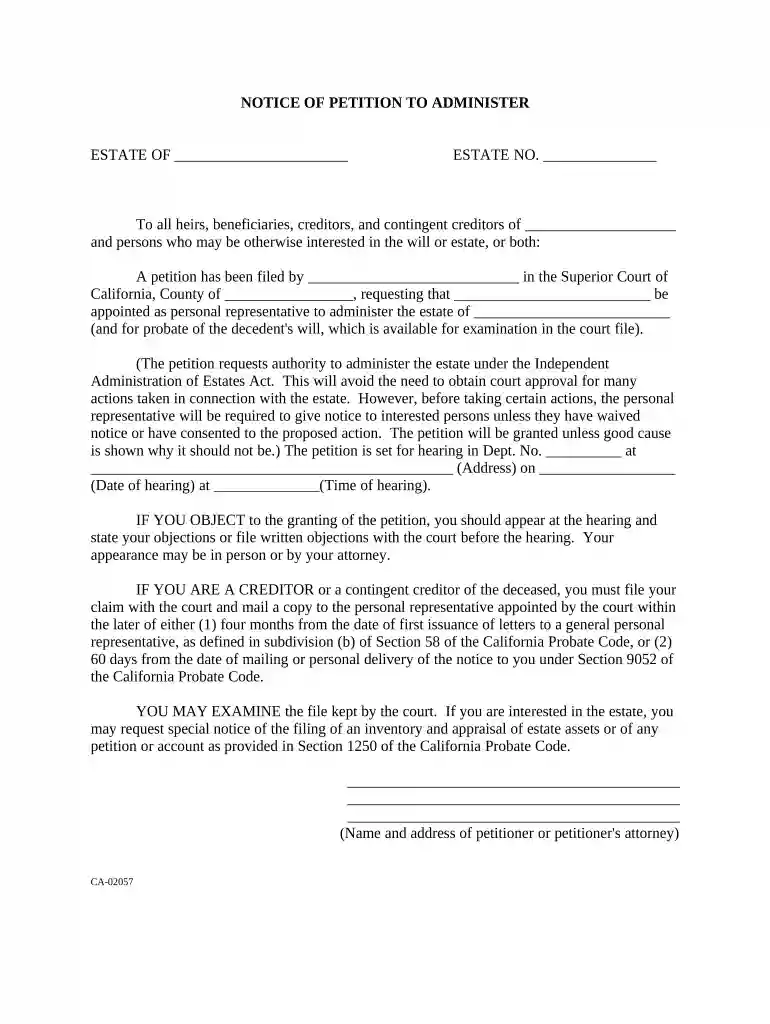
Click ‘Get Form’ to open the petition administer estate document in the editor.
Begin by filling in the name of the decedent in the designated field. This is crucial as it identifies whose estate is being administered.
Next, enter the estate number provided by the court. This number helps track the case and ensures proper documentation.
In the section for petitioner details, input your name and address, or that of your attorney if applicable. This information is essential for communication regarding the petition.
Specify the date, time, and location of the hearing. Ensure accuracy as this informs interested parties when they can voice objections.
Review all fields for completeness and accuracy before saving or exporting your completed form. This step is vital to avoid delays in processing.
Start using our platform today to streamline your petition process for free!
Fill out petition administer estate online It's free
How much does it cost to file a probate petition in California?
California probate court filing fees According to California Government Code 70650(a), the initial filing fee to petition for letters of administration or testamentary is $435. Additionally, executors must cover the final distribution fee, set at $435 under GC 70650(c).
What does it mean to administer an estate?
Estate administration is the process of winding up a persons financial dealings after they die and then distributing that persons property to the people that inherit it.
How to administer an estate in California?
Administer the estate Take inventory: The personal representative gathers the assets and prepares an Inventory and Appraisal (form DE-160) to be filed. Notice to creditors and pay debts: The personal representative must provide formal notice to creditors with the Notice of Administration to Creditors (form DE-157).
What does it mean to petition an estate?
If a person dies intestate, meaning without a Will, a petition for administration is filed. This petition initiates the process of estate administration. The Register of Wills will appoint an administrator, usually a close relative, to manage and distribute the decedents estate according to state intestacy laws.
What is a petition to administer an estate in California?
The Petition for Probate requests that (name): be appointed as personal representative to administer the estate of the decedent. The petition requests the decedents will and codicils, if any, be admitted to probate. The will and any codicils are available for examination in the file kept by the court.
Related Searches
Petition administer estate formPetition for Letters of Administration PennsylvaniaPetition for Grant of Letters Pennsylvania instructionsPetition for probate PennsylvaniaPetition for grant of Letters of AdministrationPetition for probate without a willPETITION for probate and grant of Letters TestamentarySample Petition for probate of Will
Security and compliance
At DocHub, your data security is our priority. We follow HIPAA, SOC2, GDPR, and other standards, so you can work on your documents with confidence.
How much does an administrator of an estate get paid in California?
According to the California Probate Code section 10800, the executor receives a percentage of the estate. For example, the executor is entitled to 4% of the first $100,000 of the estate, then 3% of the next $100,000, and 2% of the next $800,000.
Related links
25 CFR 11.703 - Petition and order to probate estate.
(a) Any person having an interest in the administration of an estate which is subject to the jurisdiction of the court may file a written petition with the
Cookie consent notice
This site uses cookies to enhance site navigation and personalize your experience.
By using this site you agree to our use of cookies as described in our Privacy Notice.
You can modify your selections by visiting our Cookie and Advertising Notice.