Living Trust for individual, Who is Single, Divorced or Widow (or Widower) with Children - Iowa 2026

Get Form
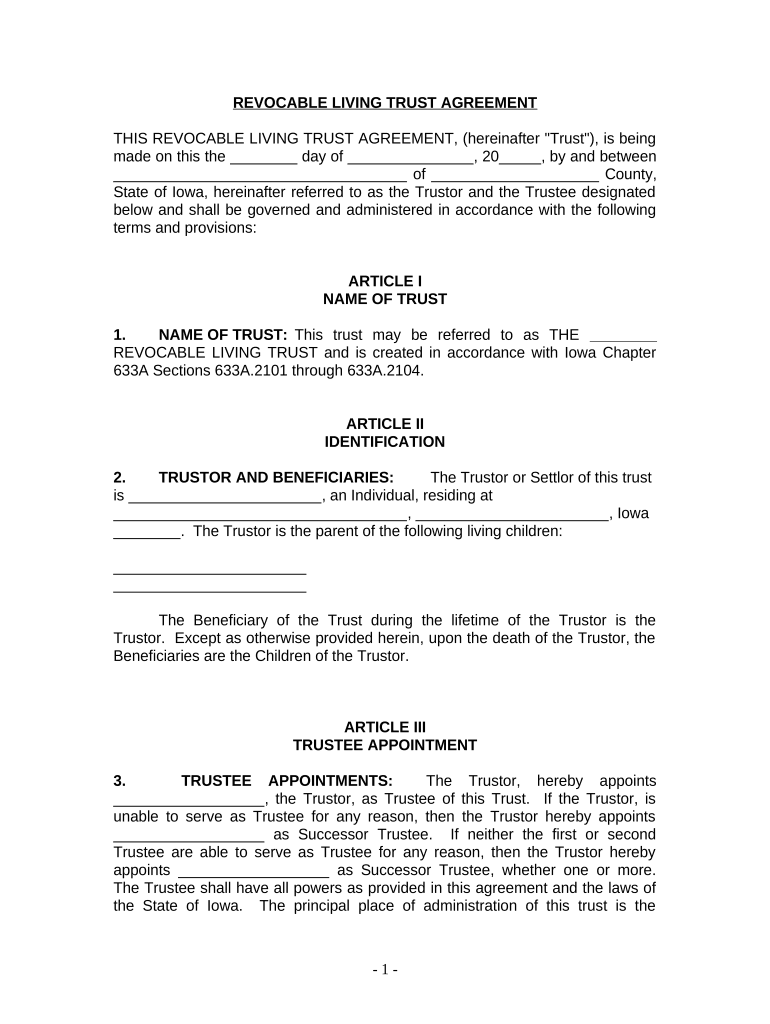
Living Trust for individual, Who is Single, Divorced or Widow (or Widower) with Children - Iowa Preview on Page 1

Here's how it works

01. Edit your form online
Type text, add images, blackout confidential details, add comments, highlights and more.
02. Sign it in a few clicks
Draw your signature, type it, upload its image, or use your mobile device as a signature pad.
03. Share your form with others
Send it via email, link, or fax. You can also download it, export it or print it out.

How to use or fill out Living Trust for individual, Who is Single, Divorced or Widow (or Widower) with Children - Iowa

Form edit decoration
9.5
Ease of Setup
DocHub User Ratings on G2
9.0
Ease of Use
DocHub User Ratings on G2
  1. Click ‘Get Form’ to open it in the editor.
  2. Begin by entering the name of the Trust on the designated line. This should reflect your chosen title for the trust.
  3. Fill in your personal details as the Trustor, including your full name and address. Ensure accuracy as this identifies you legally.
  4. List your children under the section for Beneficiaries. This is crucial as they will inherit from the trust upon your passing.
  5. Designate a Trustee by entering their name. If applicable, also provide names for Successor Trustees to ensure continuity in management.
  6. Detail any assets you wish to include in the trust on Schedule A. This can encompass real estate, bank accounts, and other valuables.
  7. Review all entries for accuracy and completeness before saving or printing your document.

Start using our platform today to create your Living Trust effortlessly and for free!

be ready to get more

Complete this form in 5 minutes or less

Get form

Got questions?

We have answers to the most popular questions from our customers. If you can't find an answer to your question, please contact us.
Contact us
The surviving spouse must be the sole beneficiary of a marital trust. Once the surviving spouse dies, the assets in the trust typically pass to surviving children. A marital trust also involves the principal, which are assets initially put into the trust.
For the most part, you are unable to completely avoid paying taxes on living trusts. The trust remains part of the grantors taxable estate, and any income earned by trust assets is taxed to the grantor. Potential for legal disputes.
If youre single, the two most important reasons for establishing a living trust is that it helps your beneficiaries to avoid the costs and hassles of probate and will keep your assets out of court-supervised guardianship.
Only the Survivors trust typically remains revocable by the surviving trustor. The terms of the other sub-trust(s) become irrevocable, with some exceptions for powers of appointment or the surviving spouses living needs, etc.
The trust becomes irrevocable upon the death of the decedent-grantor, or. The trust was created by will, and the trustee is required to distribute all the net assets in trust or free of trust to both charitable and noncharitable beneficiaries.

Security and compliance

At DocHub, your data security is our priority. We follow HIPAA, SOC2, GDPR, and other standards, so you can work on your documents with confidence.

Learn more
ccpa2
pci-dss
gdpr-compliance
hipaa
soc-compliance

People also ask

A widows trust is a testamentary trust created to protect the surviving spouse, who may be financially illiterate or may not be able to manage the funds inherited. The spouse must be the sole income beneficiary of the Trust for the duration of their lifetime.
Creating a living trust in Iowa occurs when you create a trust document and sign it in front of a notary public. You then transfer ownership of your assets into the trust to complete the process. A living trust is a useful way to maintain control over your assets and plan for the future.

Related links