Renunciation And Disclaimer of Joint Tenant or Tenancy Interest - Wisconsin 2026

Get Form
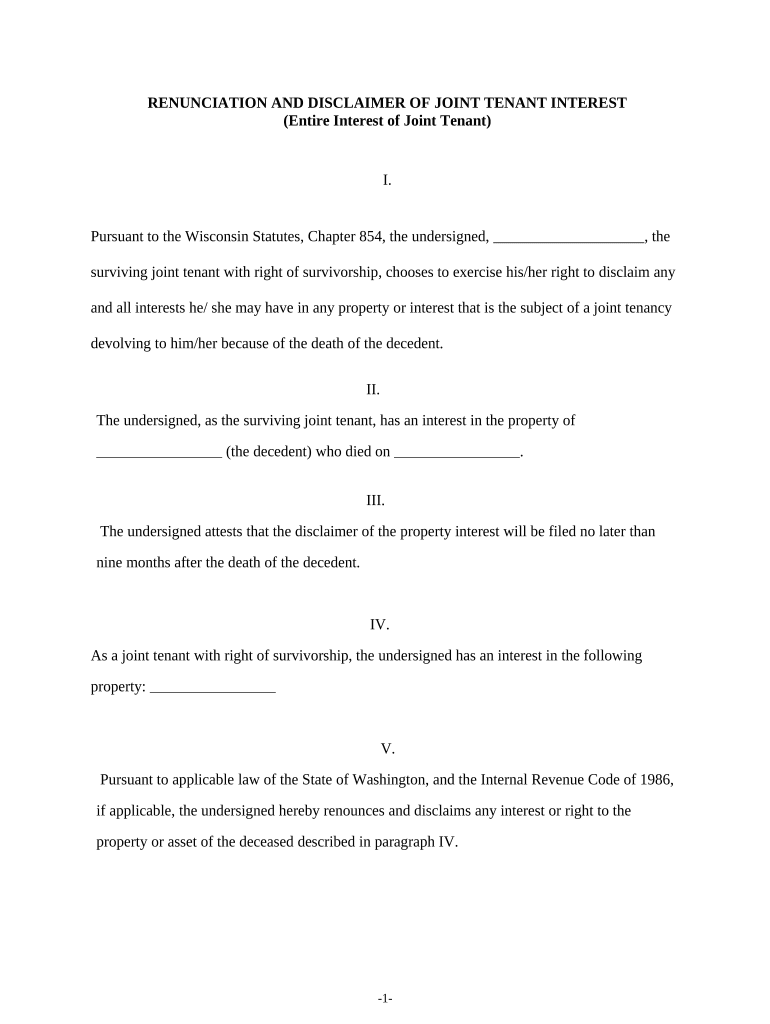
Renunciation And Disclaimer of Joint Tenant or Tenancy Interest - Wisconsin Preview on Page 1

Here's how it works

01. Edit your form online
Type text, add images, blackout confidential details, add comments, highlights and more.
02. Sign it in a few clicks
Draw your signature, type it, upload its image, or use your mobile device as a signature pad.
03. Share your form with others
Send it via email, link, or fax. You can also download it, export it or print it out.

How to use or fill out Renunciation And Disclaimer of Joint Tenant or Tenancy Interest - Wisconsin with DocHub

Form edit decoration
9.5
Ease of Setup
DocHub User Ratings on G2
9.0
Ease of Use
DocHub User Ratings on G2
  1. Click ‘Get Form’ to open it in the editor.
  2. Begin by entering your name in the first blank space, identifying yourself as the surviving joint tenant.
  3. In the next section, provide the name of the decedent and their date of death. This information is crucial for establishing context.
  4. Ensure you attest that you will file this disclaimer within nine months of the decedent's death, as required by Wisconsin law.
  5. Fill in the property details in paragraph IV, specifying what interest you are renouncing.
  6. Review and confirm your understanding that this disclaimer is irrevocable and relates back to the date of death.
  7. Finally, sign and date the document at the bottom, ensuring all necessary fields are completed before submission.

Start using our platform today to easily complete your Renunciation And Disclaimer form for free!

be ready to get more

Complete this form in 5 minutes or less

Get form

Got questions?

We have answers to the most popular questions from our customers. If you can't find an answer to your question, please contact us.
Contact us
Risks And Dangers of Joint Tenancy With Right of Survivorship. There are drawbacks to a JTWROS arrangement, including inflexibility. If one co-owner wishes to sell their share, it may dissolve the arrangement, Shirshikov says. Additionally, creditors of one owner can pursue the property, impacting all co-owners.
In community property states like Wisconsin, married couples are allowed to have property as survivorship marital property or community property with right of survivorship. What this means is, if one spouse passes away the remaining spouse is to receive the dead spouses half of the marital property.
On the death of one of 2 joint tenants, the survivor becomes the sole owner; on the death of one of 3 or more joint tenants, the survivors are joint tenants of the entire interest.
Joint tenants have an equal share in the ownership of an asset. If a joint tenant dies, the other tenant (or tenants) has a right of survivorship. The deceased tenants interest is not an asset of their estate.
Upon the death of a joint tenant, a surviving joint tenant may disclaim any property that would otherwise accrue to him or her by right of survivorship and that is the subject of the joint tenancy by delivering a written instrument of disclaimer under this section.

Security and compliance

At DocHub, your data security is our priority. We follow HIPAA, SOC2, GDPR, and other standards, so you can work on your documents with confidence.

Learn more
ccpa2
pci-dss
gdpr-compliance
hipaa
soc-compliance

People also ask

Thus, a surviving joint tenant may disclaim the one-half survivorship interest in property that the joint tenant held either in joint tenancy with right of survivorship or in tenancy by the entirety, within 9 months of the death of the first joint tenant to die.

Related links