Wisconsin property agreement 2026

Get Form
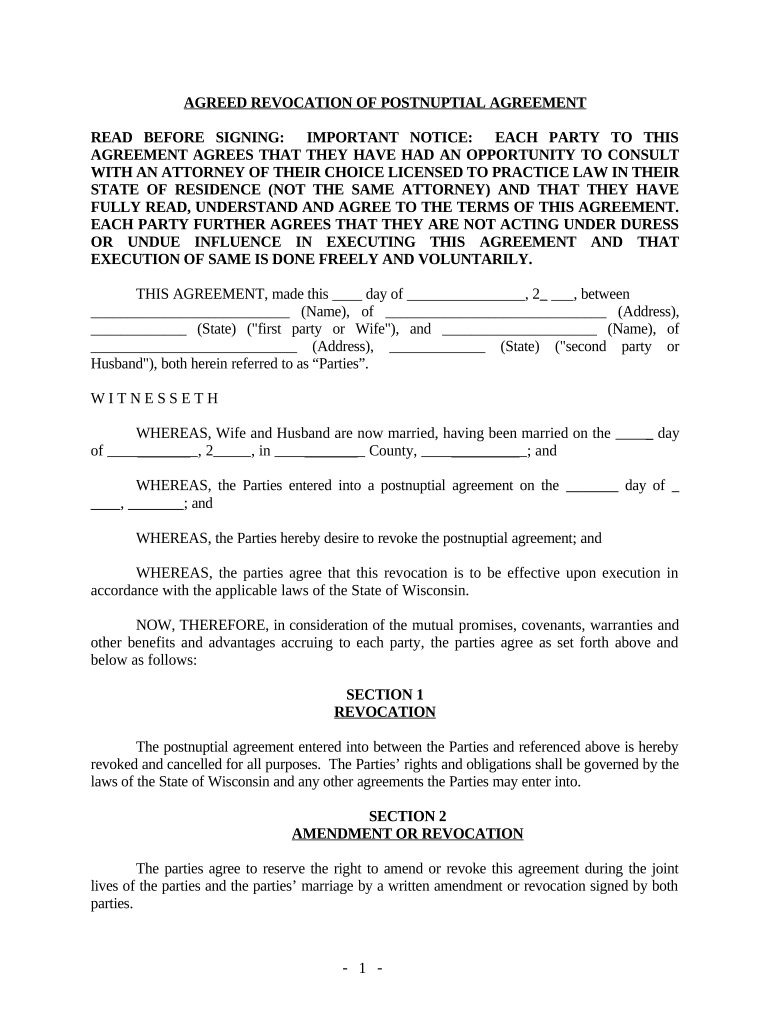
wisconsin property agreement Preview on Page 1

Here's how it works

01. Edit your form online
Type text, add images, blackout confidential details, add comments, highlights and more.
02. Sign it in a few clicks
Draw your signature, type it, upload its image, or use your mobile device as a signature pad.
03. Share your form with others
Send it via email, link, or fax. You can also download it, export it or print it out.

How to use or fill out Wisconsin Property Agreement

Form edit decoration
9.5
Ease of Setup
DocHub User Ratings on G2
9.0
Ease of Use
DocHub User Ratings on G2
  1. Click ‘Get Form’ to open the Wisconsin Property Agreement in our editor.
  2. Begin by entering the date of the agreement at the top of the form. This is crucial for establishing the timeline of your revocation.
  3. Fill in the names and addresses of both parties involved. Ensure that you accurately represent each party as 'Wife' and 'Husband' for clarity.
  4. In Section 1, confirm the revocation of the postnuptial agreement by checking that all details are correct and clearly stated.
  5. Review Section 2 regarding amendment or revocation rights. Make sure both parties understand their ability to amend this agreement in writing if needed.
  6. In Section 3, acknowledge that both parties entered into this agreement voluntarily without any undue influence. This section reinforces fairness in your agreement.
  7. Complete Sections 4 and 5, ensuring that you understand how this revocation will be governed under Wisconsin law and its binding nature on successors.
  8. Finally, sign and date the document where indicated, and ensure it is notarized as required for legal validity.

Start using our platform today to easily complete your Wisconsin Property Agreement online for free!

be ready to get more

Complete this form in 5 minutes or less

Get form

Got questions?

We have answers to the most popular questions from our customers. If you can't find an answer to your question, please contact us.
Contact us
By entering into a prenuptial agreement, you can specify which assets will remain separate property and which assets will be considered jointly. This can help protect any assets that you had before the marriage or particular assets that you want to keep separate.
Under Wisconsin statutes, to be considered as surviving, a person must outlive the decedent by at least 120 hours (5 days). Otherwise, the person is treated as though the person predeceased the decedent.
In Wisconsin, all property owned by either spouse, including assets acquired before the marriage, is considered marital property and is subject to a presumed 50/50 split in a divorce.
Wisconsin is a marital property state, also called a community property state. This means that any assets or debts acquired or shared during the marriage are owned equally by both parties. Some key exceptions include inherited property, gifted property, and assets excluded through a prenuptial agreement.
A Marital Property Agreement is a legal contract between spouses that outlines how assets and debts will be divided in the event of divorce, separation, or death.

Security and compliance

At DocHub, your data security is our priority. We follow HIPAA, SOC2, GDPR, and other standards, so you can work on your documents with confidence.

Learn more
ccpa2
pci-dss
gdpr-compliance
hipaa
soc-compliance

People also ask

The court cannot enforce a prenup if there is proof that any of the following occurred: The prenup was not signed voluntarily. A spouse did not disclose all their assets or financial obligations. The prenup was unreasonable or unfair when it was made.
Wisconsin is a community property state, meaning all assets and debts a person owns, whether they were acquired before or during the marriage, are considered marital property.
What is considered non-marital property in Wisconsin? Non-marital property is property acquired before the marriage or through an inheritance. Something like an inheritance can be commingled if it is put into a jointly held account or used to buy a marital asset.

Related links