Type text, add images, blackout confidential details, add comments, highlights and more.
02. Sign it in a few clicks
Draw your signature, type it, upload its image, or use your mobile device as a signature pad.
03. Share your form with others
Send it via email, link, or fax. You can also download it, export it or print it out.
How to use or fill out Permission to Use Student's Work with DocHub
Ease of Setup
DocHub User Ratings on G2
Ease of Use
DocHub User Ratings on G2
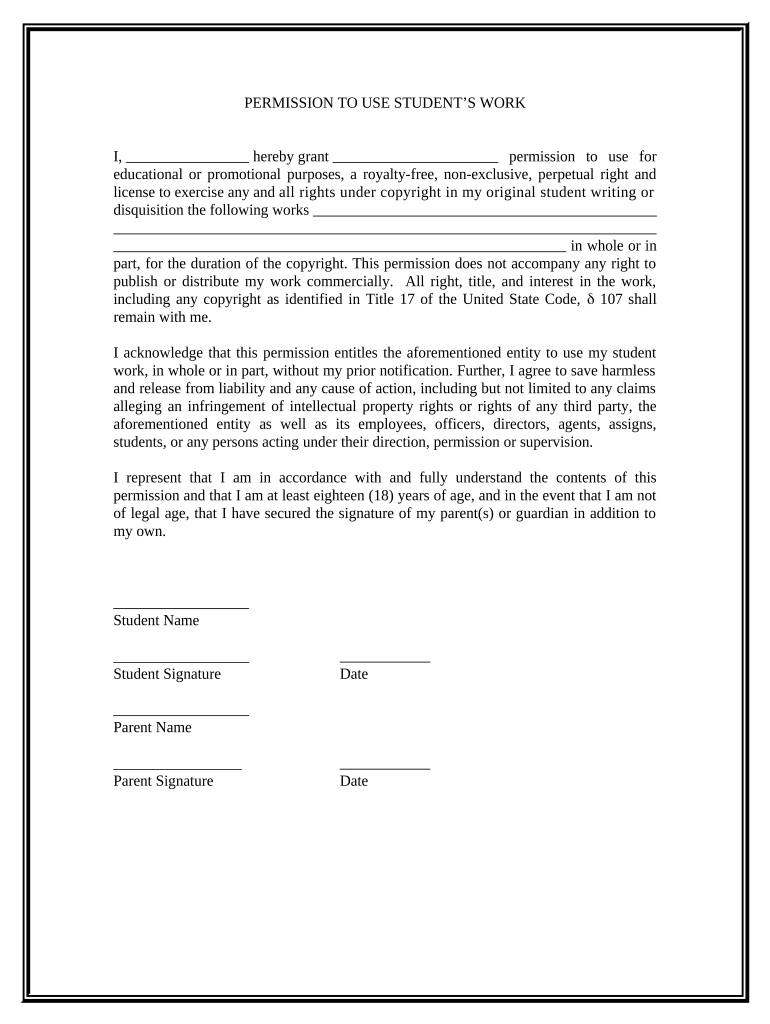
Click ‘Get Form’ to open the Permission to Use Student's Work document in our editor.
Begin by entering your name in the designated field at the top of the form, confirming your identity as the student granting permission.
In the next section, specify the works you are granting permission for. You can list titles or descriptions of your original writing.
Review the terms outlined in the document regarding copyright and liability. Ensure you understand that this permission is non-exclusive and does not allow for commercial distribution.
Sign and date the form in the provided fields. If you are under eighteen, ensure that a parent or guardian also signs where indicated.
Once completed, save your document and share it as needed using our platform’s sharing features.
Start using our platform today to easily fill out and manage your documents for free!
Fill out Permission to Use Student's Work online It's free
Sample permission to use students workPermission to use students work templatePermission to use students work examplePermission to use students work pdf
Security and compliance
At DocHub, your data security is our priority. We follow HIPAA, SOC2, GDPR, and other standards, so you can work on your documents with confidence.
by C Dunbar Cited by 148 In these situations, students have learned to: (1) check their own behavior and judge its appropriateness; (2) talk themselves through a task, using detailed,Read more
Cookie consent notice
This site uses cookies to enhance site navigation and personalize your experience.
By using this site you agree to our use of cookies as described in our Privacy Notice.
You can modify your selections by visiting our Cookie and Advertising Notice.