01. Edit your sample notice of default commercial lease online
Type text, add images, blackout confidential details, add comments, highlights and more.
02. Sign it in a few clicks
Draw your signature, type it, upload its image, or use your mobile device as a signature pad.
03. Share your form with others
Send it via email, link, or fax. You can also download it, export it or print it out.
How to use or fill out Letter from Landlord to Tenant as Notice of Default on Commercial Lease - Washington
Ease of Setup
DocHub User Ratings on G2
Ease of Use
DocHub User Ratings on G2
Click ‘Get Form’ to open it in the editor.
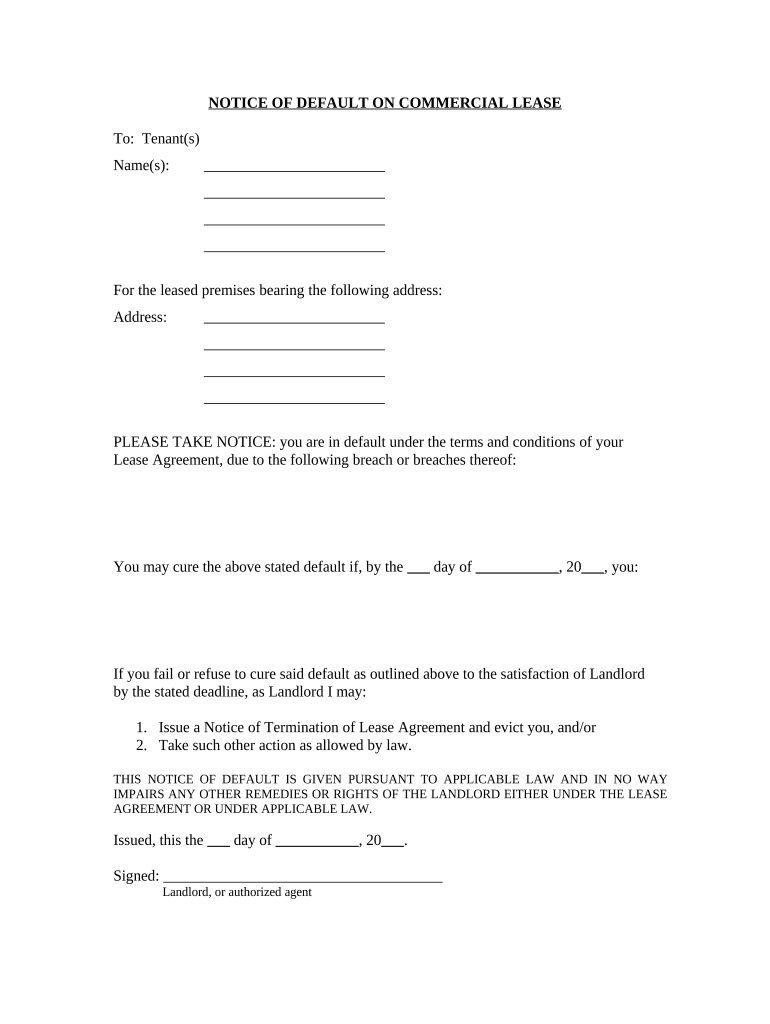
Begin by entering the tenant's name(s) in the designated field at the top of the document. This personalizes the notice and ensures clarity regarding who is being addressed.
Next, fill in the address of the leased premises. This is crucial for identifying the specific property involved in the lease agreement.
In the section detailing breaches, clearly outline the reasons for default under the lease agreement. Be specific to avoid any misunderstandings.
Indicate a deadline by which the tenant must cure the default. Fill in both day and month, along with the year, ensuring that this date is reasonable and compliant with local laws.
Complete the notice by signing it as the landlord or authorized agent. Ensure that you also include the date of issuance at this point.
Start using our platform today to easily edit and manage your documents for free!
Fill out Letter from Landlord to Tenant as Notice of Default on Commercial Lease - Washington online It's free
Notice to terminate tenancy by landlord Washington State90 day notice to terminate tenancy Washington State14-day notice to pay or Vacate template10-day notice to complyHow much notice does a landlord have to give a tenant to move out in Washington StateNotice to vacate from tenant to landlordNo cause eviction Washington State14-day notice to pay or vacate Seattle
Security and compliance
At DocHub, your data security is our priority. We follow HIPAA, SOC2, GDPR, and other standards, so you can work on your documents with confidence.
The landlord shall give the tenant written notice to comply immediately. The notice must state that failure to comply will result in termination of theRead more
Landlord and Tenant Notices - UW Law Digital Commons
by CJ Peck 1956 Cited by 7 If the tenant admits that a certain amount is due and fails to tender even that after notice of the landlords intention to terminate for default in rent, it isRead more
Cookie consent notice
This site uses cookies to enhance site navigation and personalize your experience.
By using this site you agree to our use of cookies as described in our Privacy Notice.
You can modify your selections by visiting our Cookie and Advertising Notice.