Legal Last Will and Testament Form for a Married Person with No Children - Vermont 2026

Get Form
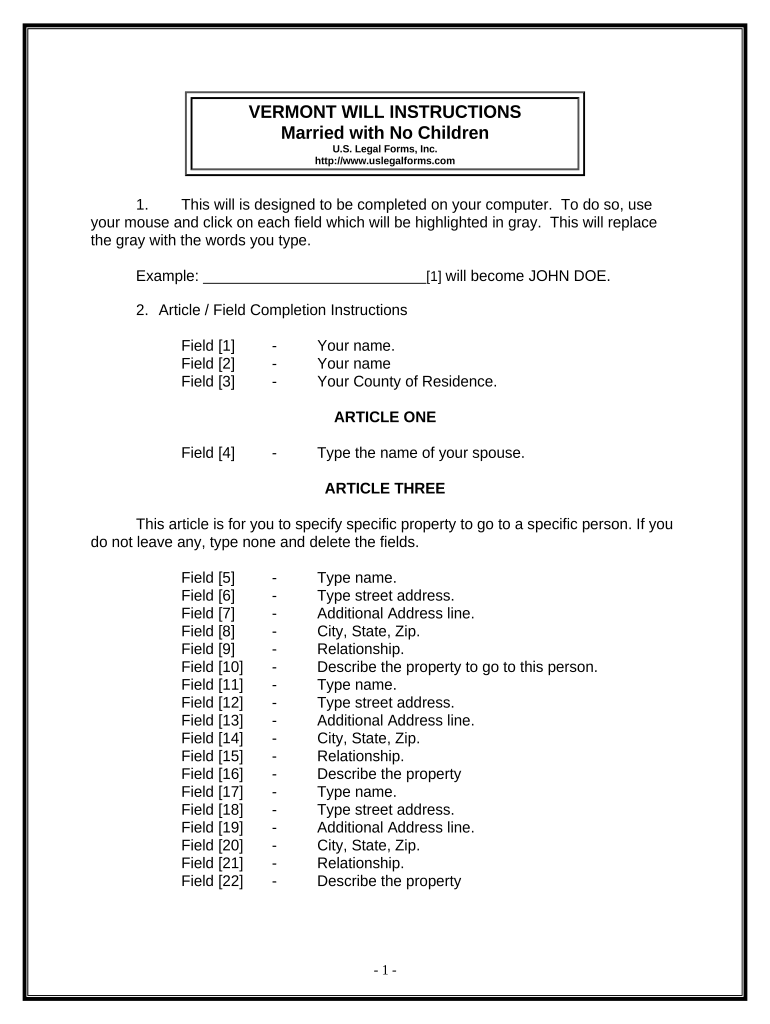
Legal Last Will and Testament Form for a Married Person with No Children - Vermont Preview on Page 1

Here's how it works

01. Edit your form online
Type text, add images, blackout confidential details, add comments, highlights and more.
02. Sign it in a few clicks
Draw your signature, type it, upload its image, or use your mobile device as a signature pad.
03. Share your form with others
Send it via email, link, or fax. You can also download it, export it or print it out.

How to use or fill out Legal Last Will and Testament Form for a Married Person with No Children - Vermont

Form edit decoration
9.5
Ease of Setup
DocHub User Ratings on G2
9.0
Ease of Use
DocHub User Ratings on G2
  1. Click ‘Get Form’ to open it in the editor.
  2. Begin by entering your name in Field [1] and your county of residence in Field [3].
  3. In Article One, specify your spouse's name in Field [4].
  4. For Article Three, list any specific property you wish to bequeath. If none, type 'none' and delete the fields.
  5. In Article Four, indicate your spouse's name again for the homestead designation in Field [23].
  6. Complete Article Five by entering your spouse's name in Field [24] for the residuary clause.
  7. If applicable, fill out Article Six with alternate beneficiaries if your spouse predeceases you.
  8. Designate a Personal Representative in Article Seven by filling Fields [29] and [30].
  9. Review all entries carefully before printing. Ensure you sign the document in front of two witnesses.

Start using our platform today to complete your Legal Last Will and Testament form easily and for free!

be ready to get more

Complete this form in 5 minutes or less

Get form

Got questions?

We have answers to the most popular questions from our customers. If you can't find an answer to your question, please contact us.
Contact us
Do I Need a Lawyer to Make a Will in Vermont? No. You can make your own will in Vermont, using Nolos Quicken WillMaker Trust. However, you might want to consult a lawyer in some situations.
Vermont Inheritance Law and Spouses If you die intestate in Vermont, which is not a community property state, your spouse will inherit everything if you have no children, or if your only descendants are with your spouse. Descendants include children, grandchildren, and great-grandchildren.
Free Resource for Creating a Will FreeWill is a secure, online tool that will take you through the will preparation process step by step. If you have a simple estate, you can print your legal will to be signed and witnessed.
Typically, the estate will pay any estate tax owed, with the beneficiaries receiving assets from the estate free of income taxes (see exception for retirement assets in the chart below). As a beneficiary, if you later sell or earn income from inherited assets, there may be income tax consequences.
Vermont has no inheritance tax, but it does have an estate tax, in addition to the federal estate tax. The estate tax in Vermont affects the estates of state residents, as well as the estates of nonresidents who own tangible personal property, real estate, or income-generating property in the Green Mountain State.

Security and compliance

At DocHub, your data security is our priority. We follow HIPAA, SOC2, GDPR, and other standards, so you can work on your documents with confidence.

Learn more
ccpa2
pci-dss
gdpr-compliance
hipaa
soc-compliance

People also ask

Establish a Revocable Living Trust: A revocable living trust is one of the most powerful tools for avoiding probate. When you create a revocable living trust, you transfer ownership of your assets into the trust, but you retain control over them during your lifetime if you appoint yourself to be the Trustee.
The heirs at law include: a. All living children of the decedent; b. All living grandchildren who are children of any deceased children; and c. All living great grandchildren who are children of deceased grandchildren who are children of deceased children, etc.
(4) The court on its own motion or for cause shown may order service to be made upon any party by a method other than those specified in this subdivision, so long as the method ordered is as calculated to give notice to the party as any other method reasonably available in all the circumstances.

Related links