General Power of Attorney for Care and Custody of Child or Children - Vermont 2026

Get Form
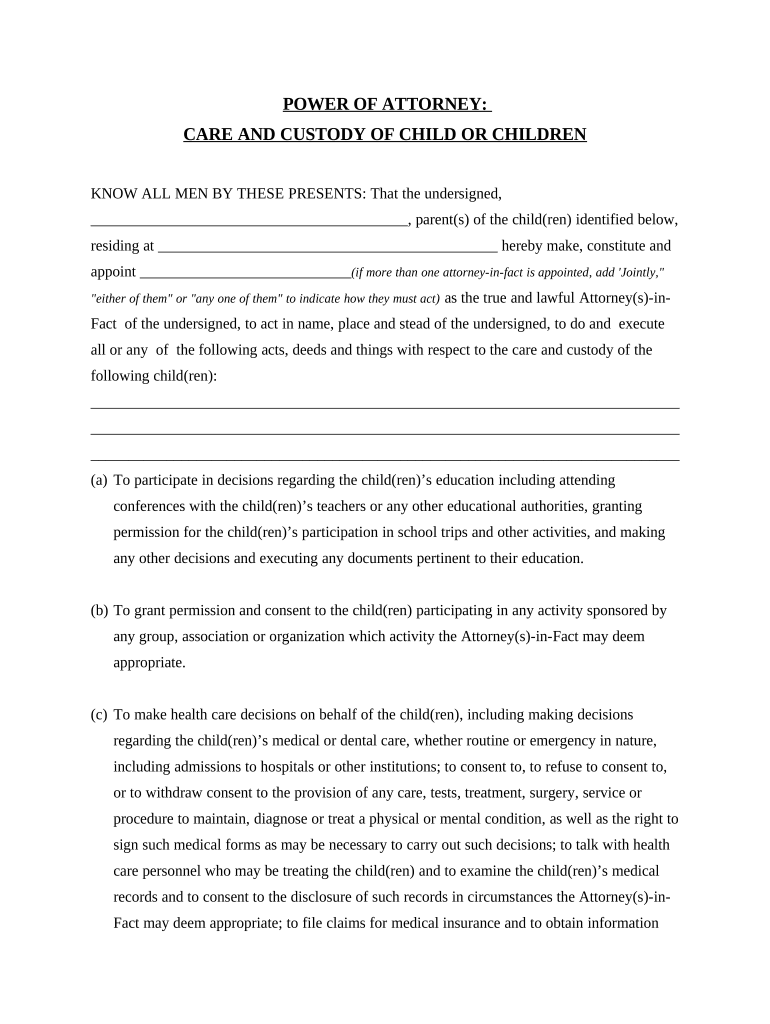
General Power of Attorney for Care and Custody of Child or Children - Vermont Preview on Page 1

Here's how it works

01. Edit your form online
Type text, add images, blackout confidential details, add comments, highlights and more.
02. Sign it in a few clicks
Draw your signature, type it, upload its image, or use your mobile device as a signature pad.
03. Share your form with others
Send it via email, link, or fax. You can also download it, export it or print it out.

How to use or fill out General Power of Attorney for Care and Custody of Child or Children - Vermont

Form edit decoration
9.5
Ease of Setup
DocHub User Ratings on G2
9.0
Ease of Use
DocHub User Ratings on G2
  1. Click ‘Get Form’ to open it in the editor.
  2. Begin by filling in your name as the parent(s) of the child(ren) at the top of the form. Ensure that you provide your current address accurately.
  3. Designate the Attorney-in-Fact by entering their name. If appointing multiple individuals, clarify how they will act (jointly or individually).
  4. List the names of the child(ren) for whom you are granting care and custody powers. Be thorough to avoid any confusion.
  5. Review each section carefully, particularly those regarding education, health care decisions, and general powers. Make sure to check any specific exclusions that apply.
  6. Sign and date the document at the bottom, ensuring that witnesses also sign and provide their addresses as required.
  7. Finally, if necessary, have the document notarized to ensure its validity.

Start using our platform today to easily complete your General Power of Attorney form for free!

be ready to get more

Complete this form in 5 minutes or less

Get form

Got questions?

We have answers to the most popular questions from our customers. If you can't find an answer to your question, please contact us.
Contact us
The POA cannot transfer the responsibility to another Agent at any time. The POA cannot make any legal or financial decisions after the death of the Principal, at which point the Executor of the Estate would take over. The POA cannot distribute inheritances or transfer assets after the death of the Principal.
14, 4005 (2023).) As of July 2023, a witnesss signature isnt required for a Vermont POA to be validunless the POA gives the agent the authority to conduct real estate transactions. In that case, youll need one witness to sign your POA, and youll need to acknowledge your POA before a notary.
In California, there are four main types of POAs, each offering a specific scope of decision-making power: general, durable, limited, and medical. Understanding these distinctions is crucial for selecting the POA that best suits your individual needs: General Power of Attorney.
You should file a motion with the court asking the court to decide who has custody until the Final Order. At the end of the divorce, separation or parentage case there will be a Final Order about physical and legal responsibility (custody).
Although new Section 4005 of the Act (14 VSA 4005) does not explicitly state a power of attorney must be acknowledged before a Notary or other officer authorized to take acknowledgments, the notarial certificate on the statutory power of attorney forms under Sections 4051 and 4052 of the Act (14 VSA 4051 and 4052)

People also ask

When the names of both of a childs parents are listed on their birth certificate in Vermont, which parent will have custody will be based on different factors. If both parents are listed, they will have child custody rights over the child, which means they will have rights to make decisions about their child.
To create a valid power of attorney (POA) in Vermont, you must choose a trusted, competent adult as your agent, specify what authority you want to grant them, and sign the power of attorney document in front of a notary public.
The short answer is: not exactly, but the childs preferences may be considered depending on age, maturity, and circumstances. Vermont courts always prioritize the best interests of the child, and while a childs wishes can be a factor, they are never the sole deciding factor.

Related links