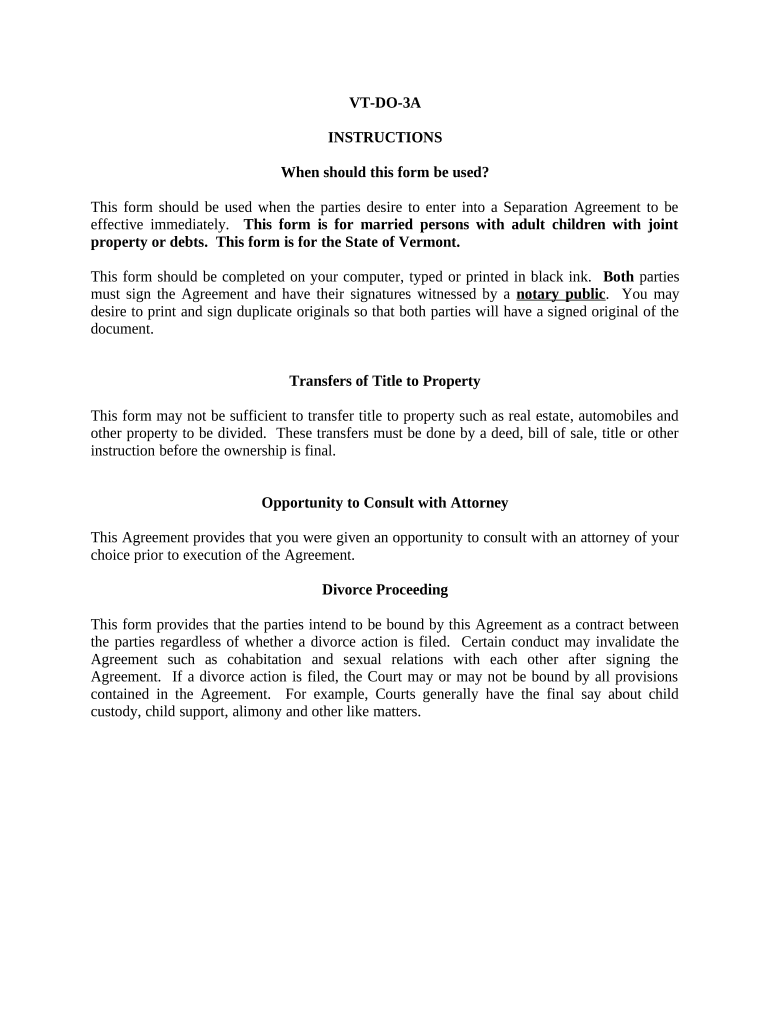
Marital Domestic Separation and Property Settlement Agreement Adult Children Parties May have Joint Property or Debts effective Immediately - Vermont 2026

Get Form
Marital Domestic Separation and Property Settlement Agreement Adult Children Parties May have Joint Property or Debts effective Immediately - Vermont Preview on Page 1

Here's how it works

01. Edit your form online
Type text, add images, blackout confidential details, add comments, highlights and more.
02. Sign it in a few clicks
Draw your signature, type it, upload its image, or use your mobile device as a signature pad.
03. Share your form with others
Send it via email, link, or fax. You can also download it, export it or print it out.

How to use or fill out Marital Domestic Separation and Property Settlement Agreement Adult Children Parties May have Joint Property or Debts effective Immediately - Vermont

Form edit decoration
9.5
Ease of Setup
DocHub User Ratings on G2
9.0
Ease of Use
DocHub User Ratings on G2
  1. Click ‘Get Form’ to open it in the editor.
  2. Begin by entering the full legal names of both parties at the top of the form, ensuring accuracy for legal purposes.
  3. In Section 1, clearly state the date of separation and confirm that both parties agree to live separately without interference.
  4. Proceed to Section 2 to disclose financial information. Each party should list their assets and liabilities honestly.
  5. In Section 3, detail the division of assets. Clearly describe each item and its current fair market value, ensuring both parties initial next to their respective sections.
  6. Move on to Section 4 for debts. Each party must specify which debts they will be responsible for, providing clarity on monthly payments and amounts owed.
  7. Complete Sections 5 through 21 as applicable, ensuring all necessary provisions are included and understood by both parties.
  8. Finally, ensure both parties sign the document in front of a notary public to validate the agreement legally.

Start using our platform today to complete your Marital Domestic Separation Agreement easily and for free!

be ready to get more

Complete this form in 5 minutes or less

Get form

Got questions?

We have answers to the most popular questions from our customers. If you can't find an answer to your question, please contact us.
Contact us
The steps in this Roadmap also generally apply if you want a legal separation. This is a legal status that is different than a divorce. In a legal separation you can divide your finances and property, and plan the custody and support of your children. But you are still married and you cannot marry someone else.
Vermont Is an Equitable Distribution State Unlike community property states, where marital assets are divided 50/50, Vermont follows equitable distribution rules. That means the court aims for a division of property that is fair, but not necessarily equal.
Under Vermont divorce laws, a fault-based divorce will be granted for the following reasons: adultery. imprisonment for at least 3 years. intolerable severity (behavior that is a present and imminent danger to the health of the other spouse)
Unlike some states, which separate separate property, Vermont law considers everything owned by both spouses at the time of the marriage to belong to the marital estate. This can include: Wages and income earned during the marriage. Bank accounts, joint and separate.
The Right to Receive Spousal Maintenance The court may order compensatory (long-term) maintenance, or rehabilitative maintenance (short-term). The court decides whether to award spousal maintenance, which kind to award, and how much to award based on the facts of each case.

Security and compliance

At DocHub, your data security is our priority. We follow HIPAA, SOC2, GDPR, and other standards, so you can work on your documents with confidence.

Learn more
ccpa2
pci-dss
gdpr-compliance
hipaa
soc-compliance

People also ask

Yes. The divorce divides everything you have, no matter whose name it is in, or who brought it to the marriage, or who earned the money to pay for it. Thats the rule of thumb. The judge has some flexibility, however.

Related links