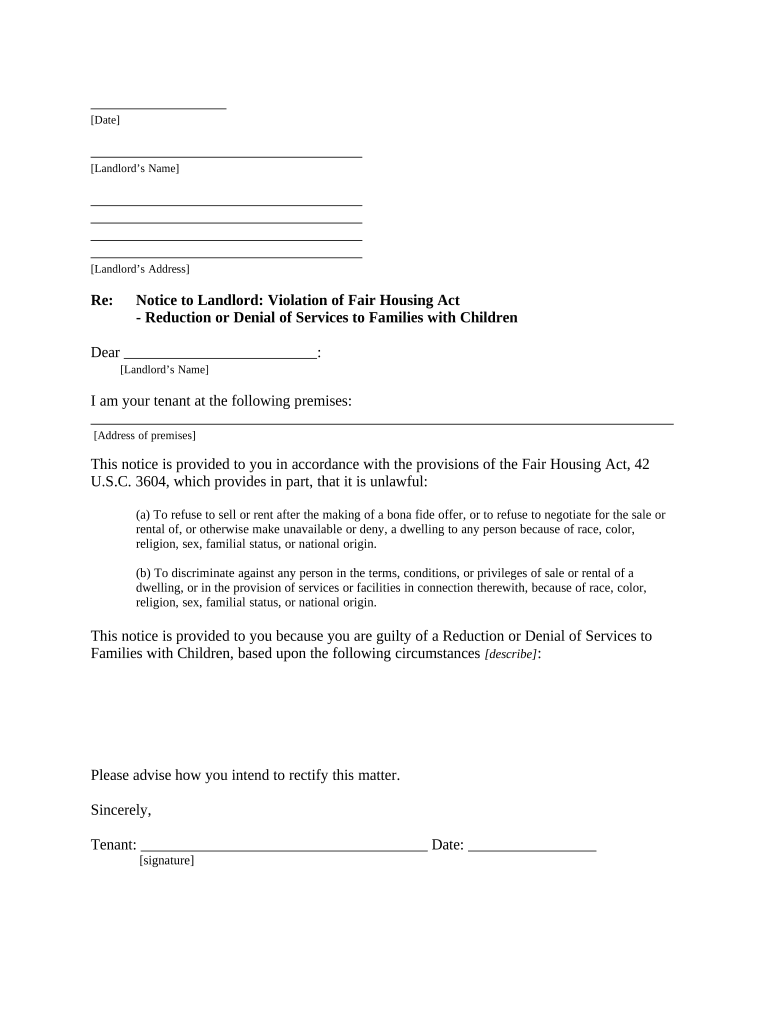
Letter from Tenant to Landlord about Fair Housing Reduction or Denial of services to Family with Children - Virginia 2026

Get Form
virginia fair housing law extends protection beyond the groups protected by the federal law which of the following is not protected under virginia law or federal law Preview on Page 1

Here's how it works

01. Edit your virginia fair housing law extends protection beyond the groups protected by the federal law which of the following is not protected under virginia law or federal law online
Type text, add images, blackout confidential details, add comments, highlights and more.
02. Sign it in a few clicks
Draw your signature, type it, upload its image, or use your mobile device as a signature pad.
03. Share your form with others
Send which of the following is not a protected class under federal or virginia fair housing laws via email, link, or fax. You can also download it, export it or print it out.

How to use or fill out Letter from Tenant to Landlord about Fair Housing Reduction or Denial of services to Family with Children - Virginia

Form edit decoration
9.5
Ease of Setup
DocHub User Ratings on G2
9.0
Ease of Use
DocHub User Ratings on G2
  1. Click ‘Get Form’ to open it in the editor.
  2. Begin by entering the date at the top of the document. This sets a clear timeline for your notice.
  3. Fill in the landlord’s name and address in the designated fields. Ensure accuracy to facilitate proper communication.
  4. In the greeting, address your landlord directly using their name, which personalizes your message.
  5. Provide your address as the tenant in the specified section. This confirms your identity and residence.
  6. Clearly state the violation of the Fair Housing Act by summarizing relevant points from the act. Use concise language for clarity.
  7. Describe specific circumstances that led to this notice under 'Reduction or Denial of Services.' Be factual and detailed.
  8. Request a response from your landlord on how they plan to rectify this issue, encouraging prompt action.
  9. Sign and date at the bottom of the letter, ensuring you have a record of when it was sent.
  10. Complete the Proof of Delivery section by selecting how you delivered this notice and signing it accordingly.

Start using our platform today to easily fill out and manage your important documents for free!

be ready to get more

Complete this form in 5 minutes or less

Get form

Got questions?

We have answers to the most popular questions from our customers. If you can't find an answer to your question, please contact us.
Contact us
Today, the law makes it illegal to discriminate against someone simply because they have children. This applies to practically all housing transactions renting, leasing, selling, or even lending for a home​ nar.
In 1988, the Federal Fair Housing Act of 1968 was amended to protect pregnant women and families with children from discrimination in the housing market.
The seven federally protected classes under the Fair Housing Act are race, religion, national origin, color, familial status (the presence of children under the age of 18 in a household), sex, and disability.
In the Sale and Rental of Housing: Refuse to rent or sell housing. Refuse to negotiate for housing. Otherwise make housing unavailable. Set different terms, conditions or privileges for sale or rental of a dwelling. Provide a person different housing services or facilities.
Under the Federal Fair Housing Act and the California Fair Employment Housing Act, familial status discrimination is defined as unfair treatment by a housing provider because an individual has children.

People also ask

Federal, state, and local laws prohibit racial and other discrimination in housing. Nonetheless, discrimination persists and can be difficult to prove. Winning a case may require good documentation and patience. Fair housing groups can render assistance.
Exemptions. The Fair Housing Act covers most housing. In some circumstances, the act exempts owner occupied buildings with no more than four units, single family housing sold or rented without the use of a broker, and housing operated by organizations and private clubs that limit occupancy to members.
Additionally, California law does not specify a strict age at which a child is considered an occupant, leaving some discretion to landlords and local jurisdictions.

Related links