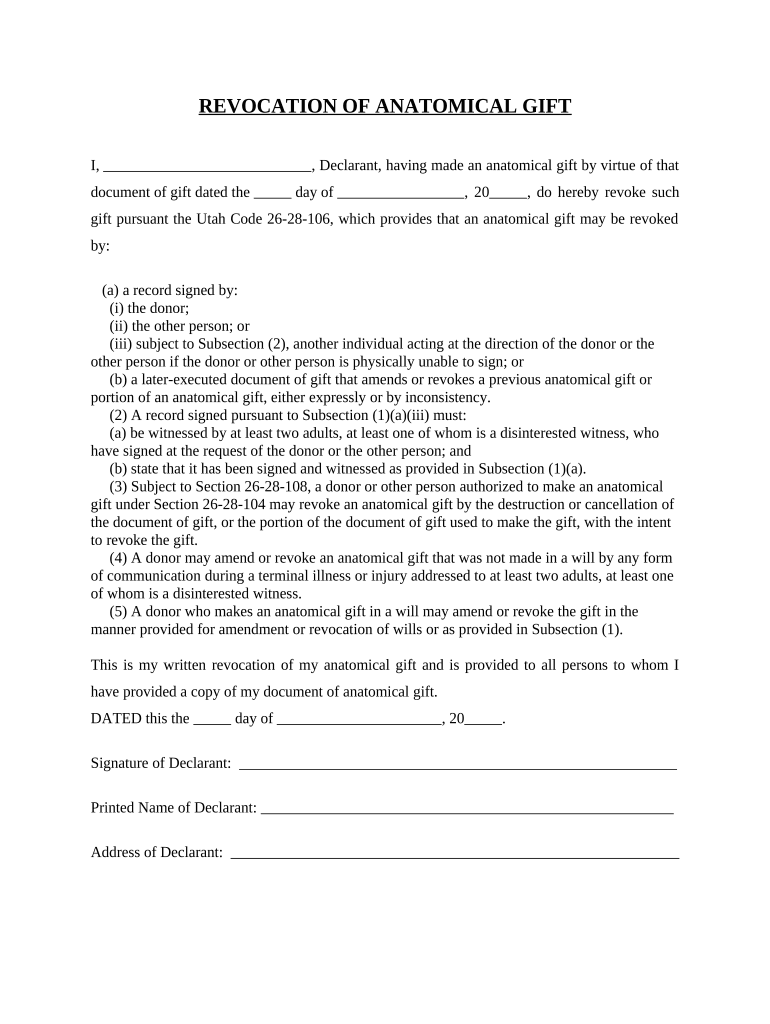


Revocation of Anatomical Gift Donation - Utah 2026

Get Form
Revocation of Anatomical Gift Donation - Utah Preview on Page 1

Here's how it works

01. Edit your form online
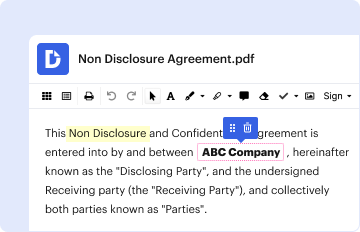
Type text, add images, blackout confidential details, add comments, highlights and more.
02. Sign it in a few clicks
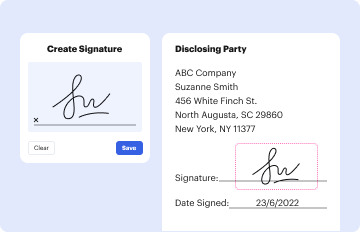
Draw your signature, type it, upload its image, or use your mobile device as a signature pad.
03. Share your form with others
Send it via email, link, or fax. You can also download it, export it or print it out.

How to use or fill out Revocation of Anatomical Gift Donation - Utah with our platform

Form edit decoration
9.5
Ease of Setup
DocHub User Ratings on G2
9.0
Ease of Use
DocHub User Ratings on G2
  1. Click ‘Get Form’ to open the Revocation of Anatomical Gift Donation - Utah in the editor.
  2. Begin by entering your name as the Declarant in the designated field at the top of the form.
  3. Fill in the date of your original anatomical gift document, specifying the day and year.
  4. Review the revocation statement carefully, ensuring it reflects your intent to revoke the anatomical gift.
  5. Sign and print your name in the provided signature section, confirming your decision.
  6. Complete your address details accurately to ensure proper documentation.
  7. If applicable, have two witnesses sign in the witness section, ensuring at least one is disinterested. They should also provide their names and addresses.

Start using our platform today for free to easily complete and manage your Revocation of Anatomical Gift Donation!

be ready to get more

Complete this form in 5 minutes or less

Get form

Got questions?

We have answers to the most popular questions from our customers. If you can't find an answer to your question, please contact us.
Contact us
Anyone can sign up to be a donor at any age. But if someone dies under the age of 18 in England, their parents would still be asked to consent on their childs behalf before organ donation can go ahead. If there was a decision recorded on the NHS Organ Donor Register, this information would be shared with the family.
(d) A donor may amend or revoke an anatomical gift that was not made in a will by any form of communication during a terminal illness or injury addressed to at least two adults, at least one of whom is a disinterested witness.
An anatomical gift is a donation of all or portion of a persons body to be used for transplanting, treatment, investigation, or teaching after the donors death. Any person over the age of 18 can donate all or portion of his or her body for investigation, transplanting, or storage in a tissue bank after dying.
A member of the OPO must obtain consent from the family before organ donation. However, the family cannot override the persons decision to donate their organs if they have registered to donate or stated it in their advance directives.
Max and Keiras Law, also known as the Organ Donation (Deemed Consent) Act, is a piece of new legislation which presumes consent for organ donation in England unless individuals explicitly opt-out.

Security and compliance

At DocHub, your data security is our priority. We follow HIPAA, SOC2, GDPR, and other standards, so you can work on your documents with confidence.

Learn more
ccpa2
pci-dss
gdpr-compliance
hipaa
soc-compliance

People also ask

Originally enacted in 1968, the Uniform Anatomical Gift Act is a federal framework that sets out how anatomical gifts can be made. Every state has enacted the provisions of the act in some form.
If the patient does not expire within 60-90 minutes, the medical staff moves the patient to a location as outlined in Step Four and continues to administer palliative care. Organs are recovered to ultimately give life to patients in need. Through DCD donation, as many as six lives can be saved with one patients gift.

Related links