Type text, add images, blackout confidential details, add comments, highlights and more.
02. Sign it in a few clicks
Draw your signature, type it, upload its image, or use your mobile device as a signature pad.
03. Share your form with others
Send it via email, link, or fax. You can also download it, export it or print it out.
How to use or fill out sample investor with our platform
Ease of Setup
DocHub User Ratings on G2
Ease of Use
DocHub User Ratings on G2
Click ‘Get Form’ to open the Sample Investor Agreement in the editor.
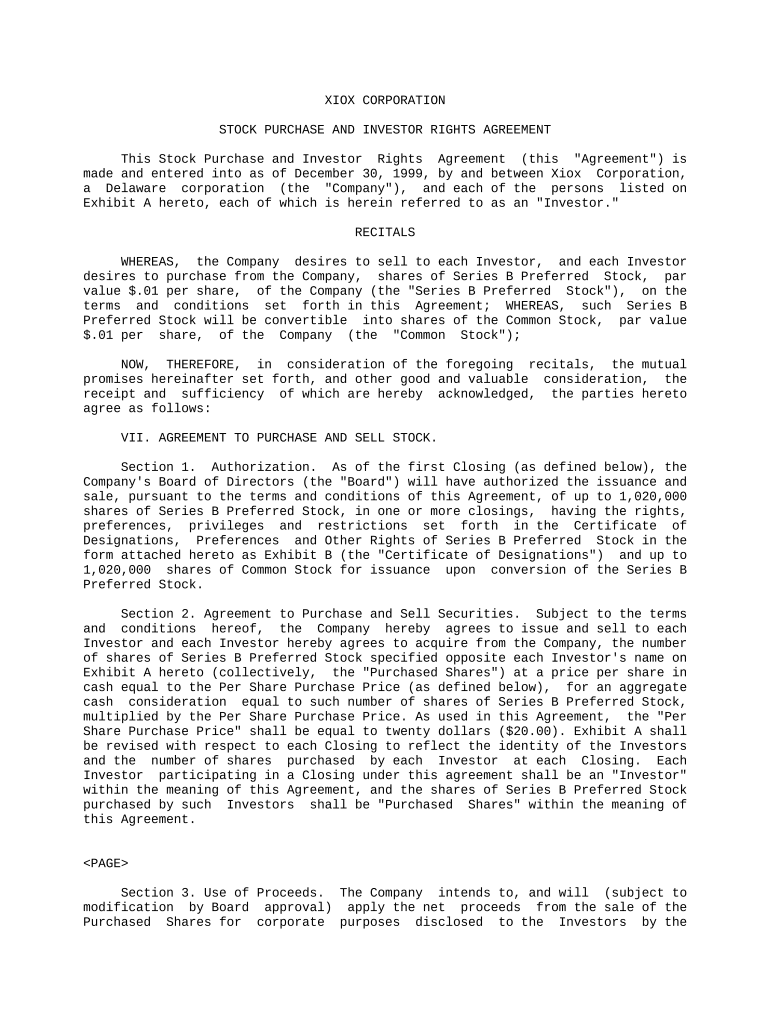
Begin by entering your name and contact information in the designated fields. Ensure that all details are accurate to avoid any issues during processing.
Review the section regarding the number of shares you wish to purchase. Input the desired quantity next to your name, ensuring it aligns with your investment strategy.
In the 'Purchase Price' field, confirm that the price per share is set at $20.00 as stated in the agreement.
Read through the terms and conditions carefully. If you agree, sign electronically in the signature field provided.
Once completed, click ‘Submit’ to finalize your investment. You can also download a copy for your records directly from our platform.
Start using our platform today for free and streamline your investment process!
OpenVC is a free fundraising platform where startup founders can search verified investors, submit their pitch decks, and manage their entire raise. Users can search 20,000+ verified investors, shortlist the right ones, and submit your pitch deck directly.
How to make $1000 a month by investing?
Youll need a portfolio worth about $300,000 generating a 4% dividend yield to earn $1,000 in monthly passive income. Building a diversified collection of 20 to 30 dividend stocks across different sectors helps protect your income.
What exactly does an investor do?
An investor is a person or entity that allocates financial capital with the expectation of a future return (profit) or to gain an advantage (interest). Through this allocated capital the investor usually purchases some species of property.
What is the 7% rule in investing?
A: Its a rule addressing when to sell; it says you should sell out of a stock if it dips by 7% or so below your purchase price. So if you bought shares of Old MacDonald Farms (ticker: EIEIO) at $100, and they dropped to $93, youd sell all of them.
How much should you pay an investor?
There are, however, a number of words of wisdom to take on board and pitfalls for a business to avoid when taking their first big step. A lot of advisors would argue that for those starting out, the general guiding principle is that you should think about giving away somewhere between 10-20% of equity.
Related Searches
Sample investor pdfFree sample investorSample investor appSample agreement between Investor and Company PDFPitch deck examples PDFInvestor pitch deck examplesInvestment Agreement Sample PDFEarly stage mining investors
Security and compliance
At DocHub, your data security is our priority. We follow HIPAA, SOC2, GDPR, and other standards, so you can work on your documents with confidence.
Not everyone gets to this stage, but those who do are generally categorized into three types: personal investors, angel investors, and venture capitalists. Knowing the stages and types of investors is essential, not just for people who are diversifying their portfolios.
What is the 10% investor rule?
And this basically is just limiting your risky investments to no more than 10% of the total money you have invested. Lets say you have $50,000 invested. And were not counting money in, like, a checking or savings account, this is just money we know is actually going to be invested.
Related links
Analyst and Investor Briefing on Second Quarter of FY2021.3
Nov 4, 2020 Sample applications. Cashless settlement for MOV taxi app, ride stamps provided for KQ Stamp, an app for alleviating congestion; etc. Page 28
A Profile of Individual Investors in an Emerging Stock Market
by L Feng Cited by 21 For example, our sample contains investors ranging in age from those in their late teens to the those in their nineties. Figures 2 and 3 graph the birth
Cookie consent notice
This site uses cookies to enhance site navigation and personalize your experience.
By using this site you agree to our use of cookies as described in our Privacy Notice.
You can modify your selections by visiting our Cookie and Advertising Notice.