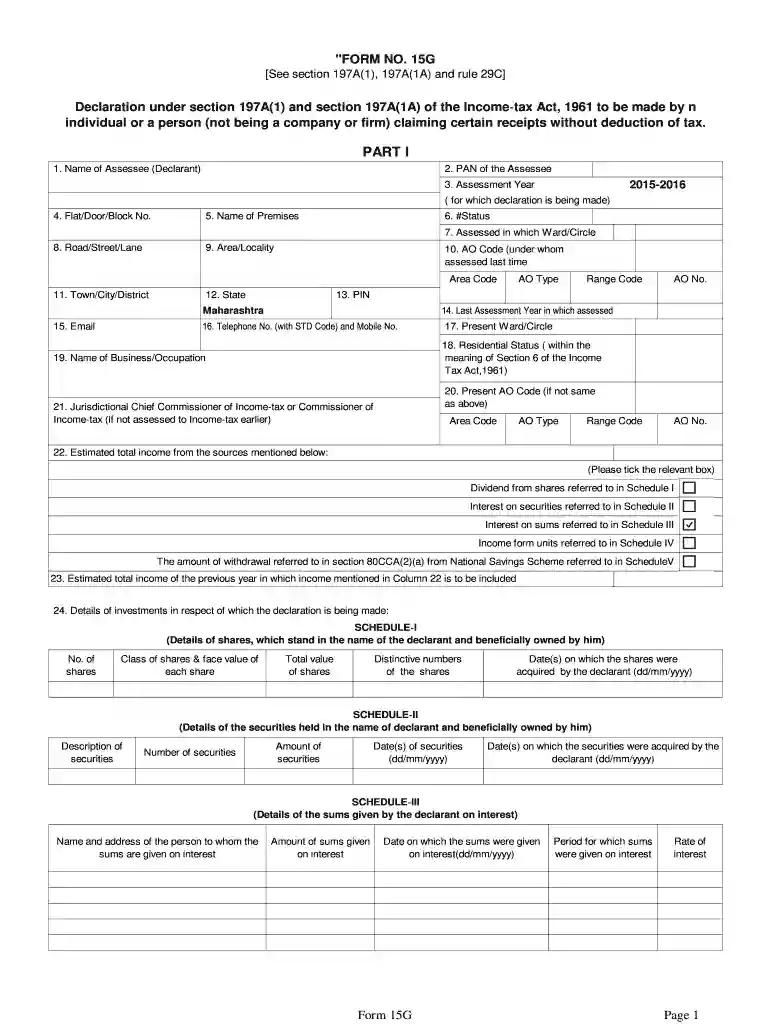
Definition & Meaning of Form 15G
Form 15G is a declaration under sections 197A(1) and 197A(1A) of the Income-tax Act, 1961. It allows individuals and non-corporate entities to receive certain income receipts, such as interest, without tax deduction at source (TDS). Primarily, it is used by individuals whose estimated total income does not exceed the taxable limit, enabling them to prevent excessive tax deductions on their earnings. This form is particularly useful for individuals who hold savings accounts, fixed deposits, or other interest-generating financial instruments.
Key Features of Form 15G
- Eligibility: It is primarily for individuals below the taxable income threshold.
- Income Sources: Covers various sources including savings account interest, fixed deposits, or mutual fund interest.
- Verification Requirement: The declarant must verify that the total income falls below the taxable limit.
- Penalties: False declarations can lead to penalties under tax laws, underscoring the need for accurate income reporting.
How to Obtain the Form 15G Download in Word Format
To download Form 15G in Word format, you can utilize various platforms, including official government portals or reputable online document management services. One such resource is DocHub, which allows you to edit and download documents efficiently.
Steps to Download the Form
- Visit the relevant document management website.
- Search for “Form 15G” in the document library.
- Select the option for Word format download.
- Save the document to your preferred location on your device.
This method provides you with a user-friendly format that can be easily edited as needed.
Steps to Complete the Form 15G Download in Word Format
Filling out Form 15G requires accurate information to ensure compliance with tax regulations. The following steps guide you through the completion process:
-
Identify Your Details:
- Enter your full name, address, and PAN (Permanent Account Number).
- Specify the nature of your income (e.g., interest from savings account).
-
Declare Your Estimated Total Income:
- Provide an estimate of your total income for the financial year from all sources.
- Include interest earnings, salary, and any other income streams.
-
Complete the Verification Section:
- Sign and date the form to verify the accuracy of the information provided.
-
Submit the Form:
- Depending on your financial institution's requirements, present the completed form to your bank or relevant entity.
Who Typically Uses Form 15G Download in Word Format
Form 15G is widely used by individuals who meet specific criteria under the income tax regulations.
Typical Users Include:
- Senior Citizens: Often exempt from tax at lower income levels.
- Students: May not have significant income yet still earn interest.
- Self-Employed Professionals: Those with fluctuating income, allowing them to manage tax deductions effectively.
- Individuals with Investment Income: Such as savings accounts, fixed deposits, or investment funds yielding income below the taxable threshold.
These demographics benefit from utilizing Form 15G to ensure they receive their interest without unnecessary tax deductions.
Important Terms Related to Form 15G Download in Word Format
Understanding the terms associated with Form 15G is crucial for effective use.
- Gross Income: Total income before exemptions or deductions, including all earnings.
- TDS (Tax Deducted at Source): A means of collecting income tax in India, where a portion is deducted before payment is made.
- Verification: The process of confirming that the filing information is accurate.
- Non-Corporate Entities: Includes individual taxpayers, Hindu Undivided Families (HUFs), partnerships, and associations of persons that do not have a corporate structure.
Familiarity with these terms can help ensure compliance and correct usage of the form.
Examples of Using the Form 15G Download in Word Format
Several scenarios exemplify the practical use of Form 15G, aiding taxpayers in avoiding TDS on their income.
Example Scenarios:
- Bank Savings Account: An individual with earnings from a savings account below the tax threshold can submit Form 15G to their bank, allowing the bank to credit the full interest without deducting TDS.
- Fixed Deposits: A retiree with fixed deposits earning interest within the exempt income limit can utilize the form to prevent tax deductions, ensuring they receive their interest in full.
- Mutual Fund Investments: A young investor earning minimal income can file Form 15G when receiving interest from mutual fund units, thereby managing cash flow without tax deductions impacting returns.
These examples illustrate how various individuals leverage Form 15G according to their income circumstances.
Filing Deadlines / Important Dates for Form 15G
Timely submission of Form 15G is a critical aspect of ensuring eligibility for tax benefits.
Key Dates to Remember:
- Financial Year: Form 15G is typically valid for the financial year beginning April 1 and ending March 31.
- Submission Deadline: Bank submissions usually require the form before the interest payment date to avoid TDS for that interest cycle.
- Annual Declaration: For continued usage, submit a new form at the start of each financial year if your income level is expected to remain unchanged.
Awareness of these dates will aid in compliance and ensure proper handling of income declarations.
Digital vs. Paper Version of Form 15G
Deciding between a digital and paper version of Form 15G can influence ease of use and efficiency.
Advantages of Digital Version:
- Accessibility: Easily accessible on various platforms, allowing for immediate editing and downloading.
- Storage: Simplified storage in the cloud or on personal devices, ensuring that the form can be retrieved when necessary.
- Convenience: Enables quick changes and reusability, particularly essential for individuals with multiple income sources.
Considerations for Paper Version:
- Physical Submission: Some institutions may still require a physical copy for their records.
- Limited Technological Access: Users without reliable internet or digital literacy may prefer tangible forms.
Weighing these factors can help individuals choose the method that best suits their needs while complying with tax requirements.