Bylaws of WW Holdings, Inc. 2026

Get Form
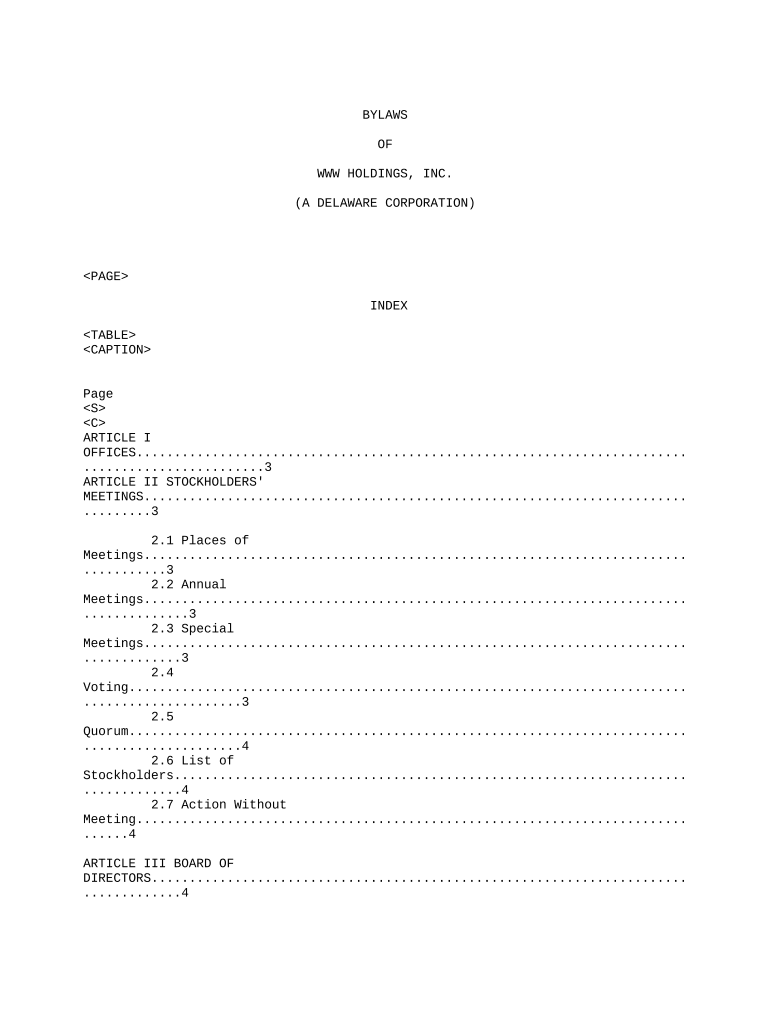
Bylaws of WW Holdings, Inc. Preview on Page 1

Here's how it works

01. Edit your form online
Type text, add images, blackout confidential details, add comments, highlights and more.
02. Sign it in a few clicks
Draw your signature, type it, upload its image, or use your mobile device as a signature pad.
03. Share your form with others
Send it via email, link, or fax. You can also download it, export it or print it out.

How to use or fill out Bylaws of WW Holdings, Inc. with our platform

Form edit decoration
9.5
Ease of Setup
DocHub User Ratings on G2
9.0
Ease of Use
DocHub User Ratings on G2
  1. Click ‘Get Form’ to open the Bylaws of WW Holdings, Inc. in the editor.
  2. Begin by reviewing Article I, which outlines the registered office requirements. Ensure you have the correct address for your registered agent.
  3. Move to Article II regarding Stockholders' Meetings. Fill in details for annual and special meetings, including dates and locations as specified.
  4. In Article III, complete information about the Board of Directors, including their powers and election procedures. Make sure to note any specific compensation arrangements outlined in Section 3.3.
  5. Proceed to Article IV to list officers and their duties. Ensure each officer's title is accurately filled out according to your organizational structure.
  6. Review Articles V through XIII for additional provisions on resignations, capital stock, fiscal year, and amendments. Fill out any necessary fields that pertain specifically to your corporation's operations.

Start editing your Bylaws today for free using our platform!

be ready to get more

Complete this form in 5 minutes or less

Get form

Got questions?

We have answers to the most popular questions from our customers. If you can't find an answer to your question, please contact us.
Contact us
How do I write Corporate Bylaws? Step 1: Select your corporation type. Step 2: Describe your incorporation status. Step 3: State your location. Step 4: Provide your corporations registered name. Step 5: Outline shareholder meeting rules. Step 6: Create rules for board meetings.
Bylaws govern how your business entity will operate and are established by your board of directors. Unlike employee guidelines, bylaws pertain to board-level decisions and actions about the day-to-day running of the business.
Bylaws are not the same as articles of incorporationthe articles are a short document filed with your state to form your business. Bylaws are a longer, more detailed, internal document. Both for-profit and nonprofit corporations should have bylaws.
LLCs are not required to have bylaws. However, they are governed by an operating agreement which is like a corporations bylaws.
For-profit corporations are only required to form a board of directors if they are publicly traded. These boards tend to be smaller than nonprofit boards and they get paid for their services. ing to the Corporate Librarys study, the average board size is about nine members.

Security and compliance

At DocHub, your data security is our priority. We follow HIPAA, SOC2, GDPR, and other standards, so you can work on your documents with confidence.

Learn more
ccpa2
pci-dss
gdpr-compliance
hipaa
soc-compliance

People also ask

Bylaws are an organizations internal operating rules. Federal tax law does not require specific language in the bylaws of most organizations. State law may require nonprofit corporations to have bylaws, however, and nonprofit organizations generally find it advisable to have internal operating rules.
Must-have documents for any corporation or LLC. Among a number of other details, corporate bylaws generally contain: the structure of the organization. the duties and responsibilities of a corporations members. details about the board of directors.
Bylaws are a set of rules and procedures that govern the operations corporation. The bylaws typically outline the roles and responsibilities of the board of directors and officers, as well as establish guidelines for holding meetings, voting procedures and record-keeping requirements.

Related links