Instruction classroom observation 2026

Get Form
comments for classroom observation Preview on Page 1

Here's how it works

01. Edit your comments for classroom observation online
Type text, add images, blackout confidential details, add comments, highlights and more.
02. Sign it in a few clicks
Draw your signature, type it, upload its image, or use your mobile device as a signature pad.
03. Share your form with others
Send instruction classroom observation via email, link, or fax. You can also download it, export it or print it out.

How to use or fill out instruction classroom observation

Form edit decoration
9.5
Ease of Setup
DocHub User Ratings on G2
9.0
Ease of Use
DocHub User Ratings on G2
  1. Click ‘Get Form’ to open it in the editor.
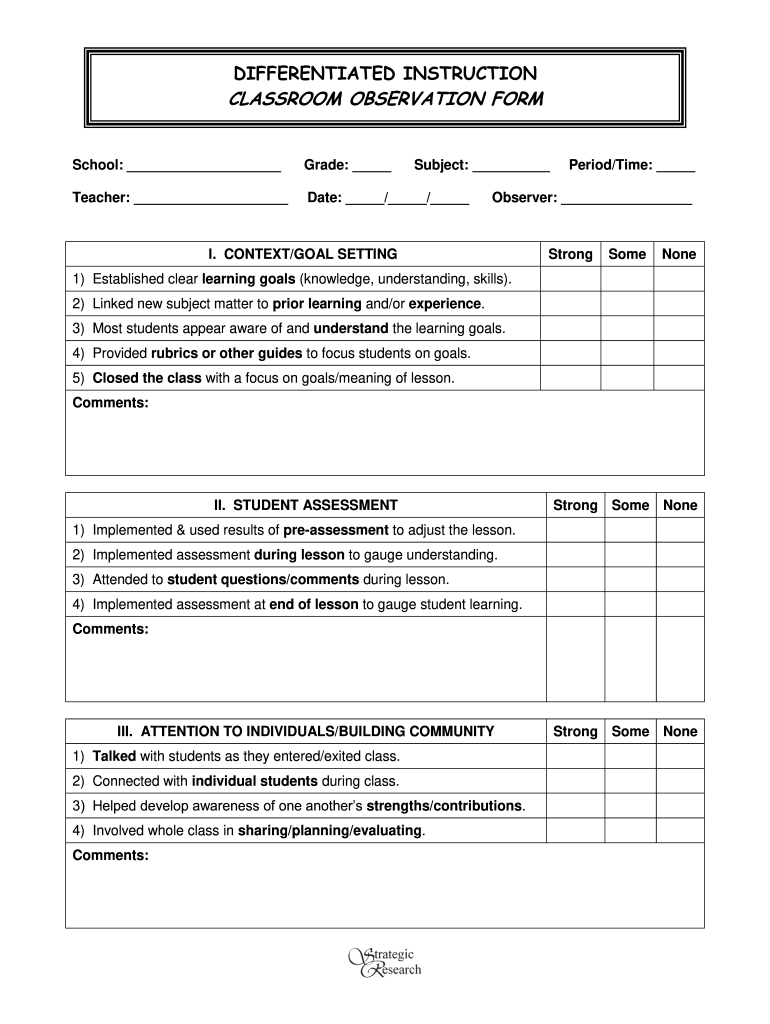
  2. Begin by filling in the basic information at the top, including the school name, grade, subject, teacher's name, date, period/time, and observer's name.
  3. Proceed to Section I: CONTEXT/GOAL SETTING. Evaluate each statement regarding learning goals and provide comments where necessary.
  4. Move to Section II: STUDENT ASSESSMENT. Assess how assessments were implemented during the lesson and add any relevant comments.
  5. In Section III: ATTENTION TO INDIVIDUALS/BUILDING COMMUNITY, reflect on interactions with students and community-building efforts.
  6. Continue to Section IV: INSTRUCTIONAL PRACTICES AND CLASSROOM ROUTINES. Rate the effectiveness of instructional practices and provide comments.
  7. Evaluate Section V: POSITIVE, SUPPORTIVE LEARNING ENVIRONMENT by assessing classroom dynamics and student engagement.
  8. In Section VI: QUALITY CURRICULUM, ensure that lessons align with state standards and focus on significant ideas.
  9. For Section VII: PREPARATION FOR & RESPONSE TO LEARNER NEEDS, assess preparation for diverse learner needs.
  10. Finally, complete Section VIII: EVIDENCE OF DIFFERENTIATION by evaluating content, process, and products used in the lesson.

Start using our platform today to streamline your classroom observation process for free!

See more instruction classroom observation versions

We've got more versions of the instruction classroom observation form. Select the right instruction classroom observation version from the list and start editing it straight away!
Versions Form popularity Fillable & printable
2006 4.8 Satisfied (151 Votes)
be ready to get more

Complete this form in 5 minutes or less

Get form

Got questions?

We have answers to the most popular questions from our customers. If you can't find an answer to your question, please contact us.
Contact us
The observation process is very straightforward: observe and reflect, document and gather evidence, plan and act, and finally, assess.
Classroom observations generally fall into two categories, informal observations, and formal observations. Informal observations tend to be shorter (3 to 20 minutes) and go by many names.
This user-friendly 13-item Classroom Observation Scale enables teachers and healthcare workers with little or no clinical training to identify, with reliable and valid results, preschoolers more likely than their peers to have autism spectrum disorder.
The purposeful direction of the learning process; one of the major teacher class activities (along with planning and management). Teachers are an indispensable part of the debate on the development of critical thinking skills.
Types of Classroom Observation Learning walk through. Goal-setting and implementation walk through. Supervisory walk through.

Security and compliance

At DocHub, your data security is our priority. We follow HIPAA, SOC2, GDPR, and other standards, so you can work on your documents with confidence.

Learn more

People also ask

Some well-known methods include anecdotal observations, running records, time-sampling, sociograms and checklists. Photos, audio or video records as well as learning stories are also valuable ways to build understandings and interpret the learning, interests, abilities, and skills of children.
A classroom observation is a simple process where an observer (usually an administrator or instructional coach) spends time in a classroom collecting data and generating feedback about the teaching and learning.

classroom observation comments