Consignment sale 2026

Get Form
consignment sale Preview on Page 1

Here's how it works

01. Edit your form online
Type text, add images, blackout confidential details, add comments, highlights and more.

02. Sign it in a few clicks
Draw your signature, type it, upload its image, or use your mobile device as a signature pad.

03. Share your form with others
Send it via email, link, or fax. You can also download it, export it or print it out.

How to use or fill out consignment sale with our platform

Form edit decoration
9.5
Ease of Setup
DocHub User Ratings on G2
9.0
Ease of Use
DocHub User Ratings on G2
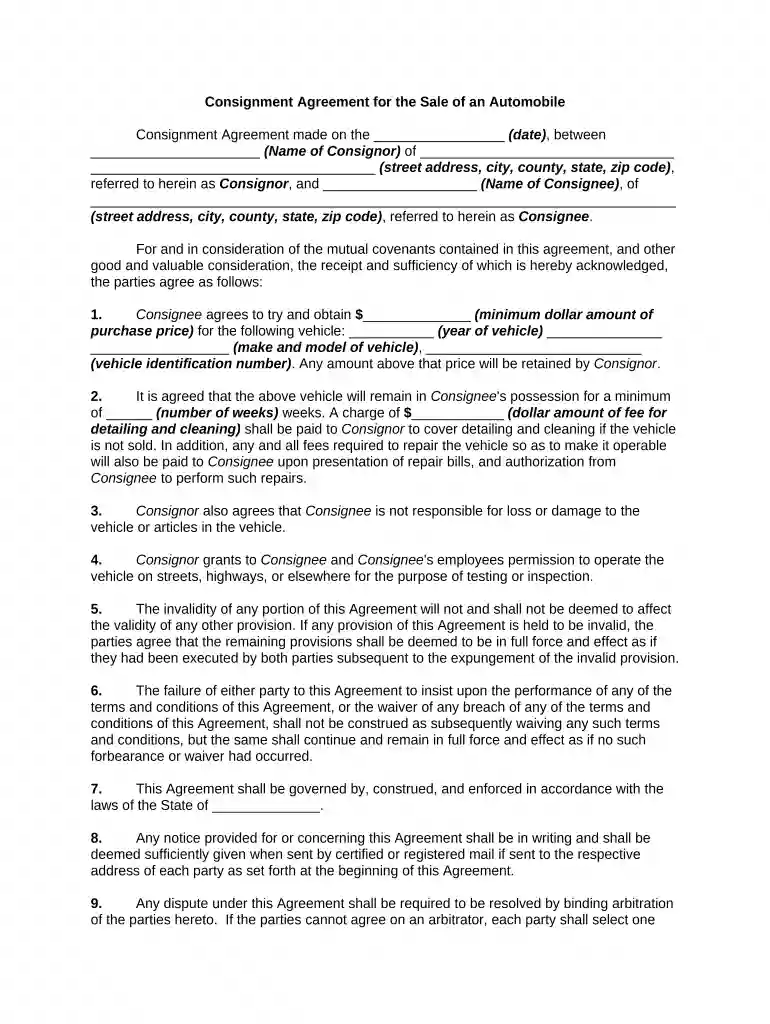
  1. Click ‘Get Form’ to open the Consignment Agreement in the editor.
  2. Begin by entering the date of the agreement in the designated field at the top of the form.
  3. Fill in the name and address of the Consignor, ensuring all details are accurate for proper identification.
  4. Next, input the name and address of the Consignee in their respective fields.
  5. Specify the minimum dollar amount for which the vehicle should be sold, along with details about the vehicle including year, make, model, and VIN.
  6. Indicate how many weeks the vehicle will remain with the Consignee and any fees related to detailing or repairs that may apply.
  7. Review all sections for accuracy before signing. Ensure both parties sign and print their names at the bottom of the document.

Start using our platform today to streamline your consignment sale process for free!

be ready to get more

Complete this form in 5 minutes or less

Get form

Got questions?

We have answers to the most popular questions from our customers. If you can't find an answer to your question, please contact us.
Contact us
Although selling on consignment may seem like a practical solution, it has disadvantages for the seller: Sales uncertainty. Lack of motivation to sell. Necessity of a good agreement. Lesser incomes. Logistic limits. Uncertainties on the condition of the products. Competitive risks.
Consignment is a business model where a shop (the consignee) sells products on behalf of their owner (the consignor). As a consignor, you provide your goods to the shop, and they handle the rest: storage, inventory management, and sales. In return, they take a cut of each sale (or sometimes a flat-rate fee).
In consignment shops, item owners consign their goods to the shop for a specific time and receive part of the profits if and when the items are sold. In thrift stores, donated items stay in stock until they are sold, and the person who donated the items does not receive any money in exchange for them.
There are two types of consignment: Outward consignment. Inward consignment. Consignment vs Sale: Types, Importance, and Key Differences vedantu.com commerce consignment-an vedantu.com commerce consignment-an
Although selling on consignment may seem like a practical solution, it has disadvantages for the seller: Sales uncertainty. Lack of motivation to sell. Necessity of a good agreement. Lesser incomes. Logistic limits. Uncertainties on the condition of the products. Competitive risks. What Are the Disadvantages of Consignment Sales? - Alice POS alicepos.com disadvantages-consignment-sales alicepos.com disadvantages-consignment-sales

Security and compliance

At DocHub, your data security is our priority. We follow HIPAA, SOC2, GDPR, and other standards, so you can work on your documents with confidence.
Learn more
ccpa2
pci-dss
gdpr-compliance
hipaa
soc-compliance

People also ask

Consignment shops typically take a 40% commission, which is considered a 60/40 split. 40/60 or 50/50 split is also appropriate, depending on the products youre selling and the type of consignment shop youre selling through.

Related links