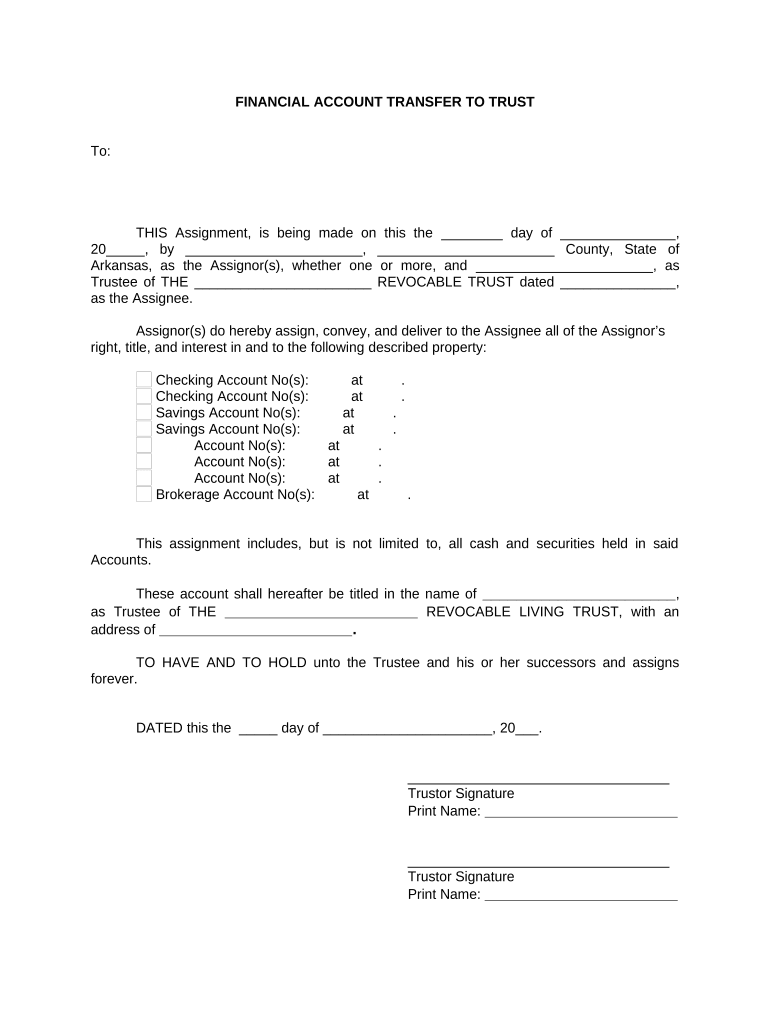
Financial Account Transfer to Living Trust - Arkansas 2026

Get Form
Financial Account Transfer to Living Trust - Arkansas Preview on Page 1

Here's how it works

01. Edit your form online
Type text, add images, blackout confidential details, add comments, highlights and more.
02. Sign it in a few clicks
Draw your signature, type it, upload its image, or use your mobile device as a signature pad.
03. Share your form with others
Send it via email, link, or fax. You can also download it, export it or print it out.

How to use or fill out Financial Account Transfer to Living Trust - Arkansas with DocHub

Form edit decoration
9.5
Ease of Setup
DocHub User Ratings on G2
9.0
Ease of Use
DocHub User Ratings on G2
  1. Click ‘Get Form’ to open it in the editor.
  2. Begin by entering the date of the assignment in the designated field. This is crucial for legal documentation.
  3. Fill in your name as the Assignor, along with your county and state. Ensure accuracy to avoid any future complications.
  4. Next, specify the Trustee's name and the title of the Revocable Trust. This identifies who will manage the assets moving forward.
  5. List all relevant account numbers under Checking and Savings Accounts, ensuring each entry is complete and accurate.
  6. Include any Brokerage Account numbers as well, confirming that all financial assets are accounted for in this transfer.
  7. Finally, both Trustors must sign and print their names at the bottom of the form. This step finalizes your assignment legally.

Start using our platform today to streamline your document editing and signing process for free!

be ready to get more

Complete this form in 5 minutes or less

Get form

Got questions?

We have answers to the most popular questions from our customers. If you can't find an answer to your question, please contact us.
Contact us
This transfer doesnt usually lead to an immediate tax obligation, meaning no tax is levied for merely changing the ownership. However, the trust, which now owns the stock, may become liable for taxes on dividends and capital gains from the stock.
There are many methods that a grantor may use to transfer assets into a trust, including the following: Deeds. Title transfer. Assignment of ownership. Opening new accounts. Assignment of rights. Incorporating a pour-over will. Naming the trust as a beneficiary.
Legal and Tax Implications Transferring assets into a trust involves more than just the physical transfer of assets. There are docHub legal and tax implications to consider. For instance: - Legal Work: Properly transferring assets into a trust typically requires the assistance of experienced legal professionals.
Preparing to transfer your assets in 5 steps Step 1: Create your living trust. Step 2: Inventory your assets. Step 3: Gather titles and deeds. Step 4: Change titles and deeds. Step 5: Update beneficiary information.
A revocable living trust is created during your life and is funded with assets during your life, or automatically upon your death through beneficiary designations. This type of trust allows you to retain full control of your assets during your lifetime. You can change or revoke the trust at any time.

Security and compliance

At DocHub, your data security is our priority. We follow HIPAA, SOC2, GDPR, and other standards, so you can work on your documents with confidence.

Learn more
ccpa2
pci-dss
gdpr-compliance
hipaa
soc-compliance

People also ask

A Trust keeps an account secure until the time comes for it to pay out to your Beneficiaries. You may use any or all of your accounts to fund your Trustchecking or savings accounts with banks, credit unions, and savings and loan associations.

Related links