




01. Edit your union bank kyc form fill up online
Type text, add images, blackout confidential details, add comments, highlights and more.

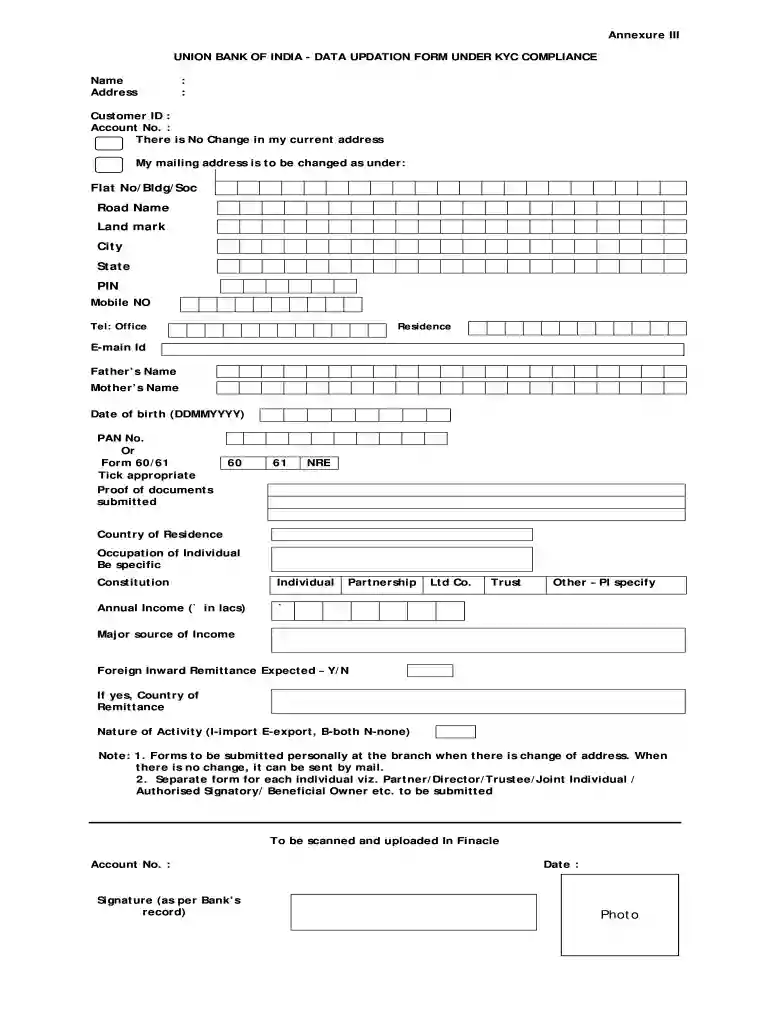
Type text, add images, blackout confidential details, add comments, highlights and more.

Draw your signature, type it, upload its image, or use your mobile device as a signature pad.

Send union bank of india kyc form via email, link, or fax. You can also download it, export it or print it out.
The Union Bank KYC form is a crucial document for customers of Union Bank of India to fulfill regulatory Know Your Customer requirements. This form is essential for updating customer information and helps the bank to verify the identity of its clients. Understanding how to fill out this form correctly is vital for maintaining your account and ensuring compliance with legal standards.
The Union Bank KYC form typically includes several key sections that customers need to complete. These components serve to collect a comprehensive view of the customer’s identity and circumstances.
To ensure accurate submission of the Union Bank KYC form, follow these steps meticulously:
Timely submission of the Union Bank KYC form is paramount for the continued operation of your bank account. Compliance with KYC regulations not only safeguards your account but also strengthens the banking system as a whole. Delays in submission can lead to restrictions on your account or potential legal implications.
Despite the straightforward nature of the Union Bank KYC form, customers might encounter challenges. Here are common issues and how to address them:
Filling out the Union Bank KYC form is not just about compliance; it also involves ensuring the security and privacy of your personal information. Union Bank of India adheres to strict data protection regulations to ensure your data is handled appropriately.
Compliance with KYC regulations through the Union Bank KYC form represents both a legal obligation and a critical safeguard for your personal and financial integrity. Ensuring that every detail is accurate and up-to-date helps not only in maintaining uninterrupted banking services but also contributes to the overall efficiency and security of banking operations. To avoid potential issues, prioritize timely updates and always keep abreast of any changes in KYC requirements established by the bank and relevant regulatory bodies.
At DocHub, your data security is our priority. We follow HIPAA, SOC2, GDPR, and other standards, so you can work on your documents with confidence.
Aug 10, 2017 Indicate by check mark if the registrant is a well-known seasoned issuer, as defined in Rule 405 of the Securities Act. Yes ☑ No ☐.Read more
A summons issued pursuant to this section may require that books, papers, records, or other data stored or maintained at any place be produced at anyRead more
Feb 1, 2021 The CIP must include risk-based procedures for verifying the identity of each customer to the extent reasonable and practicable.5 The proceduresRead more


