Construction Contract Cost Plus or Fixed Fee - New Jersey 2026

Get Form
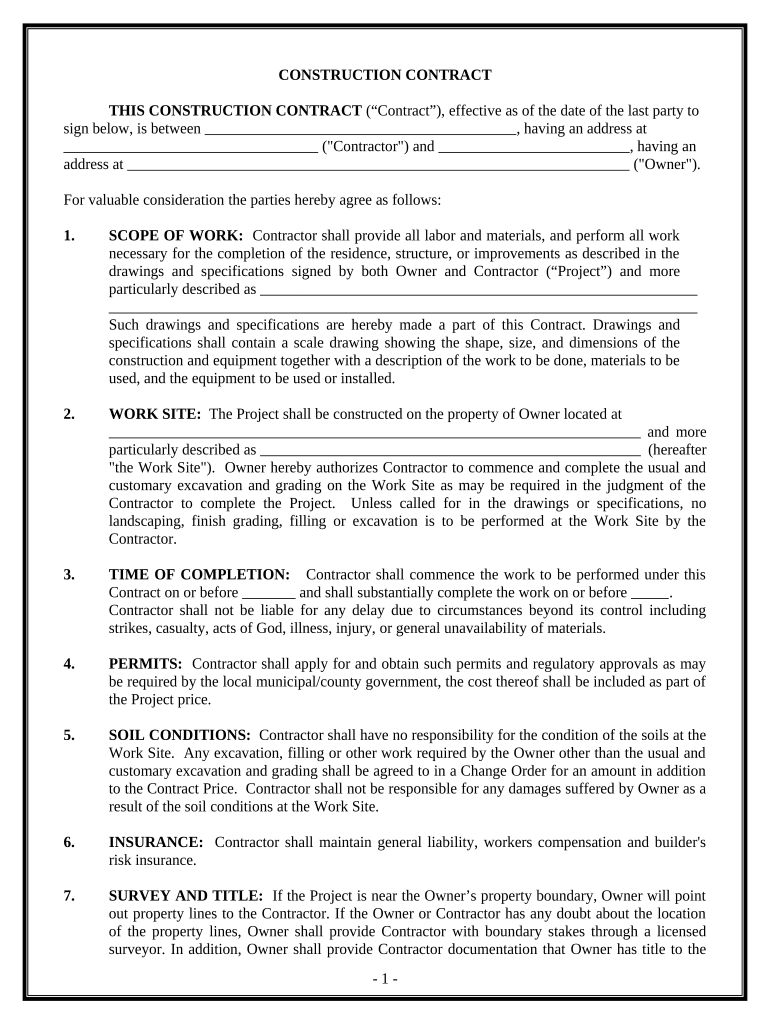
cost plus contract construction Preview on Page 1

Here's how it works

01. Edit your cost plus contract construction online
Type text, add images, blackout confidential details, add comments, highlights and more.
02. Sign it in a few clicks
Draw your signature, type it, upload its image, or use your mobile device as a signature pad.
03. Share your form with others
Send it via email, link, or fax. You can also download it, export it or print it out.

How to use or fill out Construction Contract Cost Plus or Fixed Fee - New Jersey

Form edit decoration
9.5
Ease of Setup
DocHub User Ratings on G2
9.0
Ease of Use
DocHub User Ratings on G2
  1. Click ‘Get Form’ to open it in the editor.
  2. Begin by filling in the Contractor and Owner details, including names and addresses, in the designated fields.
  3. In the 'SCOPE OF WORK' section, clearly describe the project specifications and attach any relevant drawings or documents.
  4. Specify the 'WORK SITE' address where the construction will take place, ensuring accuracy for legal purposes.
  5. Set a timeline for project commencement and completion in the 'TIME OF COMPLETION' section.
  6. Indicate whether you are using a 'COST PLUS' or 'FIXED FEE' payment structure and fill in the corresponding amounts.
  7. Review all sections for completeness and accuracy before signing. Ensure both parties sign and date the contract.

Start editing your Construction Contract today for free on our platform!

be ready to get more

Complete this form in 5 minutes or less

Get form

Got questions?

We have answers to the most popular questions from our customers. If you can't find an answer to your question, please contact us.
Contact us
Cost plus construction contracts offer advantages like transparency, flexibility, and reduced contractor risk. They also come with drawbacks, including uncertain pricing, a higher administrative workload, and a greater risk of disputes.
Most contracts have a cost-plus fee scale of 10-25%. A contractor would use takeoff software to calculate the materials costs, but they wouldnt need to be exact. Some companies use a cost-plus-fixed-fee (CPFF) instead of a percentage.
A cost-plus contract is a construction agreement that requires reimbursement for project costs as well as a markup that covers the contractors overhead and profit. In other words, the name is a short-hand way of remembering what the contract covers: project costs plus contractor markup.
Benefits of a cost-plus fixed-fee contract They allow you to explore and adjust the scope, unlike firm-fixed-price contracts. CPFF contracts foster better communication between clients and contractors, especially when both parties must work closely to guarantee contract performance.
A cost-plus-fixed-fee contract is a cost-reimbursement contract that provides for payment to the contractor of a negotiated fee that is fixed at the inception of the contract. The fixed fee does not vary with actual cost, but may be adjusted as a result of changes in the work to be performed under the contract.

Security and compliance

At DocHub, your data security is our priority. We follow HIPAA, SOC2, GDPR, and other standards, so you can work on your documents with confidence.

Learn more
ccpa2
pci-dss
gdpr-compliance
hipaa
soc-compliance

People also ask

What are the differences among fixed price and cost reimbursement agreements? Fixed price (FP) agreements have fixed payments based on a milestone payment schedule or the submission of deliverables. Cost reimbursement (CR) agreements are paid as costs are incurred and invoiced, typically monthly or quarterly.

Related links