

Renunciation And Disclaimer of Property received by Intestate Succession - South Carolina 2026

Get Form
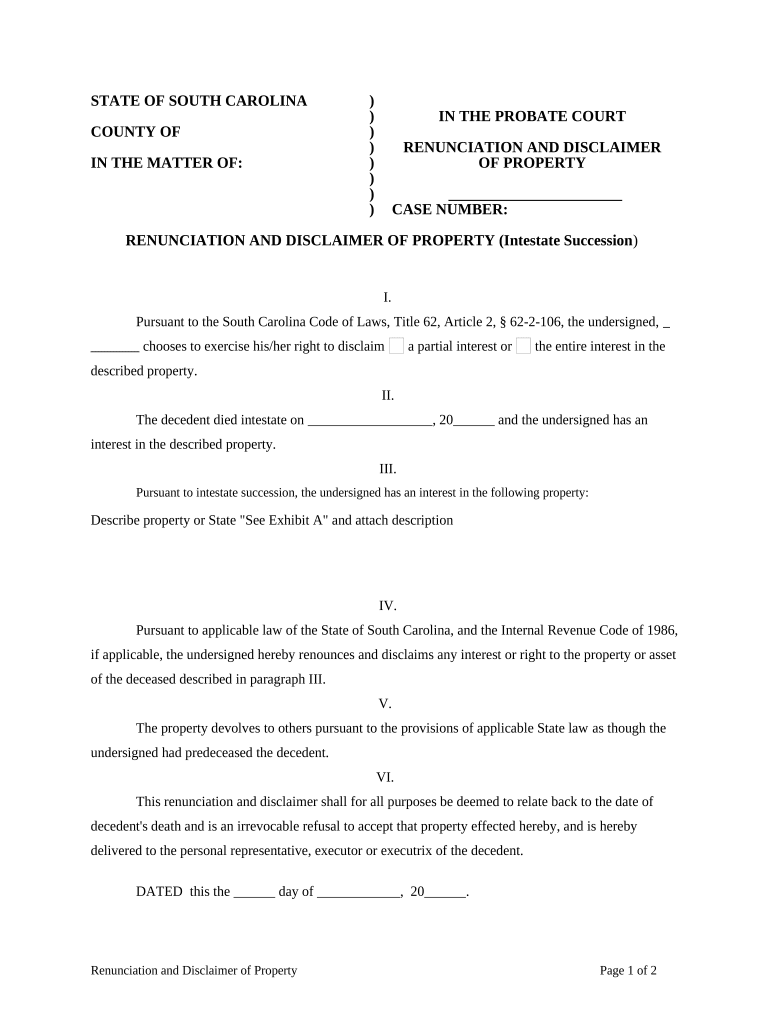
south carolina intestate succession Preview on Page 1

Here's how it works

01. Edit your south carolina intestate succession online
Type text, add images, blackout confidential details, add comments, highlights and more.
02. Sign it in a few clicks
Draw your signature, type it, upload its image, or use your mobile device as a signature pad.
03. Share your form with others
Send it via email, link, or fax. You can also download it, export it or print it out.

How to use or fill out Renunciation And Disclaimer of Property received by Intestate Succession - South Carolina

Form edit decoration
9.5
Ease of Setup
DocHub User Ratings on G2
9.0
Ease of Use
DocHub User Ratings on G2
  1. Click ‘Get Form’ to open it in the editor.
  2. Begin by filling in your name and the case number at the top of the form. This identifies you as the undersigned party.
  3. In Section I, indicate whether you are disclaiming a partial interest or the entire interest in the described property.
  4. Complete Section II by entering the date of death of the decedent. This is crucial for establishing timelines.
  5. In Section III, describe the property you are renouncing. If necessary, attach an Exhibit A with detailed descriptions.
  6. Review Section IV to ensure you understand that this disclaimer is irrevocable and relates back to the date of death.
  7. Sign and date at the bottom of the form, ensuring all required fields are completed accurately.

Start using our platform today to streamline your document editing and signing process for free!

be ready to get more

Complete this form in 5 minutes or less

Get form

Got questions?

We have answers to the most popular questions from our customers. If you can't find an answer to your question, please contact us.
Contact us
If you disclaim an inheritance it will stay as part of the deceaseds estate and will be re-distributed.
Disclaiming an inheritance is when a potential heir renounces their right to inherit any assets or property left to them. This decision must be made before the heir takes any possession or control of the inheritance. There are no reversals.
By disclaiming the inheritance, the asset can pass to another beneficiary, potentially reducing the overall tax burden on the estate or aligning with better tax planning strategies. If an heir or beneficiary has substantial debts or is facing bankruptcy, accepting an inheritance might expose the assets to creditors.
Who Gets What in South Carolina? If you die with:heres what happens: spouse and descendants spouse inherits 1/2 of your intestate property descendants inherit everything else parents but no spouse or descendants parents inherit everything siblings but no spouse, descendants, or parents siblings inherit everything2 more rows
It is important to keep in mind that the person who is disclaiming the inheritance has no control over who will receive the inheritance after the disclaimer: The identity of the next beneficiary in line is the person named in the deceased persons will or trust, or if there is no will or trust, the person specified in

Security and compliance

At DocHub, your data security is our priority. We follow HIPAA, SOC2, GDPR, and other standards, so you can work on your documents with confidence.

Learn more
ccpa2
pci-dss
gdpr-compliance
hipaa
soc-compliance

People also ask

Intestacy laws signal that your inheritance is passed on based on South Carolina Intestacy laws. Generally, intestacy laws will pass your inheritance on to your next of kin, also known as heirs. In the case that you are married, your spouse would take the entirety of your property.
When an inheritance is renounced, it is as if the renouncing beneficiary was never named in the Will or intestate succession. The inheritance will be distributed ing to the remaining provisions in the Will, or if none exist, it will be distributed ing to the rules of intestate succession.
South Carolina has no statute expressly permitting a disclaimer. Disclaimers of gifts under a will have been permitted in Bahan v. Citizens Southern Natl Bank of S.C., 267 S.C.

Related links