Living Trust for Husband and Wife with Minor and or Adult Children - Massachusetts 2026

Get Form
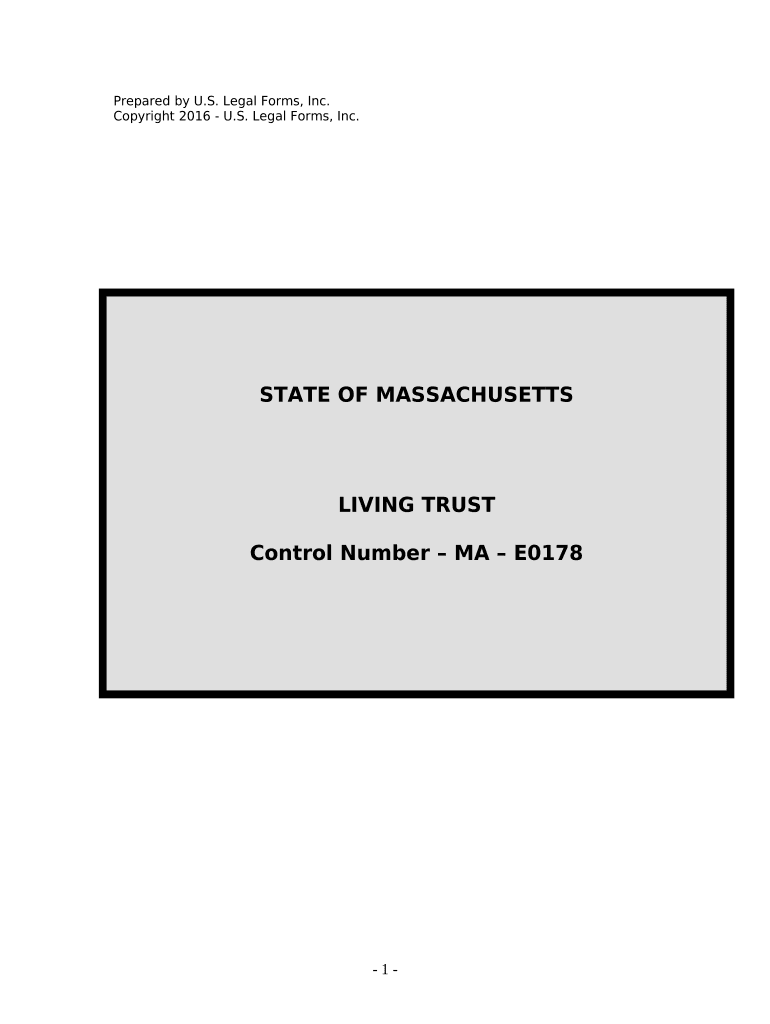
Living Trust for Husband and Wife with Minor and or Adult Children - Massachusetts Preview on Page 1

Here's how it works

01. Edit your form online
Type text, add images, blackout confidential details, add comments, highlights and more.
02. Sign it in a few clicks
Draw your signature, type it, upload its image, or use your mobile device as a signature pad.
03. Share your form with others
Send it via email, link, or fax. You can also download it, export it or print it out.

How to use or fill out Living Trust for Husband and Wife with Minor and or Adult Children - Massachusetts

Form edit decoration
9.5
Ease of Setup
DocHub User Ratings on G2
9.0
Ease of Use
DocHub User Ratings on G2
  1. Click ‘Get Form’ to open it in the editor.
  2. Begin by entering the date at the top of the document where indicated. This is essential for establishing when the trust is created.
  3. In Article I, provide a name for your trust. This can be something personal that reflects your family.
  4. In Article II, fill in the names of both Trustors (husband and wife) along with their address. Ensure all children are listed as beneficiaries.
  5. Proceed to Article III to appoint a Trustee. You can designate one of the Trustors or another individual as Successor Trustee if needed.
  6. In Article IV, list all assets being transferred into the trust. Attach an Exhibit A if necessary for detailed descriptions.
  7. Review Articles V through IX carefully, ensuring you understand each power granted to the Trustee and how distributions will be handled upon death.
  8. Finally, sign and date the document at the end, ensuring all parties involved do so in front of a notary public.

Start using our platform today to easily complete your Living Trust form online for free!

be ready to get more

Complete this form in 5 minutes or less

Get form

Got questions?

We have answers to the most popular questions from our customers. If you can't find an answer to your question, please contact us.
Contact us
What are the cons of joint trusts? Primarily, the lack of flexibility in a joint trust can be a problem, especially if the two spouses dont agree about who should ultimately be a beneficiary or how much they should receive.
The disadvantages of a living trust can include the complex and costly process of establishing a trust, the lack of ability to name a guardian for a minor or incapacitated child or dependent, and the lack of tax benefits for a revocable living trust.
Benefits of a Joint TrustSimplicity and Equality A joint trust establishes a structure in which either spouse would inherit the combined marital assets in the event of the other spouses passing. If appropriate for the couple, this type of trust can be less complex to set up and administer than separate trusts.
If you go the online, DIY route, you might wind up paying less than $100. However, some web resources can charge up to $400. If an attorney helps you set things up, the attorneys fees will raise your total costs. Theres no one-size-fits-all cost, but they can frequently exceed $1,000.
If shielding assets from creditors is a concern, separate trusts usually offer greater protection. With a joint trust, if a creditor obtains a judgment against one spouse, all trust assets may be at risk. A spouses trust is generally protected from the other spouses creditors.

Security and compliance

At DocHub, your data security is our priority. We follow HIPAA, SOC2, GDPR, and other standards, so you can work on your documents with confidence.

Learn more
ccpa2
pci-dss
gdpr-compliance
hipaa
soc-compliance

People also ask

Joint trusts are a type of living trust created by two people (usually a married couple) that allows them to combine their assets into one trust. This approach can simplify estate planning, but it also has some drawbacks that should be considered.
Joint trusts are the best trusts for married couples who are very stable and secure in their future plans. This couple will most likely be the joint co-trustees of their assets and enjoy a great deal of flexibility over the trust while they are alive.

Related links