Type text, add images, blackout confidential details, add comments, highlights and more.
02. Sign it in a few clicks
Draw your signature, type it, upload its image, or use your mobile device as a signature pad.
03. Share your form with others
Send it via email, link, or fax. You can also download it, export it or print it out.
How to use or fill out Warranty Deed from Individual to Husband and Wife - Wisconsin
Ease of Setup
DocHub User Ratings on G2
Ease of Use
DocHub User Ratings on G2
Click ‘Get Form’ to open it in the editor.
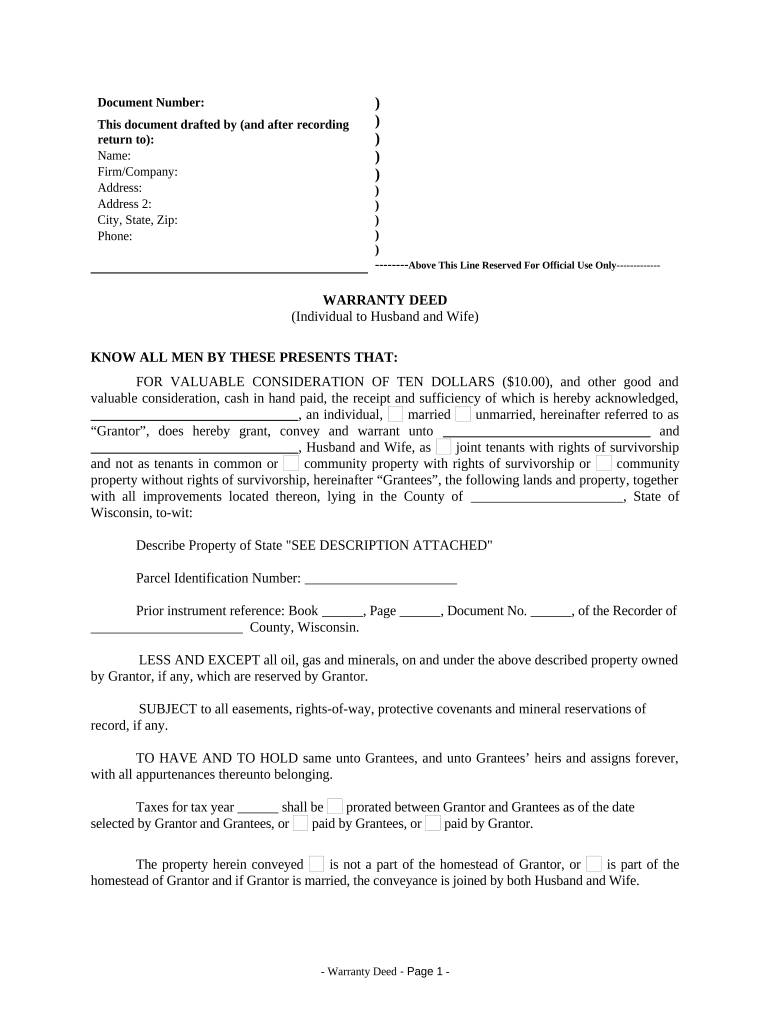
Begin by entering the Grantor's name, marital status, and contact information in the designated fields. Ensure accuracy as this identifies the individual transferring the property.
Next, input the Grantees' names (Husband and Wife) and confirm their joint tenancy status. This section is crucial for establishing ownership rights.
Describe the property being transferred. If a detailed description is attached, indicate this clearly in the provided field.
Fill in the Parcel Identification Number and any prior instrument references to ensure proper documentation of the property’s history.
Complete sections regarding taxes and whether the property is part of a homestead. This affects tax responsibilities and ownership rights.
Finally, have both Grantors sign and date the document. If notarization is required, ensure that a notary public acknowledges your signatures.
Start using our platform today to easily complete your Warranty Deed for free!
Fill out Warranty Deed from Individual to Husband and Wife - Wisconsin online It's free
Warranty deed from individual to husband and wife wisconsin formWarranty deed from individual to husband and wife wisconsin templateWarranty deed from individual to husband and wife wisconsin onlineWarranty deed from individual to husband and wife wisconsin exampleWisconsin Quit Claim DeedQuit claim Deed Dane County wiProperty deed form PDFMilwaukee County quit claim Deed form
Security and compliance
At DocHub, your data security is our priority. We follow HIPAA, SOC2, GDPR, and other standards, so you can work on your documents with confidence.
766.60(2)(2) Spouses may hold marital property in a form that designates the holder of it by the words (name of one spouse) and (name of other spouse) asRead more
by K Landman The deed was prepared on a printed form bearing across its top the label: Warranty Deed to Husband and Wife as. Joint Tenants. The granting clause providedRead more
Cookie consent notice
This site uses cookies to enhance site navigation and personalize your experience.
By using this site you agree to our use of cookies as described in our Privacy Notice.
You can modify your selections by visiting our Cookie and Advertising Notice.