Statutory Health Care Power of Attorney - Arizona 2026

Get Form
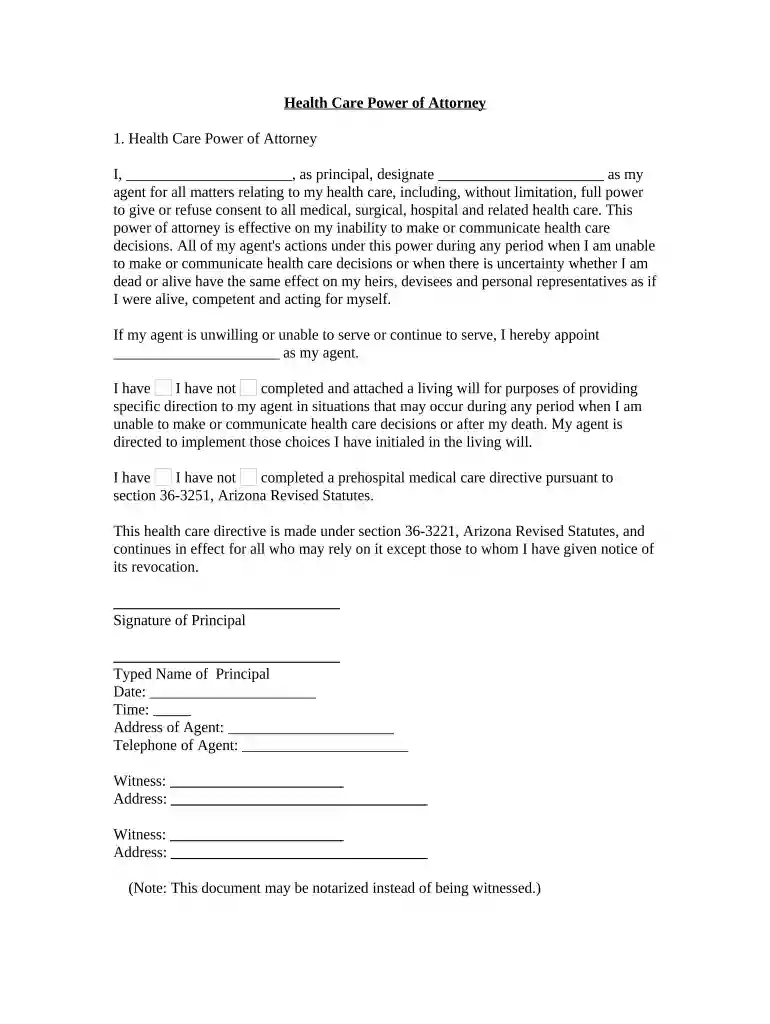
Statutory Health Care Power of Attorney - Arizona Preview on Page 1

Here's how it works

01. Edit your form online
Type text, add images, blackout confidential details, add comments, highlights and more.

02. Sign it in a few clicks
Draw your signature, type it, upload its image, or use your mobile device as a signature pad.

03. Share your form with others
Send it via email, link, or fax. You can also download it, export it or print it out.

How to use or fill out Statutory Health Care Power of Attorney - Arizona with DocHub

Form edit decoration
9.5
Ease of Setup
DocHub User Ratings on G2
9.0
Ease of Use
DocHub User Ratings on G2
  1. Click ‘Get Form’ to open the Statutory Health Care Power of Attorney - Arizona in our editor.
  2. Begin by filling in your name as the principal and designate your agent for health care decisions. Ensure you provide their full name clearly.
  3. Indicate whether you have completed a living will by checking the appropriate box. If yes, ensure it is attached to this document.
  4. Complete the section regarding autopsy consent by initialing your preference. This allows you to express your wishes clearly.
  5. If applicable, fill out the organ donation section, indicating your desires regarding organ or tissue donation.
  6. Provide your signature, typed name, date, and time at the designated fields to validate the document.
  7. Lastly, include witness information or opt for notarization if preferred. Ensure all details are accurate before finalizing.

Start using our platform today to easily complete your Statutory Health Care Power of Attorney - Arizona for free!

be ready to get more

Complete this form in 5 minutes or less

Get form

Got questions?

We have answers to the most popular questions from our customers. If you can't find an answer to your question, please contact us.
Contact us
In most states, the default surrogate decision maker for adults is normally the next of kin, specified in a priority order by state statute, typically starting with the persons spouse or domestic partner, then an adult child, a parent, a sibling, and then possibly other relatives.
Arizona law gives decision-making power to surrogates, primarily in order of kinship. The order is your spouse (unless legally separated); your adult child (if more than one, the majority available for consultation); your parent; your domestic partner; your brother or sister; your close friend.
PLEASE NOTE: At least one adult witness, not to include the proxy if there is one, OR a notary public must witness you signing this document. DO NOT have the documents signed by both a witness and a notary, just pick one. If you do not know a notary or cannot pay for one, a witness is legally accepted.
Living wills and advance directives for medical decisions. Plan ahead and get the medical care you want at the end of life. Living wills and other advance directives are written, legal instructions regarding your preferences for medical care if you are unable to make decisions for yourself.
The Bottom Line. A healthcare proxy makes decisions related to healthcare on your behalf and can only act if you are medically or legally incapacitated. A power of attorney makes legal and financial decisions on your behalf and acts based on the scope of authority and under the conditions you have given them.

Security and compliance

At DocHub, your data security is our priority. We follow HIPAA, SOC2, GDPR, and other standards, so you can work on your documents with confidence.

Learn more
ccpa2
pci-dss
gdpr-compliance
hipaa
soc-compliance
be ready to get more

Complete this form in 5 minutes or less

Get form

People also ask

When someone makes you the agent in their power of attorney, you cannot: Write a will for them, nor can you edit their current will. Take money directly from their bank accounts. Make decisions after the person you are representing dies. Give away your role as agent in the power of attorney.
If you become incapacitated and dont have a medical power of attorney, state law determines what happens. In some states, your healthcare providers may be able to rely on your next of kin, such as your spouse, to make decisions for you. In other states, a court may have to assign a guardian or healthcare agent.
Arizona law determines who can make medical decisions if no power of attorney exists. Typically, this responsibility falls to close family members in a specific order, such as spouses, adult children, or parents. A court may appoint a guardian to make decisions if no family members are available.

Related links