
Oregon easement 2026

Get Form
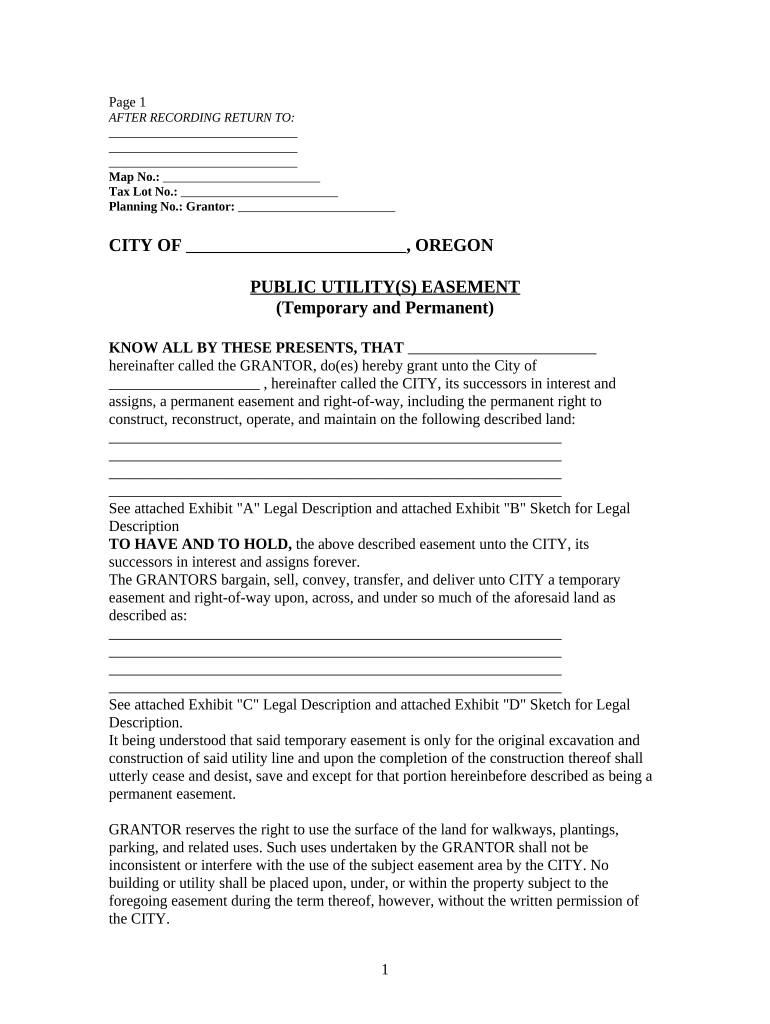
unrecorded easement oregon Preview on Page 1

Here's how it works

01. Edit your unrecorded easement oregon online
Type text, add images, blackout confidential details, add comments, highlights and more.
02. Sign it in a few clicks
Draw your signature, type it, upload its image, or use your mobile device as a signature pad.
03. Share your form with others
Send can a property owner block an easement in oregon via email, link, or fax. You can also download it, export it or print it out.

How to use or fill out oregon easement with our platform

Form edit decoration
9.5
Ease of Setup
DocHub User Ratings on G2
9.0
Ease of Use
DocHub User Ratings on G2
  1. Click ‘Get Form’ to open the Oregon Easement document in the editor.
  2. Begin by filling in the 'Map No.', 'Tax Lot No.', and 'Planning No.' fields at the top of the form. These identifiers are crucial for accurately referencing the property involved.
  3. In the section labeled 'Grantor', enter your name or the name of your organization as it appears on legal documents. This identifies who is granting the easement.
  4. Next, specify the city and any relevant details regarding the easement area. Attach Exhibit A and B for legal descriptions and sketches as required.
  5. Complete the consideration amount in the designated field, acknowledging receipt of this amount as part of the agreement.
  6. Ensure all signers provide their names and titles where indicated, including any necessary corporate seals if applicable.
  7. Finally, review all entries for accuracy before saving or exporting your completed document for signatures.

Start using our platform today to easily complete your Oregon Easement form online for free!

be ready to get more

Complete this form in 5 minutes or less

Get form

Got questions?

We have answers to the most popular questions from our customers. If you can't find an answer to your question, please contact us.
Contact us
In simpler terms, a right of way is generally focused on movement across the property, whereas an easement might allow a third party to use part of the land in ways that dont involve ongoing transit.
In California, easements are subject to specific rules and regulations, and property owners generally cannot unilaterally block or obstruct established easements. Property owners should seek legal advice to navigate the complexities of easement disputes and to comply with California Law.
An easement is a nonpossessory interest in the land of another that entitles the easement holder to limited use of anothers land without interference. ORS 105.170 (1). An easement holder is a person with a legal right to use the easement and may include the owner of the land across which the easement passes.
There are two main categories of easement, those being 1) appurtenant easements (also known as rights of way); and 2) easements in gross (commonly known as utility easements). We go into detail on both below. Appurtenant Easement: This is the most common form of easement seen in American property law.
Owners are generally prohibited from building over or too close to an easement or must obtain approval from the authority who owns the easement to do so. If a structure is built over an easement without permission or where permission is denied, then the owner will be legally required to remove the structure.

People also ask

Braukman, 111 Or App 57, 62-63, 824 P2d 1174 (1993) (servient owner may place gate across easement if necessary to preserve his reasonable use of the property). If the dominant estate will, or might be, subdivided, state how the easement is to be apportioned.

unrecorded easement