Close corporation 2026

Get Form
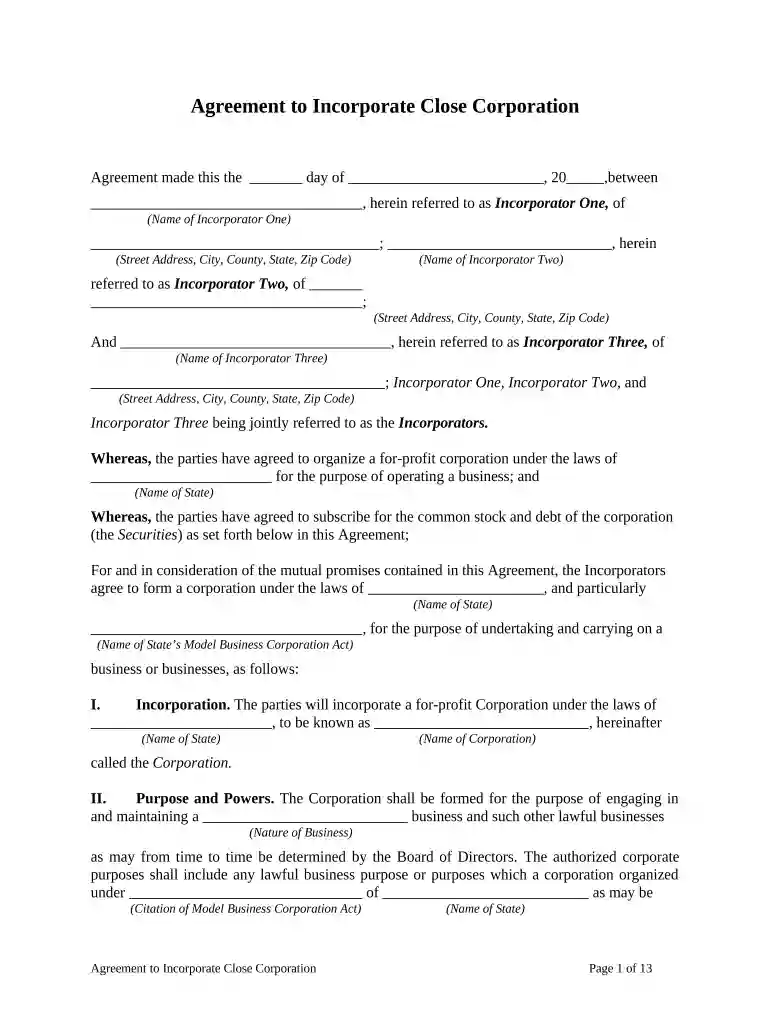
corporation agreement Preview on Page 1

Here's how it works

01. Edit your corporation agreement online
Type text, add images, blackout confidential details, add comments, highlights and more.

02. Sign it in a few clicks
Draw your signature, type it, upload its image, or use your mobile device as a signature pad.

03. Share your form with others
Send it via email, link, or fax. You can also download it, export it or print it out.

How to use or fill out close corporation with our platform

Form edit decoration
9.5
Ease of Setup
DocHub User Ratings on G2
9.0
Ease of Use
DocHub User Ratings on G2
  1. Click ‘Get Form’ to open the close corporation agreement in the editor.
  2. Begin by entering the date at the top of the form. This is crucial for establishing the timeline of your agreement.
  3. Fill in the names and addresses of all incorporators in the designated fields. Ensure accuracy as this information is vital for legal identification.
  4. Specify the state under which you are incorporating and provide a name for your corporation. This will be used throughout the document.
  5. Detail the purpose of your corporation in Section II, clearly stating what business activities it will engage in.
  6. Incorporate capitalization details, including authorized capital and stock subscriptions from each incorporator, ensuring all amounts are correctly noted.
  7. Designate initial directors and officers, filling out their names and roles as required in Sections VII and VIII.
  8. Review all sections thoroughly before finalizing. Use our platform’s features to save your progress or make edits as needed.

Start using our platform today to streamline your close corporation formation process for free!

be ready to get more

Complete this form in 5 minutes or less

Get form

Got questions?

We have answers to the most popular questions from our customers. If you can't find an answer to your question, please contact us.
Contact us
CC vs (Pty) Ltd | Key differences. A key difference between a close corporation (CC) and a private limited company is that a CC is limited to a maximum of 10 members, while a private limited company can have a docHubly larger number of shareholders.
A Close Corporation is a type of business structure where ownership is limited to a small group of individuals, often family members or a few shareholders, and it typically has less stringent reporting and regulatory requirements compared to a publicly traded company.
Ernst Young, PricewaterhouseCoopers, SC Johnson, Hearst Corporation, and Chick-Fil-A, and Hobby Lobby are other well-known U.S. closed corporations. Some examples of a non-U.S. closed corporation are Swedens IKEA, Germanys ALDI and Bosch, and Denmarks LEGO.
A close corporation is a corporation which is held by a limited number of shareholders and is not publicly traded.
Cons of close corporations Time and money. Taxation. You may not need to decide between a close corporation versus an S corporation, as your company could be both. More shareholder responsibility. Stock concerns.

Security and compliance

At DocHub, your data security is our priority. We follow HIPAA, SOC2, GDPR, and other standards, so you can work on your documents with confidence.
Learn more
ccpa2
pci-dss
gdpr-compliance
hipaa
soc-compliance

People also ask

By structuring as a closed corporation when incorporating, a partnership can benefit from liability protection without dramatically changing the way that the business operates. It can also offer companies greater flexibility in operations, as they are free from most reporting requirements and shareholder pressure.
The difference lies primarily in the way that ownership, by way of shares, is distributed. In a close corporation, shares of the corporation are generally held by only a small number of people and are not available for sale or purchase in the public markets.
The most obvious advantage of a close corporation is fewer rules to follow. You still must abide by regulations concerning the filing of incorporation documents, but beyond that, owners can focus on running the company instead of worrying about corporate regulatory compliance. Limited liability.

Related links