Calculation garnishment 2026

Get Form
wage garnishment calculator Preview on Page 1

Here's how it works

01. Edit your wage garnishment calculator online
Type text, add images, blackout confidential details, add comments, highlights and more.
02. Sign it in a few clicks
Draw your signature, type it, upload its image, or use your mobile device as a signature pad.
03. Share your form with others
Send garnishment calculation sheet via email, link, or fax. You can also download it, export it or print it out.

How to use or fill out calculation garnishment with our platform

Form edit decoration
9.5
Ease of Setup
DocHub User Ratings on G2
9.0
Ease of Use
DocHub User Ratings on G2
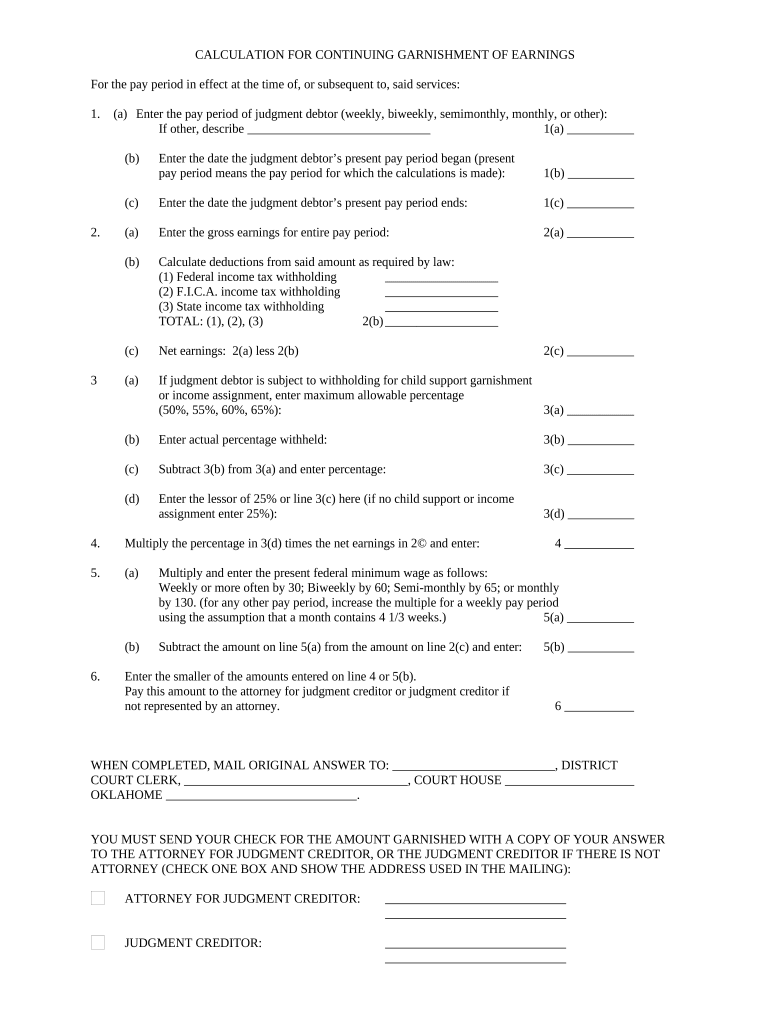
  1. Click ‘Get Form’ to open the calculation garnishment document in the editor.
  2. In section 1(a), select the pay period of the judgment debtor (weekly, biweekly, etc.). If 'other', provide a description.
  3. Enter the start date of the current pay period in section 1(b) and the end date in section 1(c).
  4. Input gross earnings for the entire pay period in section 2(a).
  5. Calculate deductions as required by law in section 2(b), including federal income tax, F.I.C.A., and state income tax withholding. Sum these amounts.
  6. Determine net earnings by subtracting total deductions from gross earnings in section 2(c).
  7. If applicable, enter maximum allowable percentage for child support garnishment in section 3(a) and actual percentage withheld in section 3(b).
  8. Subtract the actual percentage from the maximum allowable percentage in section 3(c) and enter it.
  9. In section 3(d), enter the lesser of 25% or line 3(c).
  10. Multiply this percentage by net earnings from line 2(c) and enter it in line 4.
  11. Calculate federal minimum wage based on your pay period type and enter it in line 5(a). Subtract this from line 2(c) to get line 5(b).
  12. Finally, enter the smaller amount between lines 4 and 5(b) on line 6. Ensure you send your check along with a copy of your answer to the appropriate party.

Start using our platform today to easily complete your calculation garnishment form online for free!

be ready to get more

Complete this form in 5 minutes or less

Get form

Got questions?

We have answers to the most popular questions from our customers. If you can't find an answer to your question, please contact us.
Contact us
Pre-tax deductions: Medical and dental benefits, 401(k) retirement plans (for federal and most state income taxes) and group-term life insurance. Mandatory deductions: Federal and state income tax, FICA taxes, and wage garnishments. Post-tax deductions: Garnishments, Roth IRA retirement plans and charitable donations.
Federal law caps this type of wage garnishment at 25% of your weekly disposable income, or the amount by which your weekly income exceeds 30 times the federal minimum wage (currently $7.25 an hour), This means that if you are earning $290 or more, after taxes and withholdings, 25% of your income can be taken.
The amount of pay subject to garnishment is based on an employees disposable earnings, which is the amount of earnings left after legally required deductions are made.
Federal law limits wage garnishments to 25% of your disposable income (15% for federal student loans) or the amount exceeding 30 times the federal minimum wage, whichever is less. Individuals with a child support order can garnish up to 65% of disposable earnings for child support.
Contact your employer Your employer is legally obligated to inform you of any wage garnishments. Reach out to your HR department or payroll representative and ask for details on the amount being garnished from your wages.

Security and compliance

At DocHub, your data security is our priority. We follow HIPAA, SOC2, GDPR, and other standards, so you can work on your documents with confidence.

Learn more
ccpa2
pci-dss
gdpr-compliance
hipaa
soc-compliance

People also ask

Does garnishment come out before taxes? No, wage garnishments are withheld from disposable earnings, which means all requisite taxes income tax, Social Security tax, Medicare tax, etc. are deducted prior to calculating garnishments.
For ordinary garnishments (i.e., those not for support, bankruptcy, or any state or federal tax), the weekly amount may not exceed the lesser of two figures: 25% of the employees disposable earnings, or the amount by which an employees disposable earnings are greater than 30 times the federal minimum wage (currently

wage garnishment calculation worksheet