






Definition and Meaning of Interview Scoring Rubric
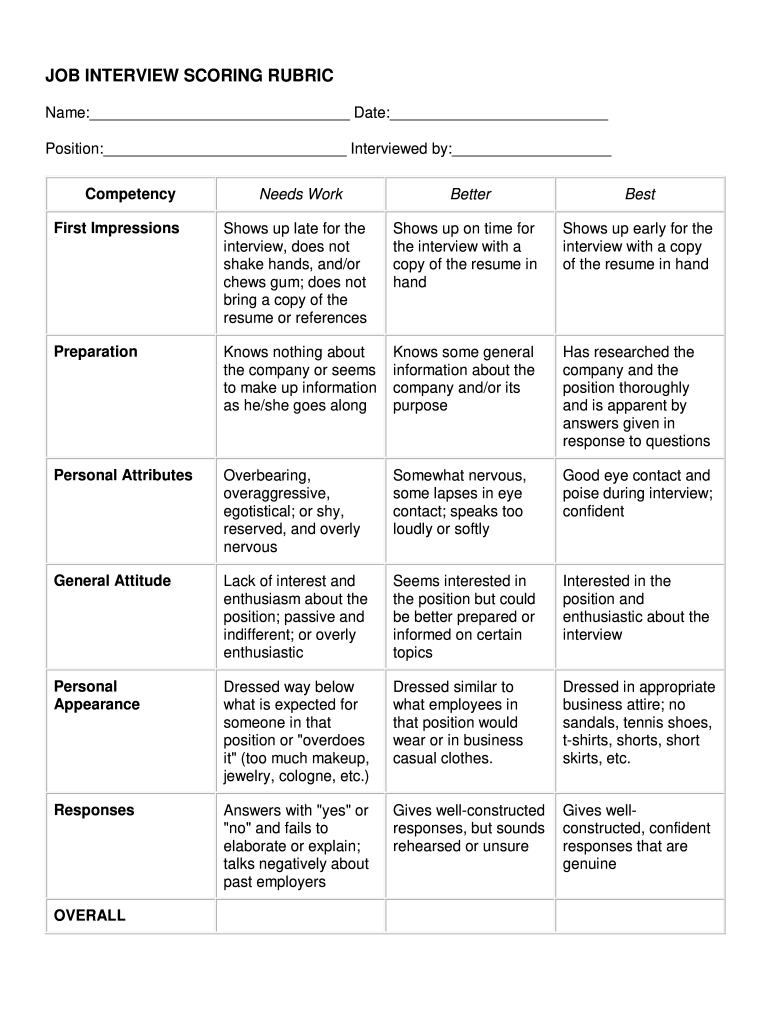
An interview scoring rubric is a structured tool designed to evaluate candidates' performance during job interviews. It typically includes various competencies that reflect the essential skills and attributes needed for the position. Each competency is assessed on a predetermined scale, allowing interviewers to systematically compare candidates. This method aids in minimizing biases, enhancing objectivity, and establishing a clear framework for decision-making.
- Competencies Evaluated: Common competencies in an interview scoring rubric often include First Impressions, Preparation, Personal Attributes, General Attitude, and Personal Appearance. Each of these elements plays a critical role in assessing a candidate's fit for the role and organizational culture.
- Scoring Scales: The rubric usually employs a rating scale, which may vary from numerical scores (e.g., one to five) to descriptive categories (e.g., Needs Work to Best). This allows interviewers to provide clear feedback and justification behind their evaluations.
How to Use the Interview Scoring Rubric
Utilizing an interview scoring rubric involves several systematic steps that enhance the overall evaluation process. Adhering to these steps ensures that interviewers gather relevant information effectively and create a reliable record of candidates’ performances.
- Preparation: Before the interview, familiarize yourself with the rubric and the specific competencies you will evaluate. It’s beneficial to align interview questions with each competency to facilitate guided responses.
- Conducting the Interview: During the interview, take notes on the candidate's responses specific to each competency. Ensure consistency by applying the same criteria across all candidates interviewed for the position.
- Scoring: After the interview, revisit your notes and assign scores based on the established rubric scale. Provide specific comments that justify each score, which can help during discussions with other interviewers.
- Comparison: Once all candidates have been evaluated, use the scores to compare performances systematically. This structured approach makes it easier to identify top candidates objectively.
Key Elements of the Interview Scoring Rubric
An effective interview scoring rubric consists of several critical elements that enhance its functionality and usefulness for interviewers. Understanding these components is vital for accurate evaluations.
- Competency Categories: Clearly defined sections that outline the skills or attributes to be assessed.
- Rating Scale: A systematic scale that offers a range of evaluations for each competency, ensuring consistency across different candidates.
- Descriptive Criteria: Specific definitions or examples that clarify what is expected at each level of the rating scale, which guides evaluators in scoring accurately.
- Feedback Mechanism: Sections where interviewers can provide comments on candidates’ performances, promoting constructive feedback.
Examples of Using the Interview Scoring Rubric
Implementing the interview scoring rubric in real-world scenarios illustrates its effectiveness in a practical context. Several examples may shed light on its applicability.
- Scenario One: A hiring manager uses a rubric to evaluate candidates for a teaching position. They assess competencies such as Classroom Management and Communication Skills. After conducting interviews, they score candidates based on predefined criteria and provide feedback that can be shared with candidates post-interview.
- Scenario Two: An HR team employs the rubric during recruitment for a sales role, focusing on competencies like Sales Acumen and Customer Interaction. By using the rubric, they can effectively discuss and justify their selection decisions based on collective scores and comments from multiple interviewers.
Who Typically Uses the Interview Scoring Rubric
Various professionals and organizations benefit from utilizing an interview scoring rubric during their hiring processes. Recognizing who typically implements this tool can help contextualize its relevance across industries.
- Human Resources Professionals: HR representatives often use the rubric to ensure fair and equitable candidate evaluations, enhancing their hiring processes.
- Hiring Managers: Managers in charge of recruitment frequently rely on the rubric to standardize scoring across multiple interviews, contributing to their decision-making.
- Educational Institutions: Schools and universities may implement the rubric when evaluating candidates for teaching or administrative roles to reflect a comprehensive assessment approach.
- Nonprofit Organizations: These organizations sometimes employ a rubric to align candidate assessment with their mission-driven objectives, ensuring they select individuals who share their values.