Statutory Power of Attorney for Health Care - District of Columbia 2026

Get Form
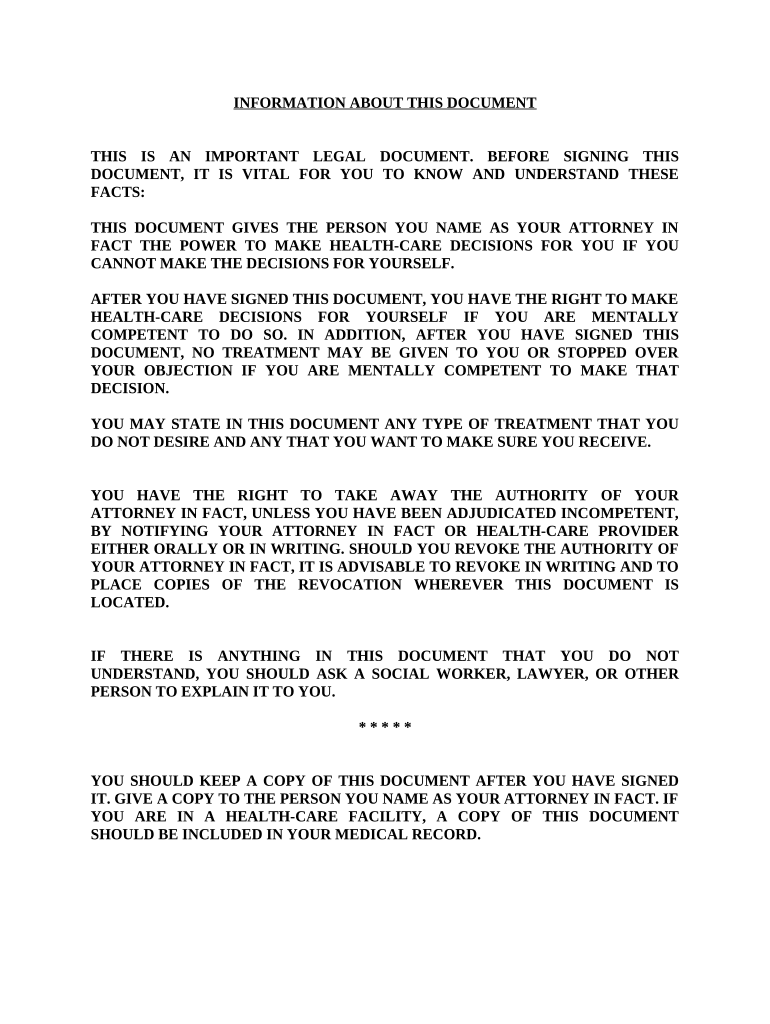
Statutory Power of Attorney for Health Care - District of Columbia Preview on Page 1

Here's how it works

01. Edit your form online
Type text, add images, blackout confidential details, add comments, highlights and more.
02. Sign it in a few clicks
Draw your signature, type it, upload its image, or use your mobile device as a signature pad.
03. Share your form with others
Send it via email, link, or fax. You can also download it, export it or print it out.

How to use or fill out Statutory Power of Attorney for Health Care - District of Columbia with DocHub

Form edit decoration
9.5
Ease of Setup
DocHub User Ratings on G2
9.0
Ease of Use
DocHub User Ratings on G2
  1. Click ‘Get Form’ to open the Statutory Power of Attorney for Health Care in our editor.
  2. Begin by filling in your name at the top of the form, followed by the name and contact information of your appointed attorney-in-fact. This person will make health-care decisions on your behalf if you are unable to do so.
  3. If you have a secondary attorney-in-fact, list their details in the designated section. This ensures that there is a backup decision-maker available.
  4. In the 'Statement of Directives' section, clearly outline any specific health-care treatments you wish to receive or refuse. This empowers your attorney-in-fact to act according to your wishes.
  5. Complete any special provisions or limitations that apply to your health care decisions. Be as detailed as necessary to ensure clarity.
  6. Sign and date the document at the bottom, ensuring that witnesses also sign as required. This step is crucial for validating your power of attorney.

Start using our platform today to easily complete and manage your Statutory Power of Attorney for Health Care!

be ready to get more

Complete this form in 5 minutes or less

Get form

Got questions?

We have answers to the most popular questions from our customers. If you can't find an answer to your question, please contact us.
Contact us
The main difference between the health care and durable power of attorney is their scope. A health care power of attorney only allows your agent to make medical decisions on your behalf, while a durable power of attorney grants your agent broader powers in financial and personal matters.
No, a durable power of attorney does not override a health care proxy; they cover different areas.
A health care proxy specifically grants authority for someone to make health care decisions on your behalf, while a power of attorney grants authority for someone to handle your financial matters and make decisions on your behalf.
This form is usually called a medical power of attorney. Ask your hospital, state bar association, or office on aging where to find these forms. You must sign the form to make it legal. Some states require you to get the form docHubd.
Here are the steps to create a legally binding medical power of attorney: Get a medical power of attorney form. Select your healthcare agent. Determine which medical decisions your agent can make on your behalf. Complete the form, and sign and witness it according to the laws in your state.

Security and compliance

At DocHub, your data security is our priority. We follow HIPAA, SOC2, GDPR, and other standards, so you can work on your documents with confidence.

Learn more
ccpa2
pci-dss
gdpr-compliance
hipaa
soc-compliance
be ready to get more

Complete this form in 5 minutes or less

Get form

People also ask

The Cons of a Healthcare Power of Attorney Develop a new health condition that changes which types of treatment you want or need to receive. Have a falling out with the person to whom you designated power of attorney or otherwise decide that you no longer want them to have that power.
(a) A competent adult may designate, in writing, an individual who shall be empowered to make health-care decisions on behalf of the competent adult, if the competent adult becomes incapable, by reason of mental disability, of making or communicating a choice regarding a particular health-care decision.

Related links