




01. Edit your fire department run report template online
Type text, add images, blackout confidential details, add comments, highlights and more.

Type text, add images, blackout confidential details, add comments, highlights and more.

Draw your signature, type it, upload its image, or use your mobile device as a signature pad.

Send volunteer fire department incident report template via email, link, or fax. You can also download it, export it or print it out.
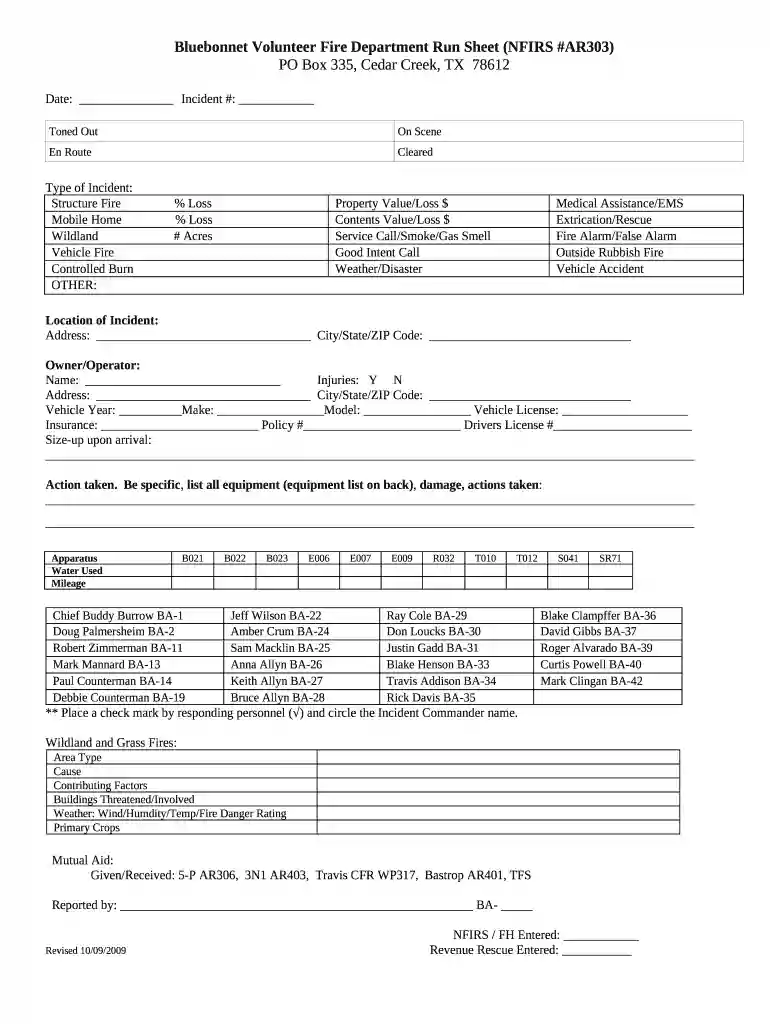
The fire department run report form is a crucial documentation tool used by fire service organizations to record the details of emergency responses. It serves as a formal record of incidents, including fires, medical emergencies, vehicle accidents, and hazardous materials incidents. This form not only provides a summary of the incident but also captures vital information about the location, type, and specifics of the response, ensuring that data is well-organized and accessible for future reference.
The form is vital not only for operational purposes but also for legal and insurance documentation, allowing departments to track patterns in emergency calls and resource usage over time.
Accurately completing a fire department run report form involves following several structured steps to ensure all necessary details are captured. Each section of the form is designed to guide the user in providing comprehensive information.
Accurate reporting is critical for maintaining precise records, ensuring legal compliance, and supporting claims processes related to incidents. Failing to provide complete and accurate information could result in challenges during legal proceedings or insurance claims.
Acquiring a fire department run report form can typically be done through several avenues, depending on local regulations and department procedures.
Depending on the state or municipality, fire departments might have unique versions or requirements for the run report form. It’s important to ensure that the correct form is utilized to meet local standards.
Understanding the key elements of the fire department run report form is vital for comprehensive incident documentation. Each section serves a specific purpose that contributes to the overall record of fire department operations.
Thorough documentation assists with post-incident evaluations and can support training and procedural adjustments within the department. It enables the identification of recurrent issues that may require attention, ultimately improving public safety services.
Practical examples offer valuable insights into the application of the fire department run report form in various scenarios.
In a residential fire incident, the form would capture critical data, including the address, time of dispatch, and response time. The narrative might detail how the fire was extinguished and any injuries to residents or responders.
For medical emergencies, the report would document the type of medical call, the presence of emergency medical technicians, and any interventions performed. This is essential for tracking emergency response effectiveness and improving medical readiness.
In incidents requiring multi-agency cooperation, such as a natural disaster, the form can capture the mutual aid provided by nearby departments. This documentation helps assess resource allocation and inter-departmental coordination.
Post-incident analysis utilizes data from run reports to compile statistics on response trends and training needs. For instance, a rise in medical emergencies could prompt a review of staff training or resource allocation.
Fire departments can also integrate run report data into comprehensive reporting tools that allow for data visualization and long-term trend analysis, aiding in strategic planning and community resource allocation.
The legal implications of the fire department run report form are significant and can influence various aspects ranging from liability issues to compliance mandates.
Fire departments should comply with privacy and data protection laws while ensuring that incident reports are accessible to authorized personnel for legal and administrative purposes. Adhering to state-specific regulations regarding documentation standards is also critical.
By understanding and implementing these detailed guidelines and practices, fire departments can enhance their operational efficacy, ensure proper documentation, and uphold community trust.
We've got more versions of the fire department run report template form. Select the right fire department run report template version from the list and start editing it straight away!
| Versions | Form popularity | Fillable & printable |
|---|---|---|
| 2009 | 4.8 Satisfied (294 Votes) |
At DocHub, your data security is our priority. We follow HIPAA, SOC2, GDPR, and other standards, so you can work on your documents with confidence.
The name of the fire department is entered on the line at the top of the form. Each individual incident must be identified by the following elements fromRead more
This form is intended FIRE DEPARTMENT SAFETY OFFICER PROFESSIONAL QUALIFICATIONS. Fulton County Fire Department. TECHNICAL RESCUE INCIDENT SAFETY REPORT.Read more
3.1. General. User manual with directions regarding the maximum ambient temperature, electrical ratings, operation, description of interfaces, connection toRead more


