Limited liability partnership 2026

Get Form
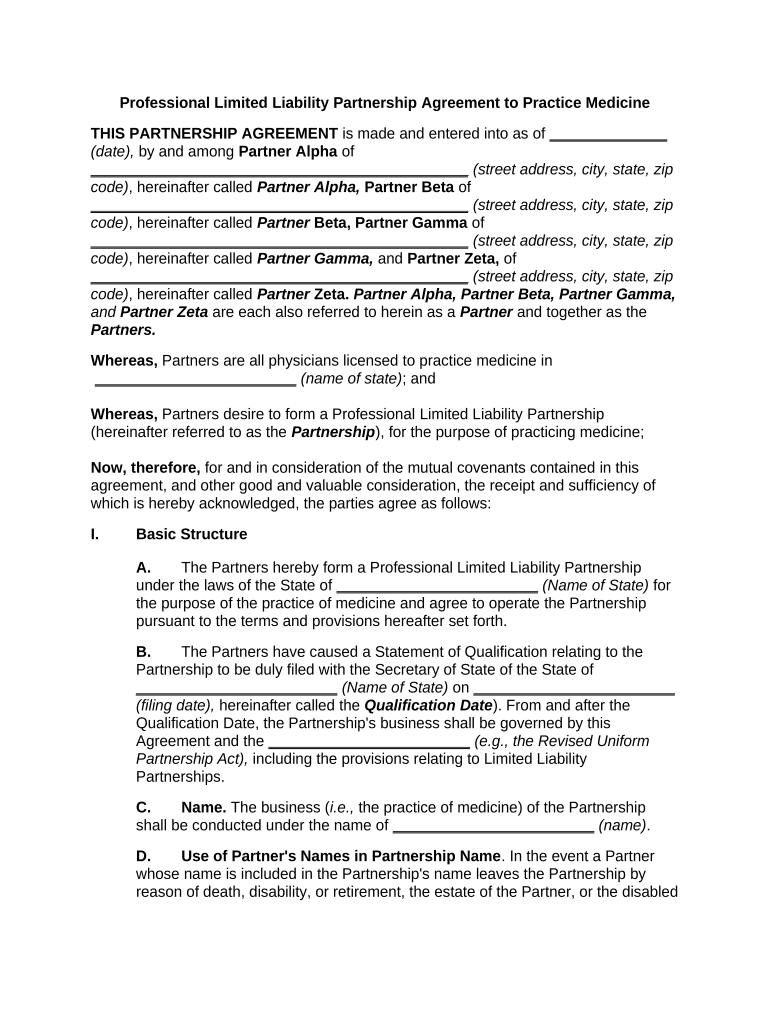
limited liability partnership Preview on Page 1

Here's how it works

01. Edit your form online
Type text, add images, blackout confidential details, add comments, highlights and more.
02. Sign it in a few clicks
Draw your signature, type it, upload its image, or use your mobile device as a signature pad.
03. Share your form with others
Send it via email, link, or fax. You can also download it, export it or print it out.

How to use or fill out limited liability partnership with our platform

Form edit decoration
9.5
Ease of Setup
DocHub User Ratings on G2
9.0
Ease of Use
DocHub User Ratings on G2
  1. Click ‘Get Form’ to open the Limited Liability Partnership Agreement in the editor.
  2. Begin by entering the date of the agreement at the top of the form. This is crucial for establishing the timeline of your partnership.
  3. Fill in the names and addresses of all partners involved. Ensure accuracy as this information is vital for legal recognition.
  4. Specify the state where your partnership will operate, as this affects legal compliance and regulations.
  5. Complete sections regarding management structure, including naming a Managing Partner and outlining their responsibilities.
  6. Detail capital contributions from each partner, ensuring clarity on initial investments and profit-sharing ratios.
  7. Review sections on meetings, voting rights, and expulsion procedures to ensure all partners understand their rights and obligations.
  8. Finalize by signing electronically within our platform, ensuring that all partners have agreed to the terms outlined in the document.

Start using our platform today to streamline your Limited Liability Partnership Agreement process for free!

be ready to get more

Complete this form in 5 minutes or less

Get form

Got questions?

We have answers to the most popular questions from our customers. If you can't find an answer to your question, please contact us.
Contact us
An LLP stands for Limited Liability Partnership. It is a business structure where partners have limited liability, meaning they are not personally liable for the debts and obligations of the LLP beyond their invested capital and any personal guarantees made.
LLPs, being partnerships, offer flexibility and confidentiality to their members, while Ltd companies have shareholders and directors at the core of their structure. LLPs resemble normal partnerships, with liability limited to the members investments, making it a fusion of a partnership and a company.
Limited partnerships are a form of partnership involving general partners, who are liable for all the debts and liabilities of the partnership, and limited partners, who are liable to the extent of their capital contribution to the partnership.
Offers Possible Pass-Through Tax Relief Typically, the LLP shares the limited liability of a corporation but avoids the double taxation associated with a corporation under IRS rules. Rather, LLPs are treated as pass-through entities. So, the LLP itself isnt taxed as a separate entity under federal tax laws.
An LLP offers limited liability protection, organizational flexibility, and tax transparency, making it ideal for professional services. However, it comes with increased administrative obligations and less tax efficiency compared to limited companies.

Security and compliance

At DocHub, your data security is our priority. We follow HIPAA, SOC2, GDPR, and other standards, so you can work on your documents with confidence.

Learn more
ccpa2
pci-dss
gdpr-compliance
hipaa
soc-compliance

People also ask

Limited liability partnerships (LLPs) allow for a partnership structure where each partners liabilities are limited to the amount they put into the business. Having business partners means spreading risk, leveraging individual skills and expertise, and establishing a division of labor.
Limited liability partnership (LLP) is a type of general partnership where every partner has a limited personal liability for the debts of the partnership. Partners will not be liable for the tortious damages of other partners but potentially for the contractual debts depending on the state.

Related links