Legal Last Will and Testament Form for Married person with Adult Children from Prior Marriage - Maryland 2026

Get Form
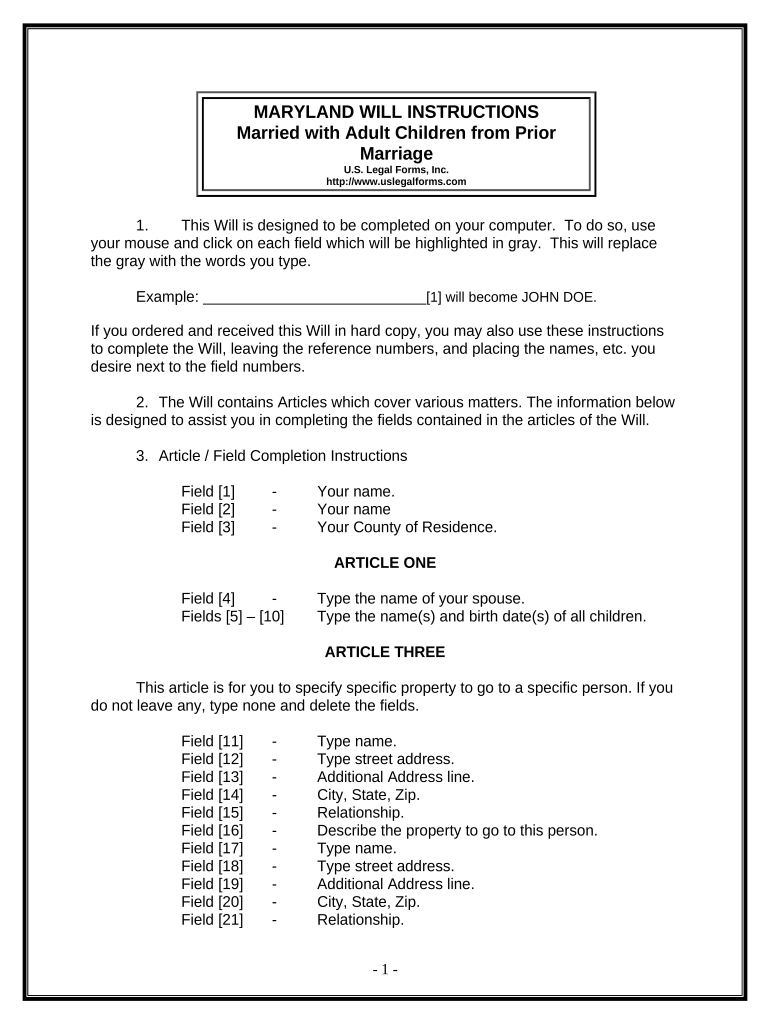
Legal Last Will and Testament Form for Married person with Adult Children from Prior Marriage - Maryland Preview on Page 1

Here's how it works

01. Edit your form online
Type text, add images, blackout confidential details, add comments, highlights and more.
02. Sign it in a few clicks
Draw your signature, type it, upload its image, or use your mobile device as a signature pad.
03. Share your form with others
Send it via email, link, or fax. You can also download it, export it or print it out.

How to use or fill out Legal Last Will and Testament Form for Married person with Adult Children from Prior Marriage - Maryland

Form edit decoration
9.5
Ease of Setup
DocHub User Ratings on G2
9.0
Ease of Use
DocHub User Ratings on G2
  1. Click ‘Get Form’ to open it in the editor.
  2. Begin by entering your name in Field [1], followed by your county of residence in Field [3].
  3. In Article One, specify your spouse's name in Field [4] and list the names and birth dates of all adult children from a prior marriage in Fields [5] to [10].
  4. For Article Three, detail any specific property you wish to bequeath. Fill out the fields for each item, including name, address, relationship, and description of the property.
  5. In Article Four, indicate who will inherit your homestead by typing their name in Field [29] or naming your children if applicable.
  6. Complete Articles Five through Eleven as directed, ensuring all necessary fields are filled accurately.
  7. Once completed, review all entries for accuracy before printing. Remember to sign the document in front of two witnesses.

Start using our platform today to easily complete your Legal Last Will and Testament form for free!

be ready to get more

Complete this form in 5 minutes or less

Get form

Got questions?

We have answers to the most popular questions from our customers. If you can't find an answer to your question, please contact us.
Contact us
The Drawbacks of Joint Wills Lack of Flexibility: One of the main issues with joint wills is their inflexibility. Once one spouse passes away, the surviving spouse cannot alter the will. This could pose challenges if circumstances change, such as the birth of new grandchildren or changes in financial status.
A joint will is a single document signed by two people (typically spouses) that serves as the will for both individuals. Mutual wills are separate documents created by two people with reciprocal terms, often with an agreement that the surviving person wont change their will after the first person dies.
A mirror will is a slightly deceptive term because a mirror will is actually two wills, but the trick here is that both wills are nearly identical. You can see why they are so attractive to married couples. Where a mirror will is especially useful when you just want your estate to pass to your partner, and vice-versa.
If the testator (the person creating the Will) lacks the testamentary capacity for reasons like dementia, mental illness, or the influence of medications or substances, this could void a Will.
In Maryland, a will must be (1) in writing (typed or handwritten), (2) signed by the person making the will, and (3) attested and signed by two credible witnesses in the presence of the person making the will. The person making the will and the two witnesses must be at least 18 years of age and legally competent.

Security and compliance

At DocHub, your data security is our priority. We follow HIPAA, SOC2, GDPR, and other standards, so you can work on your documents with confidence.

Learn more
ccpa2
pci-dss
gdpr-compliance
hipaa
soc-compliance

People also ask

In Maryland, a valid will must be (1) in writing, (2) signed, and (3) attested and signed by two credible witnesses. It may be handwritten or typed and any two adults can be witnesses. A will does not require a notary, though a notary can be a witness. Electronic, oral, and video wills are not valid in Maryland.
Yes, spouses actually always have separate wills and they do not require the consent of the other party. In many (most?) states, spouses each own 50% of all property and assets as community property.
Spouses need separate wills. Even if the majority of the information in your wills is nearly identical, you still need to each have your own. Read on to see why this is so important.

Related links