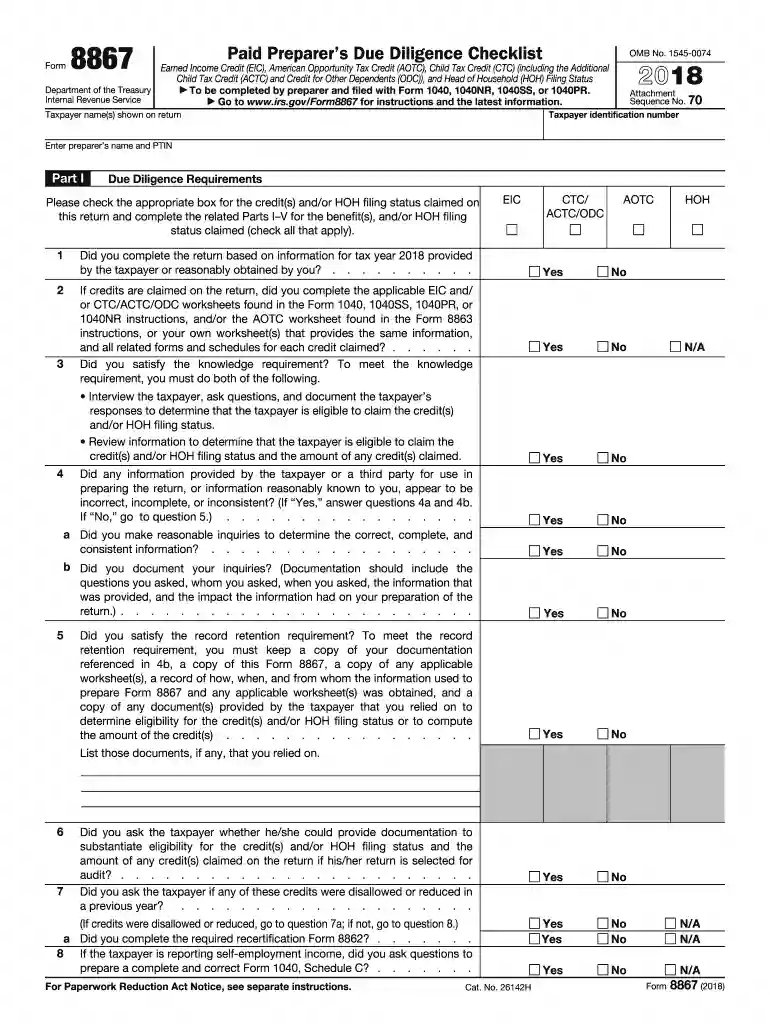
Form 8867-2026

Get Form
8867 Preview on Page 1

Here's how it works

01. Edit your 8867 online
Type text, add images, blackout confidential details, add comments, highlights and more.

02. Sign it in a few clicks
Draw your signature, type it, upload its image, or use your mobile device as a signature pad.

03. Share your form with others
Send form 8867 irs via email, link, or fax. You can also download it, export it or print it out.

Definition and Purpose of Form 8867

Form 8867, officially known as the Paid Preparer’s Due Diligence Checklist, is a document required by the Internal Revenue Service (IRS) for tax preparers. It ensures compliance when claiming various tax credits, including the Earned Income Credit (EIC), American Opportunity Tax Credit (AOTC), Child Tax Credit (CTC), and the Head of Household (HOH) filing status. The primary purpose of this form is to outline the due diligence requirements that tax preparers must follow to verify taxpayer eligibility. Proper use of this form can help mitigate penalties that may arise from incorrectly prepared tax returns.

Tax preparers must complete Form 8867 accurately and submit it alongside the taxpayer’s return. The IRS mandates that this form be used to document the due diligence efforts undertaken when claiming any of the aforementioned credits. By detailing your efforts to verify eligibility and retain necessary documentation, you protect both yourself as a preparer and your clients from potential audits.

Key Elements of Form 8867

To efficiently utilize Form 8867, it is important to understand its key elements, which include sections that address:

  • Eligibility Verification: This section requires preparers to confirm that taxpayers meet all eligibility requirements for each tax credit claimed.
  • Documentation Retention: This part focuses on what documentation should be retained by the preparer, including any inquiries made to the taxpayer to confirm eligibility.
  • Signature Requirement: Both the preparer and the client must sign the form, acknowledging that the information provided is accurate and complete.

Each of these elements works in tandem to ensure compliance with IRS regulations. For example, a preparer may need to document the review of a taxpayer's income and dependency status to substantiate claims made on their return.

Steps to Complete Form 8867

Completing Form 8867 involves several crucial steps, which should be followed meticulously:

  1. Gather Necessary Information: Collect financial documents from your client, such as W-2s, 1099s, and Social Security numbers.
  2. Confirm Eligibility: Determine if the taxpayer qualifies for any credits by verifying their income, filing status, and dependent information.
  3. Document Inquiries: Log any questions asked to the taxpayer about their eligibility and retain responses for your records.
  4. Complete the Form: Fill out each section of Form 8867 accurately based on the collected information. Make sure to check all boxes that apply to the taxpayer’s situation.
  5. Provide Signatures: Ensure that both the tax preparer and the taxpayer sign the form before submission.

Failure to follow each step can result in incomplete documentation and potential penalties from the IRS, emphasizing the importance of due diligence.

IRS Guidelines and Penalties for Non-Compliance

The IRS has stipulated specific guidelines regarding Form 8867, which aim to enforce due diligence requirements for tax preparers. Preparers must:

  • Maintain documentation supporting eligibility claims for three years from the filing date.
  • Ensure the form is completed and submitted with each claim for the EIC, AOTC, or CTC.

Non-compliance with these guidelines can lead to significant penalties. For instance, if a tax preparer fails to maintain proper documentation or knowingly claims credits without verifying a taxpayer's eligibility, they may face fines of up to $5,000 per violation. Understanding these guidelines is crucial for avoiding penalties and ensuring compliance.

Eligibility Criteria and Legal Use of Form 8867

The legal use of Form 8867 is specifically tied to the eligibility criteria for various tax credits. The following conditions must be met for taxpayers to qualify for specific credits:

  • Earned Income Credit (EIC): Taxpayers must have earned income and meet income thresholds, filing status requirements, and residency status.
  • American Opportunity Tax Credit (AOTC): This credit is available for students who are pursuing higher education and meet specific income and enrollment criteria.
  • Child Tax Credit (CTC): Eligibility for the CTC requires taxpayers to have qualifying children who meet age limits and residency requirements.

Form 8867 serves as a protective measure for preparers to ensure they are in compliance with IRS requirements while also safeguarding taxpayers from unwanted audits. By thoroughly evaluating and documenting eligibility criteria, preparers uphold the legal standards required in their profession.

decoration image ratings of Dochub

How to Obtain Form 8867

Form 8867 can be easily obtained through several channels:

  • IRS Website: The form is available for download directly from the IRS website in PDF format, which can be printed and filled out manually or completed digitally.
  • Tax Preparation Software: Many tax preparation platforms and software solutions offer integrated access to Form 8867, allowing for seamless electronic filing.
  • Professional Tax Organizations: Some professional tax preparation associations may provide access to updated forms and documents for their members.

Having the correct and up-to-date version of Form 8867 is essential for compliance, especially since IRS forms can be updated or modified periodically.

Real-World Examples of Using Form 8867

Tax preparers commonly encounter various scenarios where Form 8867 is essential. Here are a few illustrative examples:

  • Example 1: A single mother claims the EIC for her qualifying child. The preparer reviews relevant tax documents to ensure that the child meets age and residency requirements and completes Form 8867 to verify and document the eligibility.
  • Example 2: A college student applying for the AOTC presents a 1098-T form. The tax preparer verifies enrollment status and income eligibility before logging this information on Form 8867 to retain due diligence.

These examples highlight the practical application of Form 8867 in different tax situations, emphasizing its role in protecting both the preparer and the taxpayer while adhering to IRS regulations.

See more form 8867 versions

We've got more versions of the form 8867 form. Select the right form 8867 version from the list and start editing it straight away!
Versions Form popularity Fillable & printable
2023 4.9 Satisfied (25 Votes)
2022 4.6 Satisfied (58 Votes)
2021 4.8 Satisfied (90 Votes)
2020 4.4 Satisfied (83 Votes)
2019 4.3 Satisfied (54 Votes)
2018 4.3 Satisfied (151 Votes)
2017 4.4 Satisfied (88 Votes)
2016 4.3 Satisfied (117 Votes)
2015 4.1 Satisfied (67 Votes)
2014 4.3 Satisfied (38 Votes)
2013 3.9 Satisfied (35 Votes)
2011 4.1 Satisfied (38 Votes)
be ready to get more

Complete this form in 5 minutes or less

Get form

Got questions?

We have answers to the most popular questions from our customers. If you can't find an answer to your question, please contact us.
Contact us
Introducing the 4 main CDD requirements Customer identification and verification. The first core pillar of CDD involves thorough customer identity verification and investigation. Beneficial ownership identification and verification. Defining the purpose of the business-customer relationships. Ongoing monitoring.
A due diligence questionnaire, referred to by the acronym DDQ, is a list of questions designed to evaluate aspects of an organization prior to a merger, acquisition, investment or partnership. Sometimes, the due diligence questionnaire is called the due diligence checklist.
The Four Due Diligence Requirements Complete and Submit Form 8867. (Treas. Reg. section 1.6695-2(b)(1)) Compute the Credits. (Treas. Reg. section 1.6695-2(b)(2)) Knowledge. (Treas. Reg. section 1.6695-2(b)(3)) Keep Records for Three Years.
The 4 Ps of due diligence are People, Performance, Philosophy, and Process. These key elements form the foundation of a thorough due diligence process, covering aspects related to the team involved, performance metrics, investment philosophy, and the overall process followed.
The purpose of the form is to ensure that the practitioner has considered all applicable eligibility criteria for certain tax credits for each return prepared, such as the earned income tax credit (EITC), child tax credit (CTC), additional child tax credit (ACTC), credit for other dependents (ODC), American opportunity
be ready to get more

Complete this form in 5 minutes or less

Get form

People also ask

A due diligence check involves careful investigation of the economic, legal, fiscal and financial circumstances of a business or individual. This covers aspects such as sales figures, shareholder structure and possible links with forms of economic crime such as corruption and tax evasion.
About Form 8867, Paid Preparers Due Diligence Checklist | Internal Revenue Service.

irs form 8867