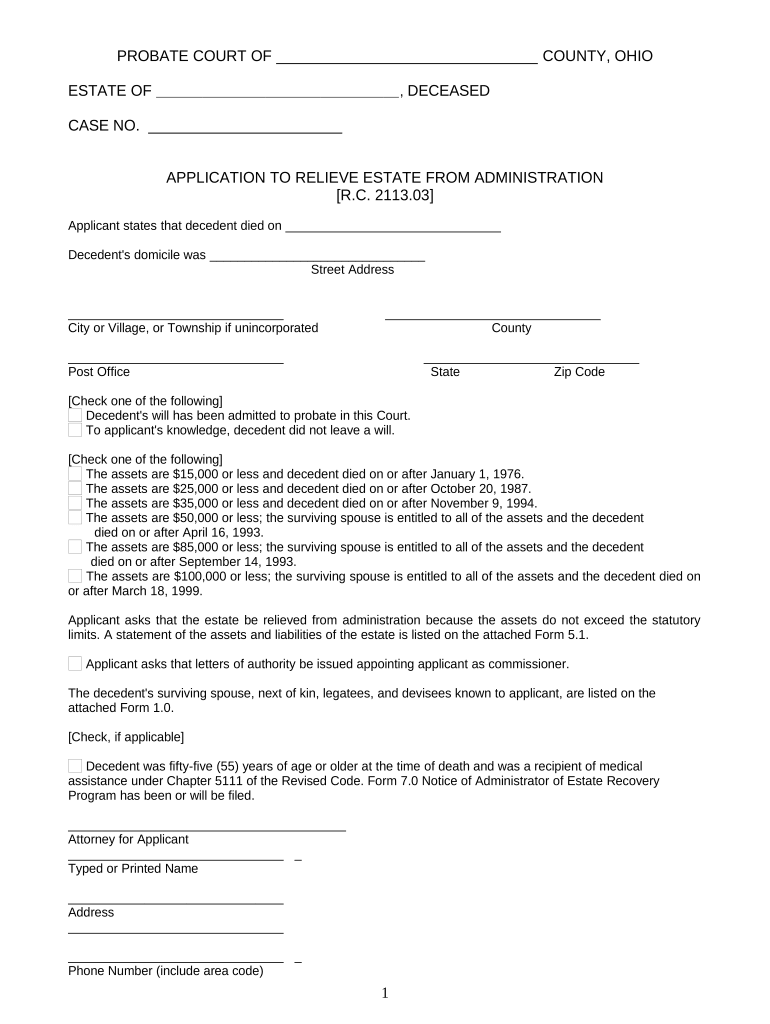
Ohio estate 2026

Get Form
ohio estate Preview on Page 1

Here's how it works

01. Edit your form online
Type text, add images, blackout confidential details, add comments, highlights and more.
02. Sign it in a few clicks
Draw your signature, type it, upload its image, or use your mobile device as a signature pad.
03. Share your form with others
Send it via email, link, or fax. You can also download it, export it or print it out.

How to use or fill out ohio estate with our platform

Form edit decoration
9.5
Ease of Setup
DocHub User Ratings on G2
9.0
Ease of Use
DocHub User Ratings on G2
  1. Click ‘Get Form’ to open the Ohio Estate Application in the editor.
  2. Begin by entering the decedent's name and case number at the top of the form. This information is crucial for identifying the estate.
  3. Fill in the date of death and the decedent's domicile address, including street, city, county, state, and zip code. Ensure accuracy as this establishes jurisdiction.
  4. Indicate whether a will exists by checking the appropriate box. This is important for determining how assets will be distributed.
  5. Select one of the asset limit options based on when the decedent died and their surviving spouse's entitlement. This helps clarify if administration is necessary.
  6. Attach Form 5.1 detailing assets and liabilities, as well as Form 1.0 listing known heirs and legatees.
  7. If applicable, check if the decedent was a recipient of medical assistance and ensure Form 7.0 is filed.
  8. Complete attorney information fields if represented, including registration number.

Start using our platform today to streamline your Ohio estate application process for free!

be ready to get more

Complete this form in 5 minutes or less

Get form

Got questions?

We have answers to the most popular questions from our customers. If you can't find an answer to your question, please contact us.
Contact us
The basic steps of administration are as follows: filing of an application for authority to administer the estate and admit the will to probate, if one exists; appointment of fiduciary; gathering assets and obtaining appraisals as required; filing an inventory of assets; paying creditors;
Summary release from the administration: Avoids probate entirely if either: The estates worth less than $40,000 and the surviving spouse is the sole heir. The estates worth less than $5,000 and/or the decedents final expenses total no more than $5,000.
Ohio doesnt have an estate tax or an inheritance tax. Ohio repealed its estate tax in 2013. Before that, estates over $338,333 were taxed, but that rule no longer applies. As of 2025, no matter how much an estate is worth, Ohio wont tax it.
Ohio Revised Code 5302.23 outlines one manner of transferring real estate outside of probate through a Transfer on Death Affidavit (TOD Affidavit). A TOD Affidavit allows an owner to designate one or more beneficiaries who will automatically receive the property upon the owners death outside of probate.
A probate estate is a legal proceeding provided for by Ohio law to determine the assets of a deceased person who was an Ohio resident at the time of death, the value of those assets, and the distribution of those assets to the persons entitled to them by law.

Security and compliance

At DocHub, your data security is our priority. We follow HIPAA, SOC2, GDPR, and other standards, so you can work on your documents with confidence.

Learn more
ccpa2
pci-dss
gdpr-compliance
hipaa
soc-compliance

People also ask

An estate refers to everything a person owns at the time of their death. This includes real estate, personal belongings, bank accounts, investments, life insurance policies, retirement accounts, and even debts. Everyone has an estate at the time of their death, not just the wealthy.
The estate may be made up of: money, both cash and money in a bank or building society account. money owed to the person who has died. shares.

Related links