
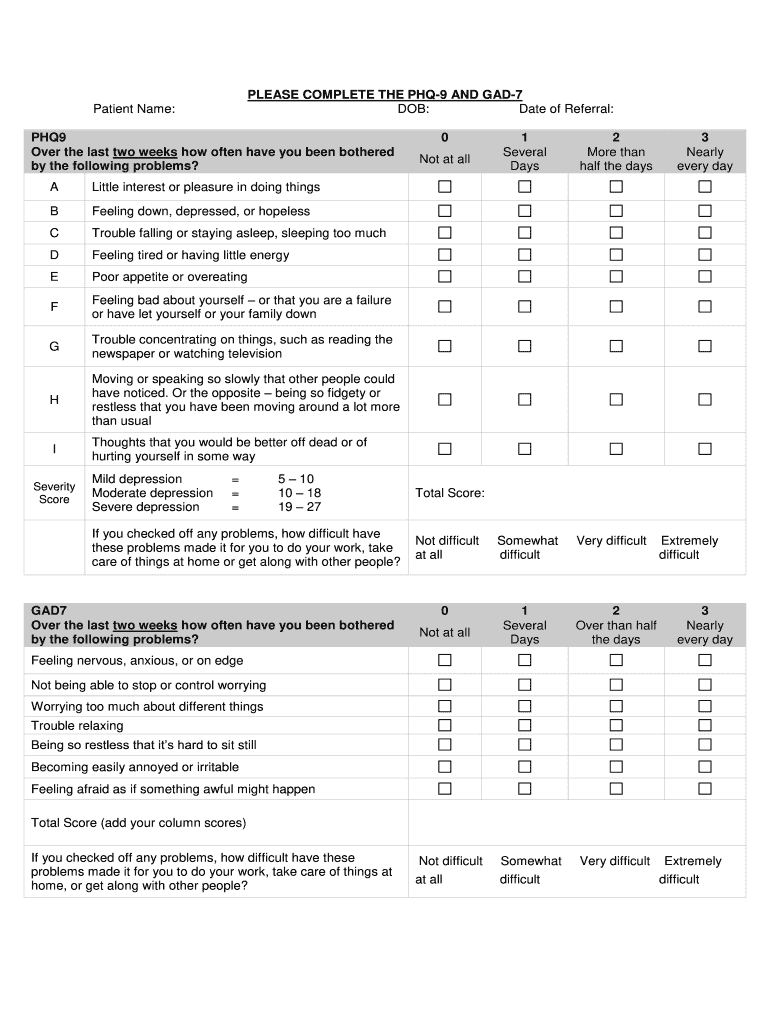







Overview of PHQ-9 and GAD-7 Forms
The PHQ-9 (Patient Health Questionnaire-9) and GAD-7 (Generalized Anxiety Disorder-7) are widely used screening tools to assess depression and anxiety in individuals. These standardized scales help healthcare providers identify symptom severity and provide necessary interventions. The PHQ-9 focuses specifically on depressive symptoms, while the GAD-7 targets anxiety symptoms, making them essential for comprehensive mental health evaluations.
- PHQ-9 Overview: The PHQ-9 contains nine questions related to depressive symptoms experienced over the past two weeks.
- GAD-7 Overview: The GAD-7 consists of seven questions targeting symptoms of generalized anxiety disorder experienced over the same timeframe.
- Utility: Both forms are key in determining treatment plans, monitoring progress, and facilitating communication between patients and healthcare professionals.
How to Complete the PHQ-9 and GAD-7 Forms
Completing the PHQ-9 and GAD-7 forms is straightforward. Each question features a four-point Likert scale, allowing respondents to indicate how often they have experienced specific symptoms.
- Read Each Statement: Patients should carefully read each statement in both questionnaires.
- Select Frequency: Respondents choose from options ranging from "not at all" (0 points) to "nearly every day" (3 points). Accurate choices depend on self-reflection regarding symptoms experienced within the last two weeks.
- Total the Scores: At the end of each questionnaire, respondents total their scores to determine the severity of symptoms.
- Scoring Interpretation:
- PHQ-9:
- 0-4: Minimal depression
- 5-9: Mild depression
- 10-14: Moderate depression
- 15-19: Moderately severe depression
- 20-27: Severe depression
- GAD-7:
- 0-4: Minimal anxiety
- 5-9: Mild anxiety
- 10-14: Moderate anxiety
- 15-21: Severe anxiety
- PHQ-9:
Importance of Using PHQ-9 and GAD-7 Together
The combined use of PHQ-9 and GAD-7 forms can provide a comprehensive view of an individual's mental health. These tools complement each other by:
- Holistic Assessment: Healthcare providers can gain insights into overlapping symptoms of anxiety and depression and their impact on daily functioning.
- Treatment Planning: Results from both questionnaires inform tailored treatment strategies, including therapy, medication, or further evaluations.
- Monitoring Effectiveness: Regular reassessment using these forms can track symptom changes over time, aiding ongoing treatment decisions.
Accessibility and Variants of PHQ-9 and GAD-7 Forms
PHQ-9 and GAD-7 forms are available in multiple formats to cater to diverse needs:
- Fillable PDF Versions: Both questionnaires can be accessed as fillable PDFs, allowing for easy completion on computers or tablets.
- Printable Formats: For those who prefer paper submissions, printable versions are available.
- Language Options: Spanish-language versions (e.g., PHQ-9 en español) and other translations are often accessible, broadening the reach of these critical tools.
Fillable Forms Availability
- Fillable PHQ-9 and GAD-7: Available on various healthcare platforms, users can easily complete these forms online.
- Word Document Formats: Users may choose to find the forms in Word document formats for direct editing and completion before submission.
Clinical Use and Legal Considerations
Mental health practitioners must adhere to ethical and legal standards when using the PHQ-9 and GAD-7 forms:
- Confidentiality: Patient responses should be treated with strict confidentiality and stored securely.
- Informed Consent: Patients should be made aware of the purpose and processes regarding the assessment.
Professional Use Cases
- Routine Screenings: Clinicians often use these assessments as part of routine mental health check-ups.
- Specialized Assessments: PHQ-9 and GAD-7 can be used in specialized settings such as primary care or therapy practices to ensure comprehensive care.
Conclusion
Utilizing the PHQ-9 and GAD-7 forms is vital for effective mental health assessment in various settings. Healthcare providers benefit from understanding the nuances of these instruments to improve patient care, monitor symptoms, and adopt interventions tailored to the needs of individuals experiencing anxiety and depression.




