
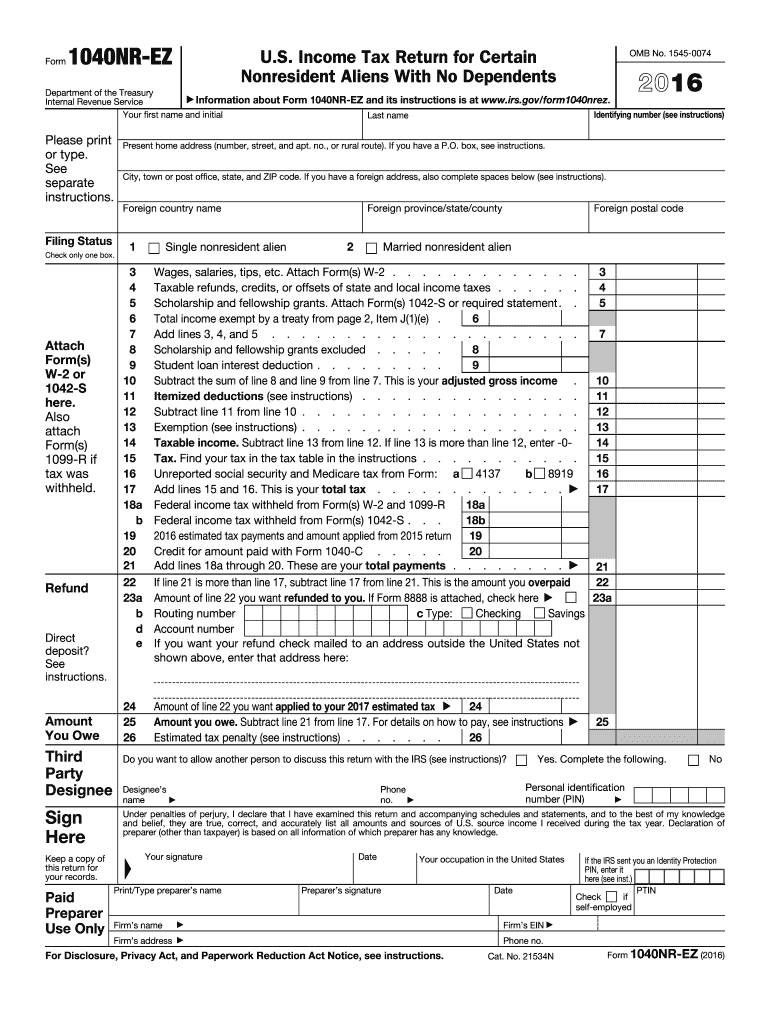







Definition and Significance of Form 1040NR-EZ
Form 1040NR-EZ is a simplified version of the U.S. Income Tax Return meant for certain nonresident aliens who do not have dependents for the tax year 2016. This form facilitates reporting of personal information, income, deductions, and tax calculations specifically for individuals who meet specific conditions. It's a streamlined method that excludes complex elements such as claimed exemptions for dependents or itemized deductions, making it more accessible for qualifying nonresident aliens.
Eligibility Criteria for Form 1040NR-EZ
To qualify to use Form 1040NR-EZ, an individual must meet the following criteria:
- Be a nonresident alien.
- Have no dependents.
- Have taxable income below $100,000.
- Have no income other than those identified as wages and salaries, unless treaty benefits are claimed.
- Not be claiming any special credits or deductions other than the student loan interest deduction.
Understanding these criteria is crucial as failing to meet any can require the use of a more complex form, such as Form 1040NR.


Common Uses and Users of Form 1040NR-EZ
Form 1040NR-EZ is commonly utilized by nonresident aliens in the United States who earn income through employment or scholarships. Particularly, international students, visiting professors, or researchers might frequently need this form to fulfill federal tax obligations while residing temporarily in the country. The form is tailored for individuals who engage only in simple financial activities and ensures uncomplicated tax compliance.
IRS Guidelines and Compliance
According to IRS guidelines, nonresident aliens must adhere to specific instructions when completing Form 1040NR-EZ. They must accurately report all U.S.-sourced income and ensure they do not claim ineligible deductions. Failure to comply with these guidelines may lead to penalties or legal complications.
Steps to Complete the Form 1040NR-EZ
Successfully completing Form 1040NR-EZ involves several detailed steps:
- Personal Information: Provide full name, identification number, and filing status at the top of the form.
- Income Reporting: List wages, salaries, and any other earned income. Include specific sources and amounts.
- Calculations: Compute taxable income by subtracting allowable deductions.
- Tax Liability: Use the tax table to find the corresponding tax liability for the taxable income calculated.
- Signature: A signature at the form's end is mandatory for validation.
Examples of Filing Scenarios
Consider a visiting scholar who earns salaries through a U.S.-based educational institution. This person would list their income in the relevant section and apply any allowable deductions, such as student loan interest, to lower taxable income, ensuring compliance with IRS rules.
Important Terms Related to Form 1040NR-EZ
Understanding specific terms associated with Form 1040NR-EZ is crucial for accurate completion:
- Nonresident Alien: An individual who is neither a U.S. citizen nor a resident alien.
- Tax Treaty Benefits: Provisions in treaties between the U.S. and other countries that can affect tax liabilities.
- Standard Deduction: A deduction that some taxpayers claim instead of itemizing, not applicable in this form.
Explanation of Tax Treaty Applications
Tax treaty benefits may allow tax exemptions or reduced rates on different income types. However, only qualified individuals can benefit, and it often requires proper documentation and calculations to ensure correct application.
Key Elements of Form 1040NR-EZ
The form includes critical components that taxpayers need to understand:
- Filing status: Only single or married filing separately are applicable.
- Income Section: Streams of income that must be declared for tax purposes.
- Tax and Credits Section: Calculation of owed taxes and any applicable credits.
Understanding these elements enables users to navigate the form efficiently, ensuring all relevant information is provided.
Obtaining and Filing Form 1040NR-EZ
Nonresident aliens can obtain Form 1040NR-EZ from various sources:
- Online: The IRS website offers downloadable forms.
- In-Person or Mail: Visit local IRS offices or request a mailed copy.
Once completed, the form can be submitted electronically, via mail, or by visiting IRS service centers.
Filing Deadlines and Late Submission Penalties
The filing deadline for Form 1040NR-EZ generally aligns with the regular tax filing deadline in April. Late submissions may incur penalties, emphasizing the need for timely compliance.
Digital Versus Paper Version of Form 1040NR-EZ
Taxpayers can choose between digital and paper submissions:
- Digital Version: Allows for easier calculations and quicker submissions.
- Paper Version: Favored by those who prefer manual entry and physical records.
Each method has its pros and cons, and it's crucial to select the one that best fits the user’s preference and circumstance.
Compatibility with Tax Software
While Form 1040NR-EZ is relatively straightforward, some individuals may use software such as TurboTax or QuickBooks for added accuracy and convenience. These tools typically support this form, facilitating error minimization and streamlining the submission process.




