Wisconsin trust 2026

Get Form
wisconsin trust Preview on Page 1

Here's how it works

01. Edit your form online
Type text, add images, blackout confidential details, add comments, highlights and more.
02. Sign it in a few clicks
Draw your signature, type it, upload its image, or use your mobile device as a signature pad.
03. Share your form with others
Send it via email, link, or fax. You can also download it, export it or print it out.

How to use or fill out Wisconsin Trust with our platform

Form edit decoration
9.5
Ease of Setup
DocHub User Ratings on G2
9.0
Ease of Use
DocHub User Ratings on G2
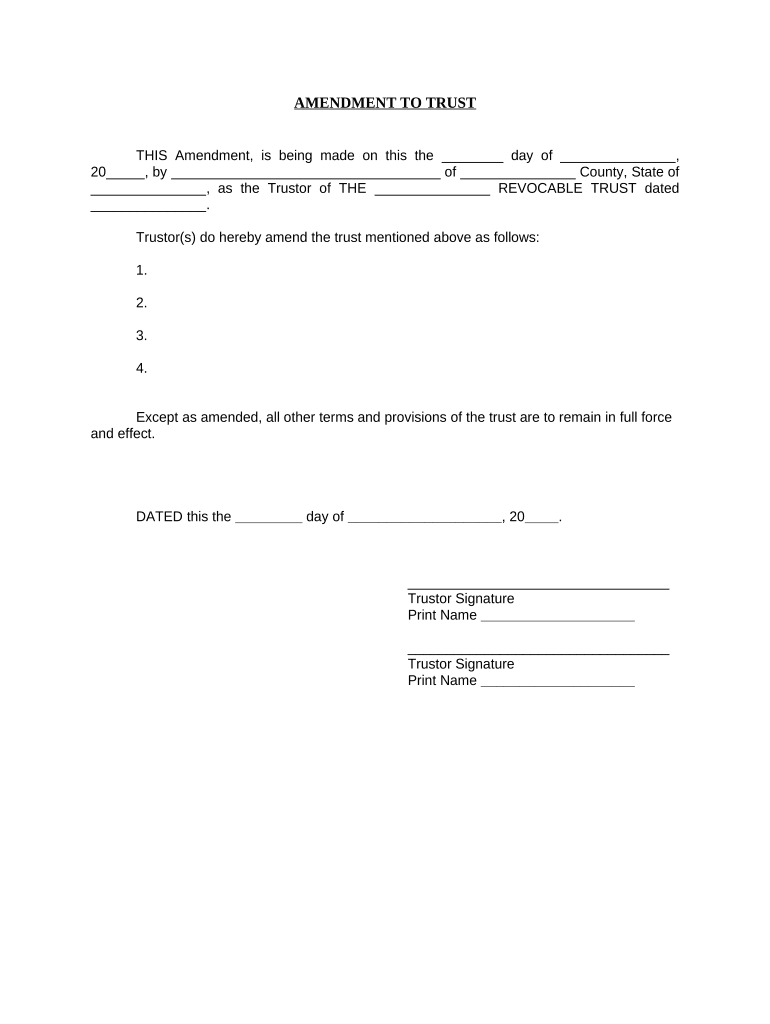
  1. Click ‘Get Form’ to open the Wisconsin Trust Amendment in the editor.
  2. Begin by entering the date of the amendment in the first blank field. This should reflect the day you are completing the document.
  3. In the next section, fill in your name as the Trustor and specify your county and state. Ensure accuracy for legal purposes.
  4. Identify and write down the name of the revocable trust being amended, along with its original date.
  5. List any amendments to the trust in sections 1 through 4. Be clear and concise about each change you wish to make.
  6. Sign and print your name at the bottom of the form where indicated. If there are multiple Trustors, ensure all signatures are included.
  7. Complete the notary section by having a Notary Public acknowledge your signatures on the specified date.

Start editing your Wisconsin Trust Amendment for free today!

be ready to get more

Complete this form in 5 minutes or less

Get form

Got questions?

We have answers to the most popular questions from our customers. If you can't find an answer to your question, please contact us.
Contact us
What is the Inheritance Tax in Wisconsin? Since Wisconsin is not a state that imposes an inheritance tax, the inheritance tax in 2025 is 0% (zero). As a result, you wont owe Wisconsin inheritance taxes.
If you have a large estate or complex assets, a trust may be a better option because it allows you greater control and flexibility over how your assets are managed and distributed. If you have a smaller estate or simpler assets, a will may be sufficient.
A Wisconsin living trust holds ownership of your assets while you continue to use and control them during your lifetime. After your death, the trust assets are distributed to the beneficiaries you have chosen.
A living trust also avoids the probate filing fee. shorten or eliminate delays in distributing your property to beneficiaries This is another advantage of avoiding probate. The probate process may delay property distribution.
TRUSTS: A trust created by a decedents will (testamentary trust) is resident of Wisconsin if the decedent was domiciled in Wisconsin at the time of death, unless transferred by a court having jurisdiction to another courts jurisdiction.

Security and compliance

At DocHub, your data security is our priority. We follow HIPAA, SOC2, GDPR, and other standards, so you can work on your documents with confidence.

Learn more
ccpa2
pci-dss
gdpr-compliance
hipaa
soc-compliance